
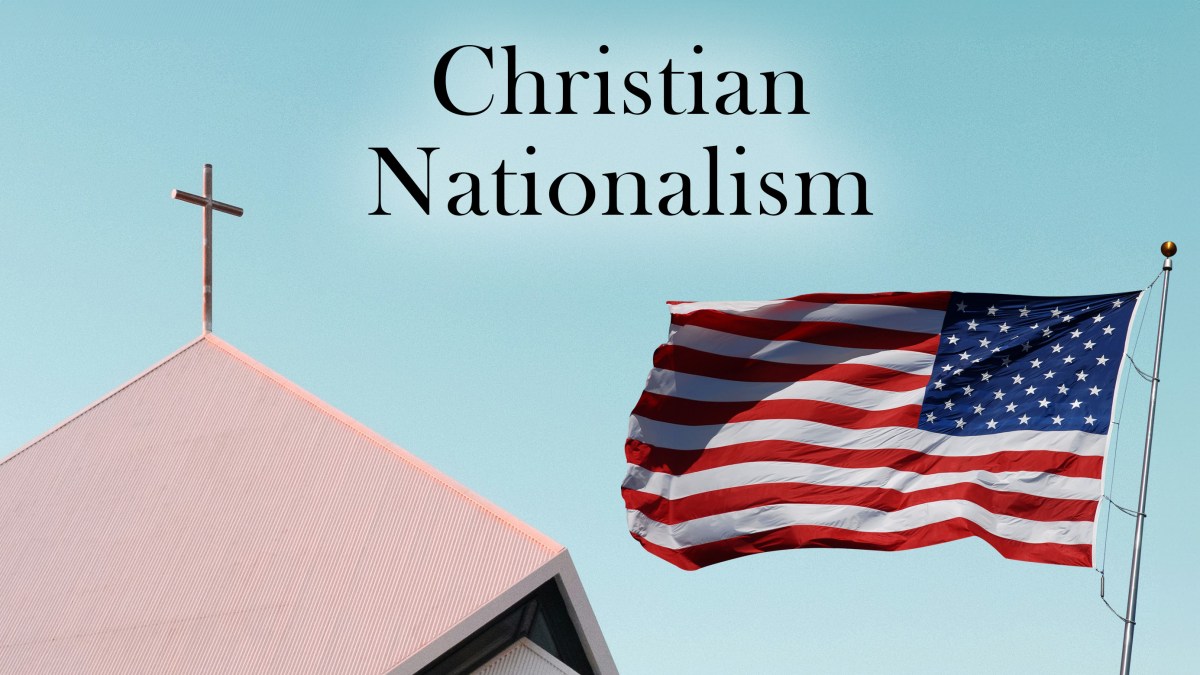
Christian nationalism is a popular topic nowadays in the news and on social media. It’s even starting to come up in normal conversation. But… what is Christian nationalism?
Let’s start the conversation with a funny video by Lutheran Satire on YouTube (or you can skip it and scroll down, it’s a free country).
This guy does a fantastic job of demonstrating the main problem with the discourse surrounding Christian nationalism. Everyone’s definition is different. Liberals seem to think that Christians taking part in elections or politics in any capacity is Christian nationalism. Edgy political commentators like Nick Fuentes seem to think that Christian nationalism means supporting white supremacy and antisemitism. But they’re at the extremes. What’s a better definition? Here’s one we can start with, taken directly from the video:
Christian nationalism: “A social and governmental system in which Christianity is the driving force that shapes a nation’s laws, people, and culture.”
This seems reasonable, right? At first glance, yes. But the fundamental problem remains. Extremists may be terrible at defining Christian nationalism, but people in the middle are almost as bad. Nobody can agree on this definition, or any definition for that matter.
No Consensus on Christian Nationalism
I’ve heard several people assert that Christian nationalism is inherently Protestant. They argue that the United States was founded by Protestants. But others propose a Catholic influence, given that the Catholic church is by far the largest and most organized church in America. And that’s not even bringing up other major church traditions. Who is correct?
Many assume that Christian nationalism is merely incidental in its influence. They believe the good morals of a nation’s people will naturally lead to laws and practices that reflect a Biblical worldview without the need for top-down mandates. This is roughly what happened in early American history, though it certainly wasn’t perfect. If you ask me, this is the best we can hope for in theory. I’ll talk more about this in the next post.
But times have changed. Public opinion is wildly out of line with the Bible. Christian nationalism is no longer realistic unless the government uses brute force. Many Christian nationalists realize this and don’t mind forcing their religion onto others. In fact, they want to take things further than the founding fathers ever did by eliminating basic freedoms and mandating their form of Christianity for all citizens. This is actually quite similar to the religious persecution that the early American settlers fled from in Europe, ironically enough.
Let’s assume for a moment that a strictly Christian government is possible. What sins should this government regulate? Should theft be illegal? Yes. Should homosexuality be illegal? Maybe, but it depends on who you ask. What about greed or gluttony? Huh… that’s tricky. What about grumbling or complaining? There’s no chance you’re putting anyone in jail for that. But we can go further.
Different denominations disagree on what constitutes a sin. Is drinking a sin, or only heavy drinking? Is divorce always a sin, or is it okay to divorce a cheating partner? Is it a sin for a woman to teach a man anything, or just to preach from the pulpit? It’s impossible to satisfy all Christians, or even all Christians in just one denomination. Let’s not forget how far into progressivism and blatant heresy many modern church denominations are. Do we let them write laws or only traditional churches? How traditional do you have to be? It gets messy very fast. But we can go even further!
What about doctrinal disagreements? If a Baptist gets elected, can he mandate believer’s baptism for all adult Lutherans and Presbyterians? Can a Catholic government punish all churches that fail to affirm the real presence of Christ in the Eucharist? These are secondary issues, but I guarantee you that citizens in a Christian government will fight over them, and it won’t be pretty.
History Repeats Itself
For countless examples of my point, just pick up a history book. The decades following the Reformation were some of the bloodiest in Christian history. Catholics and Protestants killed and ruled over each other in brutal fashion for centuries. Remember Bloody Mary? She burned hundreds of Protestants at the stake for rebelling against her efforts to restore the Catholic church to power in England. Remember the Thirty Years’ War? It was a period of heavy conflict between Catholic and Protestant rulers that devastated Germany, killing one third of its population (a mortality rate twice that of World War I1), and shattered any hope of a unified Europe under one Roman Catholic empire.
I could go on, but I hope the point is clear. Every time a government officially aligns itself with a church, things get ugly. Governments make for terrible church authorities. Do we really expect things to be different this time? Before you know it, you start sounding like a communist. “True Christian nationalism hasn’t been tried! This time it will work. Trust me!”
Where’s the Movement?
Finally, a key problem with Christian nationalism is its complete lack of organization on a national level. There is no central authority leading the charge to make Christian nationalism a reality. There are no clear goals being put forward by any kind of majority as representative of the movement. There is no “Christian Nationalist” party you can vote for in elections. The list goes on…
Conclusion
Christian nationalism falls short right out of the gate because it has no real definition. Nobody can agree on what it should look like. How can you create a unified movement out of so many radically different positions? How can you fight for something if you can’t even articulate what it is that you’re fighting for? And if it’s just a theoretical ideal that will never come to pass, what’s the point?
I don’t have any problem with Christian morals influencing the laws of a country. I think it’s a great thing. But I agree with the founding fathers that religious freedom is paramount. I don’t believe in a top-down approach. I believe in living the Christian life openly and boldly, being a voice of truth and reason for the values you hold dear, and praying for your nation fervently, that God might send more workers for the harvest no matter what the government looks like. Live and let live, but most importantly, evangelize. We are not called to save governments. We are called to save souls.
“First of all, then, I urge that supplications, prayers, intercessions, and thanksgivings be made for all people, for kings and all who are in high positions, that we may lead a peaceful and quiet life, godly and dignified in every way.” – 1 Timothy 2:1-2 (ESV)
Let me know your thoughts in the comments below. Enter your email to be notified for my next post. Thanks for reading. Godspeed.
Sources:
- Onnekink, David (2013). War and Religion after Westphalia, 1648–1713. Ashgate Publishing. pp. 1–8. ISBN 9781409480211.
 Veracity Quest