

The Deadly Practicality of Christian Nationalism

There’s a new ideology lurking in the church. It might not seem like a threat. After all, it isn’t very widespread yet. But that’s part of what makes it dangerous. “Christian nationalism” is growing in large part thanks to vague duplicitous language that masks it as something innocuous. And the draw is strong for disillusioned young men who want to change the world for the better. But when you break it down, the logic falls apart. The morality is hollow. Christ is missing.

Before we get into it, let’s get our definitions straight. When I criticize “Christian nationalism,” I’m referring to the new movement of Christians advocating for the use of authoritarian power to enforce Christianity as the only permitted religion in the nation. The idea is to take back the culture by brute force from the top down and burn any “heretics” who stand in the way. These folks overlap significantly with Kinists, who justify racism by arguing that we’re supposed to “take care of our own” when it comes to tribe and skin color, not just family. If that doesn’t clear things up enough for you, click here to read my introductory post on the topic. Or try Samuel Say’s excellent breakdown.

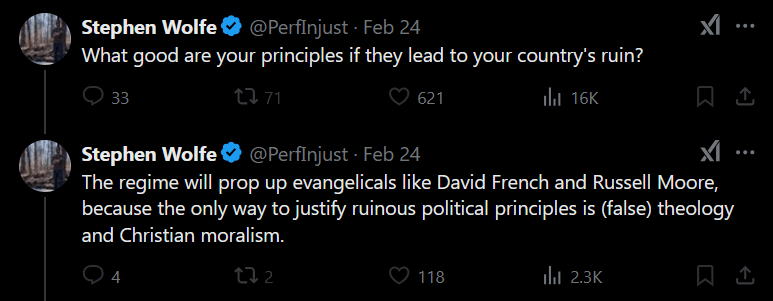
This post from X (Twitter) is what we’ll be discussing today.

Stephen Wolfe is the author of “The Case for Christian Nationalism” and a prominent voice in the movement. It should already be a red flag that he welcomes comparisons to psychopathic serial killers, but we’ll come back to that later. Wolfe advocates for an aggressive Christianity that isn’t afraid to take over the government and enforce God’s laws on all men. Here, he’s criticizing the comparatively passive worldviews proposed by figures such as Russell Moore.
Moore is the author of “Onward: Engaging the Culture without Losing the Gospel.” He stands against the Christian nationalism movement and instead longs for the days of the early church when Christians were on the back foot. He believes Christianity is incompatible with worldly political power and that we should concern ourselves with evangelism instead.

I agree with a lot of Moore’s points in his book, but I do not agree that we should be so passive as to refuse to engage in politics. As Christians, it is our responsibility to use whatever rights or abilities we have to push our culture and government towards what honors God and protects the advancement of the gospel. Moore also has some unsavory (read: left-wing) sources of funding for his work, but that’s another story.

I can agree with some criticism of Moore and French, but I cannot agree with Wolfe’s main point. He’s arguing that principles which lead to the ruin of your country are useless. This is faulty logic.

Post Hoc Ergo Propter Hoc

Let’s assume that our country has fallen into ruin and moral decay. What led us here? Wolfe seems to think it’s the fault of passive Christianity. But is that true?

No. Just because one thing follows another does not prove a causal link. Passive Christians did not advance secularism. They did not fight for abortion or the LGBTQ agenda or humanist reform in schools. They did not vote for the leaders who have done so much damage to our country. Passive Christians were attending church, spreading the gospel, and reading the Bible. None of this is wrong. None of this causes ruin. In fact, it promotes the exact opposite in our culture from the bottom up.

The disagreement is one of strategy—bottom up instead of top down. Moore and others believe in a hands-off approach to politics. We can talk all day about whether this is Biblical. But it is wrong to conclude that this approach is useless just because the secular culture around us has advanced over the years.

The world has always been full of sin. One could easily argue that “the good old days” never existed—that what we imagine as a truly Christian nation in our past was merely a facade of moralistic deism and good manners that we erroneously interpreted as the fruit of genuine faith in Christ.

This is not to say that morals or good manners are bad, only that they do not make a culture “Christian” any more than they make a person “Christian.” In this, I mostly agree with Moore. While America definitely has its roots in Christian values, it was never the bona fide “Christian nation” that Wolfe and others think it was. If anything, you’d have to attribute that label to the Puritan colonies before the USA was formed, and they had their own problems. I talk more about that here.

“Going to church doesn’t make you a Christian any more than going to McDonald’s makes you a hamburger!” — Keith Green

The “use” of passive Christian principles is in the advancement of the true and effectual gospel to hearts and minds, no matter what the culture decides to do. A few more saved souls are better than one “moral” nation without saved souls.

Let’s frame Wolfe’s statement another way.

“What use were the principles of the early church if they led to the fall of Rome?”

I hope you can see just how absurd this statement is. The early church did not contribute to the fall of early Rome. If anything, the early church might have delayed the fall somewhat. It’s hard to know for sure. But early Christians weren’t even trying to save Rome. They were trying to spread the gospel to the world.

This is the fundamental problem with Christian nationalism. It values cultural influence over the gospel. It values worldly power over the power of the Spirit. It values aesthetics over holiness. It values the world more than Christ.

Another Angle

Now, I know what you’re thinking. “That’s not Wolfe’s point! He’s just saying that passive Christian principles didn’t do enough to stop our country from coming to ruin.”

This more charitable interpretation still retains some of the same flaws. The premise of the argument makes no sense. In what universe is any set of principles “enough” to prevent a given culture from falling into moral decay? The cycle of governments, nations, and kings rising and falling has occurred since the dawn of time. Israel fell away from God over and over again. Which nation “did it right” exactly? The USA is very young itself; if even this great experiment has fallen too far, what hope is there?

The fallen, sinful nature of humanity prevents the possibility of a healthy, long-lasting government firmly established on Christian principles that avoids vague moralism and misguided religious violence. You cannot have an ideal society this side of heaven. It’s not going to happen.

But let’s assume for a moment that it is possible, or at least that preserving something better in America was possible. What principles could do that? Wolfe gives us an answer.

Well, it’s sort of an answer. Not really. You’d have to read Wolfe’s book to get a sense for his proposed principles (he basically wants a Christian king). For now, we get a theory.

Wolfe argues that political principles were ordained by God for our political good—therefore, these principles are sufficient and effective towards that end. Wolfe affirms the inverse as well. If your political principles are not sufficient and effective, then God didn’t ordain them, he says.

This is another way of saying, “Whatever works is right.” Wolfe is attempting to sanctify a relativistic practical morality. Why? Because it allows him to do whatever it takes to attain his goals. As long as it leads to a good end, then God must have ordained it! In other words, the end justifies the means. I hope I don’t have to explain the many problems with this.

No Country for Christian Men

Let’s stop for a second and ponder at the choice to reference Anton from “No Country for Old Men.” This character is a violent psychopath. Near the end of the film (spoilers), he has our protagonist at gunpoint. He’s won. He says, “If the rule you followed brought you to this, of what use was the rule?” That’s the line referenced in the image.

The writer of the movie is not proposing that Anton makes a great point here and morality should bend to whatever is most useful. The writer is using Anton as a tool to disillusion the protagonist and offer an observation to the audience. Good guys don’t always win. Sometimes evil prevails. In a world of unfeeling chaos, can justice and order really be preserved? What do we do with that? Do we follow our moral principles even if they lead us to the grave?

For the Christian, the answer is quite simple. Yes, we should do the right thing even if it “doesn’t work.” In the end, God wins. He has saved us and we will get to enjoy him forever in his eternal kingdom. The world isn’t just pure chaos. It’s God’s creation corrupted by sin, but it will be restored someday. The real question for Anton (and those who identify with him) is, “If the practical principles you follow send you to hell, of what use were those principles?”

Back to Wolfe

In addition to supporting moral relativism, Wolfe’s post also makes a sweeping judgement against passive Christianity and any other set of principles that “doesn’t work.” If it fails to preserve the nation (by Wolfe’s standard), then it must not have come from God. This is such an ignorant statement that it’s hard to know where to begin.

The early church did not prevent their countries’ ruin. Were their principles not ordained by God?

Where in the Bible would you even begin to argue that God promises us a Christian nation that won’t fail? Where are we instructed to create such a thing? To be sure, there are plenty of verses that say God blesses nations that obey him. There are plenty that affirm God’s ultimate rule over all nations. There are plenty that say all nations should bow down to God. But nowhere are we promised the possibility of an eternal Christian kingdom. Except…

“Then the seventh angel blew his trumpet, and there were loud voices in heaven, saying, ‘The kingdom of the world has become the kingdom of our Lord and of his Christ, and he shall reign forever and ever.'” — Revelation 11:15 (ESV)

The only government that will last is Christ’s coming kingdom.

“When the Son of Man comes in his glory, and all the angels with him, then he will sit on his glorious throne. Before him will be gathered all the nations, and he will separate people one from another as a shepherd separates the sheep from the goats.” — Matthew 25:31-32 (ESV)

The only “Christian king” who is incorruptible, who will judge the masses rightly, is Christ himself.

“They asked him, ‘Lord, will you at this time restore the kingdom to Israel?’ He said to them, ‘It is not for you to know times or seasons that the Father has fixed by his own authority. But you will receive power when the Holy Spirit has come upon you, and you will be my witnesses in Jerusalem and in all Judea and Samaria, and to the end of the earth.'” — Acts 1:6-8 (ESV)

When the disciples asked Jesus about establishing a kingdom on earth, he made it crystal clear that the time is not yet here. Christ will return. But in the meantime, we are not meant to make a shallow imitation of what we imagine that kingdom will be. We are not given power to physically conquer our enemies. No, we are to love our enemies (Matt 5:44, Rom 12:14, 19-21). That’s the scandal of the gospel. Paul says we are “more than conquerors” because nothing can separate us from God’s love; not death, not ruined nations, not anything (Rom 8:31-39). We are given power to be Christ’s witnesses to the ends of the earth. That is our mission.

Conclusion

In short, I reject the notion that an incorruptible Christian nation is possible in this age. I reject relativistic moral frameworks that propose the end justifies the means. I reject the idea that passive Christianity has contributed to the decline of morality in America. Yet I also condemn passive Christianity’s failure to engage meaningfully with the culture and government. I believe there’s a middle ground where we can fight for what’s right within the peaceful political systems that already exist.

Do not long for the coming kingdom so much that you forget where you are and what your mission is. Do not mistake earthly victory for spiritual victory. Spread the gospel. Pursue holiness. Uphold what is right by the good, righteous means God gives you. Imitate Christ. Be wary of heroes. They come and go. They are sometimes right and sometimes very wrong. But Christ will not fail you, and neither will his Word.

“May the God of peace himself sanctify you completely, and may your whole spirit and soul and body be kept blameless at the coming of our Lord Jesus Christ.” — 1 Thessalonians 5:23 (ESV)

Let me know your thoughts in the comments below. Enter your email to be notified of my next post. Thanks for reading. Godspeed.

Processing…
Success! You're on the list.

What Does it Mean to “Love Your Neighbor?”

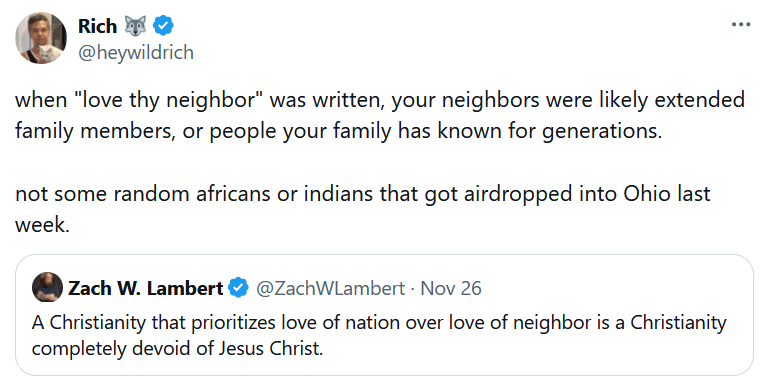
Here’s the post that made me want to write this.

For context, Zach Lambert is a self-proclaimed “Post-Evangelical,” which basically means he’s a liberal Christian with “progressive” theological positions. I don’t recommend Zach as a source for sound Biblical doctrine. But let’s ignore him for a moment and focus on his point. He says true Christians should not love their nation more than they love their neighbor.

This refers to the words of Jesus Christ, who said that the second-greatest commandment is to “love your neighbor as yourself” (Mark 12:31). There is no command in the Bible to love your nation. It’s not wrong to love your nation, but it seems pretty clear that loving your neighbor is more important. On this, at least, I can agree with Zach.

Rich challenges this notion. He asserts that the context of “love your neighbor” in the Bible was back when your “neighbors” were people you knew well or were related to. As many have pointed out, this is nonsense. If he read the passage he’s talking about, he would quickly realize how wrong he is. Let’s take a look.

“He, desiring to justify himself, said to Jesus, ‘And who is my neighbor?’ Jesus replied, ‘A man was going down from Jerusalem to Jericho, and he fell among robbers, who stripped him and beat him and departed, leaving him half dead. …a Samaritan, as he journeyed, came to where he was, and when he saw him, he had compassion. … Which of these…proved to be a neighbor to the man who fell among the robbers?’ He said, ‘The one who showed him mercy.’ And Jesus said to him, ‘You go, and do likewise.'”
— Luke 10:29-30, 33, 36-37 (ESV)

A man in the crowd asks Jesus “Who is my neighbor?” This is an important question, but the answer isn’t as simple as “family” or “people who live near you.” No, instead Jesus answers in the form of a parable which demonstrates a fuller meaning.

The principle character in this parable is a Samaritan. This was a people group living near Israel in the time of Christ. Their ancestors were part of the Northern Kingdom of Israel, which fell in 721 B.C. when the Assyrians attacked.1 Some were led off to Assyria, but those who stayed intermarried with foreigners and eventually became known as the Samaritans. The Jews considered them half-breeds. They hated each other.

Jesus specifically picks out a hated enemy of the Jews to be the protagonist of his story, the one who puts aside racial and national divides in order to show kindness to a man in need. This is in stark contrast to the religious leaders in Jesus’ parable who step over the man on the road. They’re shown to care less about following the second-greatest commandment than a lowly Samaritan, a great offense to those listening to Jesus. The Jews saw themselves as superior, as garnering God’s favor purely based on their heritage. How wrong they were.

Rich is essentially the man who questions Jesus. He refuses to accept that certain people groups are worthy of our love as Christians (though he himself doesn’t claim to be a Christian, interestingly). We have to draw the line somewhere, he thinks. I’ll love my family and other Americans, but not the “random africans or indians that got airdropped into Ohio last week” as he so eloquently puts it. No, Rich. God wants you to love them too. He would have you love even your most hated enemy.

“But I say to you who hear, Love your enemies, do good to those who hate you.”
— Luke 6:27 (ESV)

Between the Lines & Outside the Context

But here’s where I must take a step back and look at the bigger picture. This isn’t just about who you show love to in your daily life. This isn’t just about moral principles. Rich is getting at something different. Ironically, so is Zach. They’re bringing connotations of foreign policy into this discussion. And that’s certainly NOT something Jesus was talking about in his parable. This is essential to point out.

It’s a common trend nowadays for liberal Christians (like Zach) to take the Bible out of context in an attempt to force the Scriptures to support their positions on all sorts of societal, economic, and political issues. “Jesus was a socialist,” they might say. “The early church is an example of Communism,” they might say. It’s all lies. There’s a world of difference between Jesus’ actual teachings and his theoretical position on which laws should be passed relating to mass immigration or wealth redistribution. We must be careful to rightly divide the words of God.

“Do your best to present yourself to God as one approved, a worker who has no need to be ashamed, rightly handling the word of truth.”
— 2 Timothy 2:15 (ESV)

The question is not, “How can I apply Jesus’ words to foreign policy?” This is an improper use of Scripture called “eisegesis,” in which we attempt to inject our own ideas into the Bible. No, instead we ought to ask, “What was Jesus trying to say here?”

The answer seems to relate to the way Jesus’ audience, the Jews, conducted themselves in their daily lives. They might encounter people they despise, but Jesus tells them to show love regardless. They might have enemies, but Jesus tells them to show love regardless. Jesus was NOT trying to advocate for any kind of foreign policy position. He wasn’t aligning himself with any law. He wasn’t rebuking or affirming Rome’s authority in how it managed borders. Those are completely separate issues.

It’s perfectly acceptable to vote for strong borders while obeying Jesus’ command to love your neighbor. There are very good practical reasons for the government to regulate immigration, especially with how many widespread problems have arisen from lax policies as of late. Our “neighbors” are not just foreigners, but also our fellow Americans. Voting for strong borders is a form of loving our neighbors. At the same time, it’s imperative that we imitate Christ in how we treat any and all people we come across in our daily lives as Americans. If we see immigrants, we should love them. They are our “neighbors,” as Jesus makes clear to us.

Is this a contradiction? No, it is not. Whatever situation we find ourselves in, we obey Christ in loving our neighbors, even if the situation is not ideal. But that does not imply that we should actively seek to tear down our borders and invite everyone into America. Those are two completely different things. In the same way, we should trust God to provide for our needs, but this does not mean we should neglect to use the resources God provides. “Jesus take the wheel,” we say as we press on the gas with our eyes closed. “I gave you a steering wheel for a reason!” God replies as he shakes his head in disappointment.

It’s also worth pointing out that the man on the road was genuinely in need. Many immigrants are in need, but many are not. In fact, some are dangerous and should be refused entry regardless.2 Jesus certainly didn’t mean to imply that loving your neighbor means inviting criminals into your home. Locking up criminals, no matter where they come from, is not opposed to Jesus’ command to love your enemy. It’s just another way governments keep the peace and protect their citizens. This is entirely appropriate and consistent with how Paul talks about the purpose of government in Romans 13:1-7.

Another potential connotation in Zach’s post is a disagreement with “Christian Nationalism,” which I go over in detail here. I’m not certain this was his intention, but it seems likely. Suffice to say that Christian Nationalism is not Biblical, but that doesn’t give Zach a pass. Many Christian Nationalists want to bring patriotism (love of country) back. I don’t have a problem with patriotism. I have a problem with uniting the church and the state. Again, see my other post for more details. The only point on which I can confidently agree with Zach is the idea that no Christian should love his nation more than he loves his neighbor. Jesus is clear on this.

Conclusion

I do believe it is my responsibility as a Christian to show love and kindness to all people, whether they are an African immigrant or a close friend. The Christian faith has no racial or national boundaries. We ought to be evangelizing to all people as well. At the same time, I will openly advocate for strong borders in America. Most civilized countries around the world also want strong borders. This is not racist or hateful. It is simply a reality in properly governing a country and keeping citizens safe.

Don’t go looking for foreign policy from Jesus’ parables. Don’t go looking for Christian insights from an unbeliever like Rich. Don’t go looking for sound doctrine from a “Post-Evangelical” like Zach. Read Christ’s words on his own terms. Follow wise counsel from leaders in your local church who imitate Christ in their daily lives. Vote for policies that promote the safety and prosperity of the nation. But do not cling to race or national identity or social justice. Cling to Christ.

Let me know your thoughts in the comments below. Enter your email to be notified for my next post. Thanks for reading. Godspeed.

Processing…
Success! You're on the list.

Sources:

  1. Roat, Alyssa. “Who Were the Samaritans.” Bible Study Tools. May 17, 2024. https://www.biblestudytools.com/bible-study/topical-studies/the-samaritans-hope-from-the-history-of-a-hated-people.html
  2. Conklin, Audrey. “Laken Riley trial highlights Biden-era immigration crisis as mom of slain cheerleader awaits justice.” Fox News. November 21, 2024. https://www.foxnews.com/us/laken-riley-trial-highlights-biden-era-immigration-crisis-mom-slain-cheerleader-awaits-justice

Were Early Americans Christian Nationalists?

In my first post about Christian nationalism, I talked about how everyone’s definition is different. So before we get started, I want to make it clear that today I’ll be discussing Christian nationalism in the sense of a top-down, authoritarian approach to aligning a nation’s laws with the Bible.

The people who want this kind of government today in the United States usually view early America through rose-colored glasses. They love the idea of returning to the 1800s when everyone was Christian and nobody questioned how many genders there were. Don’t get me wrong, I get it. I’m sick and tired of postmodernism too. But it’s naive to think that early America was some kind of ideal Christian nationalist society.

A Christian Culture?

It is true that the vast majority of early Americans identified as Christian. As one might expect, this led to leaders, policies, and ways of living that reflected traditional Christian values to some extent. But make no mistake, this was still a country rife with sin. The true, invisible church has always been a minority.

“Enter by the narrow gate. For the gate is wide and the way is easy that leads to destruction, and those who enter by it are many. For the gate is narrow and the way is hard that leads to life, and those who find it are few.” — Matthew 7:13-14 (ESV)

Most people who call themselves Christians in an accepting society are not bonafide believers. They’re nominal Christians—Christian in name only. They might believe in good moral principles. They might go to church. They might even read their Bible. But none of this makes you a Christian. Only by truly believing in Jesus Christ and his sacrifice for you on the cross can you be saved.

“But,” I hear you say, “even if the true church was the minority, wouldn’t you rather live in a society full of nominal Christians than a society full of degenerates?” Not really. I’d rather evangelize to people who don’t know Christ than people who’ve been deluded into thinking they’re Christians because they attend church. Sure, living in a society accepting of Christians is more comfortable for me, but we are not promised comfort and it’s not our end goal as Christians. Regardless, it’s not our decision how people behave because we cannot control what people believe.

The Founding Fathers Rejected Christian Nationalism

You see, early America had this thing called the First Amendment. In part, it reads: “Congress shall make no law respecting an establishment of religion, or prohibiting the free exercise thereof.”

The founding fathers had various perspectives on religion. Many were deists or Unitarians. Some were devout Christians.1 But in the end, they agreed that freedom of religion was necessary and a state church was a bad idea. This philosophy traces its origins back to the Anabaptist movement.2 It also flies in the face of Christian nationalism, which proposes that we revoke this freedom in favor of an exclusively Christian state. The harsh reality is that the founding fathers rejected this notion, though their writings were still clearly inspired by Christian principles.

Some will argue that because everyone identified as Christian at the time, the founding fathers really only wanted freedom of denomination, not freedom of religion. This might make some degree of sense at first glance. We should interpret the founding documents according to their historical context, right? Well, maybe, but not to the degree that we completely change the meaning of the original text. The First Amendment makes no distinction about denominations. It addresses religion. To those who still disagree, I would ask you this: Do you think the Second Amendment is only supposed to apply to old-fashioned muskets? Of course not. It addresses the right to bear arms. This doesn’t change with the times. Neither does the First Amendment change with the times.

Early Americans Fled Christian Nationalism

Why did the founding fathers value freedom of religion? Well, it goes back to the settlers who came over on the Mayflower. Not to be confused with the British settlers who founded Jamestown to expand the Crown, these Pilgrims were fleeing a form of “Christian nationalism” back home. They were sick of being persecuted for their beliefs by the Church of England. We talked in my last post about the dangers of giving governmental power to any specific branch of Christianity. You end up with one group of Christians condemning another group of Christians as heretics and bringing down the full force of the state upon them. This is not the way of Christ.

“Some indeed preach Christ from envy and rivalry, but others from good will… What then? Only that in every way, whether in pretense or in truth, Christ is proclaimed, and in that I rejoice.” — Philippians 1:15, 18 (ESV)

Paul is not too concerned with those preaching Christ from wrong motives. In Mark 9:38-41, Jesus tells the apostles not to worry about separate groups of people casting out demons in his name. I get the feeling that Jesus does not look down kindly on the horrific violence between “Christian” governments throughout history.

From Christian Colonies to Free States

The Puritans who founded the Massachusetts Bay Colony were much closer to being Christian nationalists. They also fled religious persecution, but they sought to create explicitly Christian commonwealths under England to demonstrate that their beliefs were superior to the state church they escaped. They had laws against committing adultery, committing blasphemy, and ignoring the Sabbath. The punishment in many cases was death, after one or two strikes.3 Remember, this is when Christianity had its strongest influence on the civil order of society.

From the Library of Congress:

“The religious persecution that drove settlers from Europe to the British North American colonies sprang from the conviction, held by Protestants and Catholics alike, that uniformity of religion must exist in any given society. This conviction rested on the belief that there was one true religion and that it was the duty of the civil authorities to impose it, forcibly if necessary, in the interest of saving the souls of all citizens. … The dominance of the concept … meant majority religious groups who controlled political power punished dissenters in their midst.”4

The colonial era saw plenty of Christian-on-Christian persecution. This time, it was between Protestant groups over denominational differences. Whichever group had the most influence in a region bullied minority groups until they submitted or fled. And if you were Catholic, you could expect even worse treatment. We don’t want to go back to these times. It wasn’t the utopia many believe it was. I much prefer the mentality of the founding fathers, who in the course of creating one of the best countries in the world, implemented some of the strongest protections for human rights and freedom for all.

“Be kind to one another, tenderhearted, forgiving one another, as God in Christ forgave you.” — Ephesians 4:32 (ESV)

The Christian influence on America didn’t stop with the founding fathers, however. Laws in various states relating to Christian principles persisted through the 19th century, such as religious requirements to hold public office. But by the 20th century, the Supreme Court was striking down these discriminatory laws, the separation of church and state saw more support, and public opinion shifted towards humanism. Today, some of these laws remain on the books, but they’re never enforced.

Conclusion

As you can see, there’s a lot of nuance in the history of American Christianity. The Pilgrims sought to separate from the Church of England so they could worship in peace. The Puritans fled from persecution under Christian nationalism, only to establish their own version of it. The founding fathers enshrined freedom of religion in our Constitution, but the public continued to uphold Christian values in the fabric of society for many decades. Now, we’re seeing the continual downfall of Christian influence on American life. Many long for the old days, and I can see why. But it’s important that we not forget the lessons our history has taught us.

1. Implicit Christian influence has always led to a healthier society. It’s impossible to deny the positive cultural effect that a majority Christian opinion can have on a nation.

2. Explicit Christian authority has always led to persecution and oppression, whether it’s the Church of England against the Pilgrims, the Protestant settlers against each other, or both Protestants and Catholics against the Anabaptists.

I’m very thankful that the founding fathers established freedom of religion. It’s why I can drive past so many different denominations worshiping peacefully on the way to my own church with its specific beliefs and traditions. It’s why none of us have to fear for our lives when we change our minds about certain doctrines or secondary issues. It’s why we still have the power to openly preach the gospel to our neighbors despite the fact that most of our nation has fallen so far from God. I’m proud to be an American.

Let me know your thoughts in the comments below. Enter your email to be notified for my next post. Thanks for reading. Godspeed.
Processing…
Success! You're on the list.

Sources:

  1. Stratton, Eleanor. “Founders’ Vision of Religious Freedom.” U.S. Constitution.net. May 23, 2024. https://www.usconstitution.net/founders-vision-of-religious-freedom/
  2. Verduin, Leonard. That First Amendment and The Remnant, The Christian Hymnary, 1998.
  3. Smith, Sarah M., Tucker, Ellen D., Tucker, David. State (Colonial) Legislatures>Virginia House of Burgesses & William Penn. “Laws, Rights, and Liberties Related to Religion in Early America: Articles, Laws, and Orders, Divine, Politic, and Martial for the Colony in Virginia.” December 31, 1610. https://teachingamericanhistory.org/document/laws-rights-and-liberties-related-to-religion-in-early-america/
  4. America as a Religious Refuge: The Seventeenth Century, Part 1.” The Library of Congress. https://www.loc.gov/exhibits/religion/rel01.html

What is Christian Nationalism?

Christian nationalism is a popular topic nowadays in the news and on social media. It’s even starting to come up in normal conversation. But… what is Christian nationalism?

Let’s start the conversation with a funny video by Lutheran Satire on YouTube (or you can skip it and scroll down, it’s a free country).

It’s a great video.

This guy does a fantastic job of demonstrating the main problem with the discourse surrounding Christian nationalism. Everyone’s definition is different. Liberals seem to think that Christians taking part in elections or politics in any capacity is Christian nationalism. Edgy political commentators like Nick Fuentes seem to think that Christian nationalism means supporting white supremacy and antisemitism. But they’re at the extremes. What’s a better definition? Here’s one we can start with, taken directly from the video:

Christian nationalism: “A social and governmental system in which Christianity is the driving force that shapes a nation’s laws, people, and culture.”

This seems reasonable, right? At first glance, yes. But the fundamental problem remains. Extremists may be terrible at defining Christian nationalism, but people in the middle are almost as bad. Nobody can agree on this definition, or any definition for that matter.

No Consensus on Christian Nationalism

I’ve heard several people assert that Christian nationalism is inherently Protestant. They argue that the United States was founded by Protestants. But others propose a Catholic influence, given that the Catholic church is by far the largest and most organized church in America. And that’s not even bringing up other major church traditions. Who is correct?

Many assume that Christian nationalism is merely incidental in its influence. They believe the good morals of a nation’s people will naturally lead to laws and practices that reflect a Biblical worldview without the need for top-down mandates. This is roughly what happened in early American history, though it certainly wasn’t perfect. If you ask me, this is the best we can hope for in theory. I’ll talk more about this in the next post.

But times have changed. Public opinion is wildly out of line with the Bible. Christian nationalism is no longer realistic unless the government uses brute force. Many Christian nationalists realize this and don’t mind forcing their religion onto others. In fact, they want to take things further than the founding fathers ever did by eliminating basic freedoms and mandating their form of Christianity for all citizens. This is actually quite similar to the religious persecution that the early American settlers fled from in Europe, ironically enough.

Let’s assume for a moment that a strictly Christian government is possible. What sins should this government regulate? Should theft be illegal? Yes. Should homosexuality be illegal? Maybe, but it depends on who you ask. What about greed or gluttony? Huh… that’s tricky. What about grumbling or complaining? There’s no chance you’re putting anyone in jail for that. But we can go further.

Different denominations disagree on what constitutes a sin. Is drinking a sin, or only heavy drinking? Is divorce always a sin, or is it okay to divorce a cheating partner? Is it a sin for a woman to teach a man anything, or just to preach from the pulpit? It’s impossible to satisfy all Christians, or even all Christians in just one denomination. Let’s not forget how far into progressivism and blatant heresy many modern church denominations are. Do we let them write laws or only traditional churches? How traditional do you have to be? It gets messy very fast. But we can go even further!

What about doctrinal disagreements? If a Baptist gets elected, can he mandate believer’s baptism for all adult Lutherans and Presbyterians? Can a Catholic government punish all churches that fail to affirm the real presence of Christ in the Eucharist? These are secondary issues, but I guarantee you that citizens in a Christian government will fight over them, and it won’t be pretty.

History Repeats Itself

For countless examples of my point, just pick up a history book. The decades following the Reformation were some of the bloodiest in Christian history. Catholics and Protestants killed and ruled over each other in brutal fashion for centuries. Remember Bloody Mary? She burned hundreds of Protestants at the stake for rebelling against her efforts to restore the Catholic church to power in England. Remember the Thirty Years’ War? It was a period of heavy conflict between Catholic and Protestant rulers that devastated Germany, killing one third of its population (a mortality rate twice that of World War I1), and shattered any hope of a unified Europe under one Roman Catholic empire.

I could go on, but I hope the point is clear. Every time a government officially aligns itself with a church, things get ugly. Governments make for terrible church authorities. Do we really expect things to be different this time? Before you know it, you start sounding like a communist. “True Christian nationalism hasn’t been tried! This time it will work. Trust me!”

Where’s the Movement?

Finally, a key problem with Christian nationalism is its complete lack of organization on a national level. There is no central authority leading the charge to make Christian nationalism a reality. There are no clear goals being put forward by any kind of majority as representative of the movement. There is no “Christian Nationalist” party you can vote for in elections. The list goes on…

Conclusion

Christian nationalism falls short right out of the gate because it has no real definition. Nobody can agree on what it should look like. How can you create a unified movement out of so many radically different positions? How can you fight for something if you can’t even articulate what it is that you’re fighting for? And if it’s just a theoretical ideal that will never come to pass, what’s the point?

I don’t have any problem with Christian morals influencing the laws of a country. I think it’s a great thing. But I agree with the founding fathers that religious freedom is paramount. I don’t believe in a top-down approach. I believe in living the Christian life openly and boldly, being a voice of truth and reason for the values you hold dear, and praying for your nation fervently, that God might send more workers for the harvest no matter what the government looks like. Live and let live, but most importantly, evangelize. We are not called to save governments. We are called to save souls.

“First of all, then, I urge that supplications, prayers, intercessions, and thanksgivings be made for all people, for kings and all who are in high positions, that we may lead a peaceful and quiet life, godly and dignified in every way.” – 1 Timothy 2:1-2 (ESV)

Let me know your thoughts in the comments below. Enter your email to be notified for my next post. Thanks for reading. Godspeed.

Processing…
Success! You're on the list.

Sources:

  1. Onnekink, David (2013). War and Religion after Westphalia, 1648–1713. Ashgate Publishing. pp. 1–8. ISBN 9781409480211.