“The Lord tests the righteous, but his soul hates the wicked and the one who loves violence.”
— Psalm 11:5 (ESV)
On Wednesday, September 10th, 2025, Charlie Kirk was assassinated at the kickoff event of his “American Comeback Tour” at Utah Valley University.
He was a Christian. He was a husband. He was a father. He was a patriot.
And they murdered him.
A single shot was fired from afar, hitting Charlie in the neck as he was in the middle of a peaceful conversation with a student regarding the rising violence of radical leftists.
Charlie has been warning about the growing trend of violent rhetoric on the left for some time now. Today, they proved him right.
Assassination culture is spreading on the left. Forty-eight percent of liberals say it would be at least somewhat justified to murder Elon Musk. Fifty-five percent said the same about Donald Trump.
In California, activists are naming ballot measures after Luigi Mangione.
Ironically, his legacy now has more power than ever before. They made him a martyr. They ensured that his name and ideas will ring out for generations to come. The young men and women watching this unfold today are becoming more emboldened than ever, more ready to fight if the fight is brought to them—and it most certainly has.
Mark my words. A reckoning is coming upon this nation. If you don’t see it now, you’ll see it in a few years. You’ll see it in the eyes of the young people growing up to be colder than they might have been, more determined than they might have been, less compromising than they might have been. This will be a defining moment for America.
The Best Of Us
Charlie wasn’t like other conservatives. He wasn’t in it for the money or the attention. He wasn’t a career politician. He wasn’t an atheist or an agnostic or even a religious person carrying the label begrudgingly. He was a genuine, outspoken, deeply passionate Christian who regularly advocated for evangelism and spiritual growth in America.
If you’re a conservative Christian reading this, there’s something you have to understand. Charlie wasn’t some kind of crazy radical. His beliefs were representative of the average conservative voter. He wasn’t a racist. He worked with and inspired people from all different backgrounds. He wasn’t hateful. He spoke with love and care, even to those he disagreed with the most. He was the purest among us, a real conservative actually fighting to conserve what’s right and true.
“What is so important to our country is to find our disagreements, respectfully, because when people stop talking, that’s when violence happens. People like me are facing violence, assaults from the left.”
If they wanted him dead, what makes you think they see you any differently?
The only difference between you and Charlie is visibility. The only difference between you and Charlie is that he decided to get up and speak his mind.
He was making a difference, changing hearts and minds across the nation. He brought his confidence and conservative viewpoints to college campuses, the very places the left planted their flag of victory long ago. He made an impact they couldn’t ignore, and they knew it was impossible to stop his viral grassroots movement without resorting to violence.
We should be so bold as to make the enemies of truth and justice want to murder us. We should stand so tall and speak with such expertise as to be unbeatable without using a bullet. It’s easy to say, but extremely hard to live up to.
The Radical Left Celebrates
Thousands of leftists are celebrating Charlie’s death today. They’re giddy to see his blood spilled onto the ground. You think I’m lying, don’t you? You think it’s just a tiny minority of anonymous online accounts doing this. But you’re wrong. This is happening everywhere.
There’s a lot more where these came from. I’ve seen similar talk even from those I’ve known personally. These are people you might see on the street. Maybe they work in your local grocery store. Maybe you went to school with them. They’re posting from their public social media accounts tied to their jobs and communities. They aren’t afraid to show the world that they want conservative Christians like Charlie Kirk dead.
The only thing I have to say in response is an imprecatory Psalm, for anyone and everyone who dares curse Charlie’s name while his body is still warm and his wife and children in tears.
“He loved cursing—let it fall on him; he took no delight in blessing—let it be far from him. He wore cursing like his coat—let it enter his body like water and go into his bones like oil.”
— Psalm 109:17-18 (CSB)
Stay vigilant, fellow Christians. Be aware, fellow conservatives. Protect your family. Keep a watchful eye. Those who would seek to harm you and yours are acting upon their hatred more and more every day. Understand the times we are living in and act accordingly. Prepare for the worst. Pray for the best.
How to Keep Going
How do you move on from this? How do you go about your day knowing that thousands of people you thought of as fellow Americans would rejoice over your death? How do you keep fighting against such evil without giving in to violence yourself?
We must remind ourselves that the battle is not yet over. We have not lost. Charlie is closer now to his Lord than ever before. God’s judgement will come down upon the wicked; he will have the final say. Not just the murderer, but all those who praise wickedness will be punished according to their deeds. God is the great avenger.
“Vengeance and retribution belong to me. In time their foot will slip, for their day of disaster is near, and their doom is coming quickly.”
— Deuteronomy 32:35 (CSB)
Paul comments on this in Romans, urging his readers to—if possible—live peaceably.
“If possible, as far as it depends on you, live at peace with everyone. Friends, do not avenge yourselves; instead, leave room for God’s wrath, because it is written, ‘Vengeance belongs to me; I will repay,’ says the Lord.”
— Romans 12:17-19 (CSB)
And let us never forget that without God’s grace, each and every one of us would be destined for the lake of fire, and rightly so. Christ’s sacrifice on the cross is all that stands between us and judgement.
“All have sinned and fall short of the glory of God, and are justified by his grace as a gift, through the redemption that is in Christ Jesus”
Another Psalm comes to mind. In it, we see David’s righteous anger and grief over the prevalence of the wicked.
“Oh that you would slay the wicked, O God! O men of blood, depart from me! They speak against you with malicious intent; your enemies take your name in vain. Do I not hate those who hate you, O Lord? And do I not loathe those who rise up against you? I hate them with complete hatred; I count them my enemies.”
— Psalm 138:19-22 (ESV)
But what is his conclusion?
“Search me, O God, and know my heart! Try me and know my thoughts! And see if there be any grievous way in me, and lead me in the way everlasting!”
— Psalm 138:23-24 (ESV)
He lays himself before God. He invites God’s pure and utter holiness to purge his heart of any and all sin. He invites God to attend to his every thought, ensuring that it is honoring to his Creator. He asks for God’s guidance along the path towards everlasting life.
We should do the same. Charlie would have wanted nothing less.
“Blessed are those who mourn, for they shall be comforted.”
— Matthew 5:4 (ESV)
Processing…
Success! You're on the list.
Whoops! There was an error and we couldn't process your subscription. Please reload the page and try again.
There’s a new ideology lurking in the church. It might not seem like a threat. After all, it isn’t very widespread yet. But that’s part of what makes it dangerous. “Christian nationalism” is growing in large part thanks to vague duplicitous language that masks it as something innocuous. And the draw is strong for disillusioned young men who want to change the world for the better. But when you break it down, the logic falls apart. The morality is hollow. Christ is missing.
Before we get into it, let’s get our definitions straight. When I criticize “Christian nationalism,” I’m referring to the new movement of Christians advocating for the use of authoritarian power to enforce Christianity as the only permitted religion in the nation. The idea is to take back the culture by brute force from the top down and burn any “heretics” who stand in the way. These folks overlap significantly with Kinists, who justify racism by arguing that we’re supposed to “take care of our own” when it comes to tribe and skin color, not just family. If that doesn’t clear things up enough for you, click here to read my introductory post on the topic. Or try Samuel Say’s excellent breakdown.
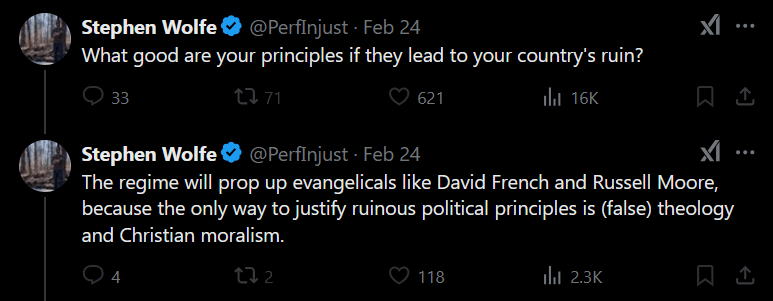
This post from X (Twitter) is what we’ll be discussing today.
Stephen Wolfe is the author of “The Case for Christian Nationalism” and a prominent voice in the movement. It should already be a red flag that he welcomes comparisons to psychopathic serial killers, but we’ll come back to that later. Wolfe advocates for an aggressive Christianity that isn’t afraid to take over the government and enforce God’s laws on all men. Here, he’s criticizing the comparatively passive worldviews proposed by figures such as Russell Moore.
Moore is the author of “Onward: Engaging the Culture without Losing the Gospel.” He stands against the Christian nationalism movement and instead longs for the days of the early church when Christians were on the back foot. He believes Christianity is incompatible with worldly political power and that we should concern ourselves with evangelism instead.
I agree with a lot of Moore’s points in his book, but I do not agree that we should be so passive as to refuse to engage in politics. As Christians, it is our responsibility to use whatever rights or abilities we have to push our culture and government towards what honors God and protects the advancement of the gospel. Moore also has some unsavory (read: left-wing) sources of funding for his work, but that’s another story.
I can agree with some criticism of Moore and French, but I cannot agree with Wolfe’s main point. He’s arguing that principles which lead to the ruin of your country are useless. This is faulty logic.
Post Hoc Ergo Propter Hoc
Let’s assume that our country has fallen into ruin and moral decay. What led us here? Wolfe seems to think it’s the fault of passive Christianity. But is that true?
No. Just because one thing follows another does not prove a causal link. Passive Christians did not advance secularism. They did not fight for abortion or the LGBTQ agenda or humanist reform in schools. They did not vote for the leaders who have done so much damage to our country. Passive Christians were attending church, spreading the gospel, and reading the Bible. None of this is wrong. None of this causes ruin. In fact, it promotes the exact opposite in our culture from the bottom up.
The disagreement is one of strategy—bottom up instead of top down. Moore and others believe in a hands-off approach to politics. We can talk all day about whether this is Biblical. But it is wrong to conclude that this approach is useless just because the secular culture around us has advanced over the years.
The world has always been full of sin. One could easily argue that “the good old days” never existed—that what we imagine as a truly Christian nation in our past was merely a facade of moralistic deism and good manners that we erroneously interpreted as the fruit of genuine faith in Christ.
This is not to say that morals or good manners are bad, only that they do not make a culture “Christian” any more than they make a person “Christian.” In this, I mostly agree with Moore. While America definitely has its roots in Christian values, it was never the bona fide “Christian nation” that Wolfe and others think it was. If anything, you’d have to attribute that label to the Puritan colonies before the USA was formed, and they had their own problems. I talk more about that here.
“Going to church doesn’t make you a Christian any more than going to McDonald’s makes you a hamburger!” — Keith Green
The “use” of passive Christian principles is in the advancement of the true and effectual gospel to hearts and minds, no matter what the culture decides to do. A few more saved souls are better than one “moral” nation without saved souls.
Let’s frame Wolfe’s statement another way.
“What use were the principles of the early church if they led to the fall of Rome?”
I hope you can see just how absurd this statement is. The early church did not contribute to the fall of early Rome. If anything, the early church might have delayed the fall somewhat. It’s hard to know for sure. But early Christians weren’t even trying to save Rome. They were trying to spread the gospel to the world.
This is the fundamental problem with Christian nationalism. It values cultural influence over the gospel. It values worldly power over the power of the Spirit. It values aesthetics over holiness. It values the world more than Christ.
Another Angle
Now, I know what you’re thinking. “That’s not Wolfe’s point! He’s just saying that passive Christian principles didn’t do enough to stop our country from coming to ruin.”
This more charitable interpretation still retains some of the same flaws. The premise of the argument makes no sense. In what universe is any set of principles “enough” to prevent a given culture from falling into moral decay? The cycle of governments, nations, and kings rising and falling has occurred since the dawn of time. Israel fell away from God over and over again. Which nation “did it right” exactly? The USA is very young itself; if even this great experiment has fallen too far, what hope is there?
The fallen, sinful nature of humanity prevents the possibility of a healthy, long-lasting government firmly established on Christian principles that avoids vague moralism and misguided religious violence. You cannot have an ideal society this side of heaven. It’s not going to happen.
But let’s assume for a moment that it is possible, or at least that preserving something better in America was possible. What principles could do that? Wolfe gives us an answer.
Well, it’s sort of an answer. Not really. You’d have to read Wolfe’s book to get a sense for his proposed principles (he basically wants a Christian king). For now, we get a theory.
Wolfe argues that political principles were ordained by God for our political good—therefore, these principles are sufficient and effective towards that end. Wolfe affirms the inverse as well. If your political principles are not sufficient and effective, then God didn’t ordain them, he says.
This is another way of saying, “Whatever works is right.” Wolfe is attempting to sanctify a relativistic practical morality. Why? Because it allows him to do whatever it takes to attain his goals. As long as it leads to a good end, then God must have ordained it! In other words, the end justifies the means. I hope I don’t have to explain the many problems with this.
No Country for Christian Men
Let’s stop for a second and ponder at the choice to reference Anton from “No Country for Old Men.” This character is a violent psychopath. Near the end of the film (spoilers), he has our protagonist at gunpoint. He’s won. He says, “If the rule you followed brought you to this, of what use was the rule?” That’s the line referenced in the image.
The writer of the movie is not proposing that Anton makes a great point here and morality should bend to whatever is most useful. The writer is using Anton as a tool to disillusion the protagonist and offer an observation to the audience. Good guys don’t always win. Sometimes evil prevails. In a world of unfeeling chaos, can justice and order really be preserved? What do we do with that? Do we follow our moral principles even if they lead us to the grave?
For the Christian, the answer is quite simple. Yes, we should do the right thing even if it “doesn’t work.” In the end, God wins. He has saved us and we will get to enjoy him forever in his eternal kingdom. The world isn’t just pure chaos. It’s God’s creation corrupted by sin, but it will be restored someday. The real question for Anton (and those who identify with him) is, “If the practical principles you follow send you to hell, of what use were those principles?”
Back to Wolfe
In addition to supporting moral relativism, Wolfe’s post also makes a sweeping judgement against passive Christianity and any other set of principles that “doesn’t work.” If it fails to preserve the nation (by Wolfe’s standard), then it must not have come from God. This is such an ignorant statement that it’s hard to know where to begin.
The early church did not prevent their countries’ ruin. Were their principles not ordained by God?
Where in the Bible would you even begin to argue that God promises us a Christian nation that won’t fail? Where are we instructed to create such a thing? To be sure, there are plenty of verses that say God blesses nations that obey him. There are plenty that affirm God’s ultimate rule over all nations. There are plenty that say all nations should bow down to God. But nowhere are we promised the possibility of an eternal Christian kingdom. Except…
“Then the seventh angel blew his trumpet, and there were loud voices in heaven, saying, ‘The kingdom of the world has become the kingdom of our Lord and of his Christ, and he shall reign forever and ever.'” — Revelation 11:15 (ESV)
The only government that will last is Christ’s coming kingdom.
“When the Son of Man comes in his glory, and all the angels with him, then he will sit on his glorious throne. Before him will be gathered all the nations, and he will separate people one from another as a shepherd separates the sheep from the goats.” — Matthew 25:31-32 (ESV)
The only “Christian king” who is incorruptible, who will judge the masses rightly, is Christ himself.
“They asked him, ‘Lord, will you at this time restore the kingdom to Israel?’ He said to them, ‘It is not for you to know times or seasons that the Father has fixed by his own authority. But you will receive power when the Holy Spirit has come upon you, and you will be my witnesses in Jerusalem and in all Judea and Samaria, and to the end of the earth.'” — Acts 1:6-8 (ESV)
When the disciples asked Jesus about establishing a kingdom on earth, he made it crystal clear that the time is not yet here. Christ will return. But in the meantime, we are not meant to make a shallow imitation of what we imagine that kingdom will be. We are not given power to physically conquer our enemies. No, we are to love our enemies (Matt 5:44, Rom 12:14, 19-21). That’s the scandal of the gospel. Paul says we are “more than conquerors” because nothing can separate us from God’s love; not death, not ruined nations, not anything (Rom 8:31-39). We are given power to be Christ’s witnesses to the ends of the earth. That is our mission.
Conclusion
In short, I reject the notion that an incorruptible Christian nation is possible in this age. I reject relativistic moral frameworks that propose the end justifies the means. I reject the idea that passive Christianity has contributed to the decline of morality in America. Yet I also condemn passive Christianity’s failure to engage meaningfully with the culture and government. I believe there’s a middle ground where we can fight for what’s right within the peaceful political systems that already exist.
Do not long for the coming kingdom so much that you forget where you are and what your mission is. Do not mistake earthly victory for spiritual victory. Spread the gospel. Pursue holiness. Uphold what is right by the good, righteous means God gives you. Imitate Christ. Be wary of heroes. They come and go. They are sometimes right and sometimes very wrong. But Christ will not fail you, and neither will his Word.
“May the God of peace himself sanctify you completely, and may your whole spirit and soul and body be kept blameless at the coming of our Lord Jesus Christ.” — 1 Thessalonians 5:23 (ESV)
Let me know your thoughts in the comments below. Enter your email to be notified of my next post. Thanks for reading. Godspeed.
Processing…
Success! You're on the list.
Whoops! There was an error and we couldn't process your subscription. Please reload the page and try again.
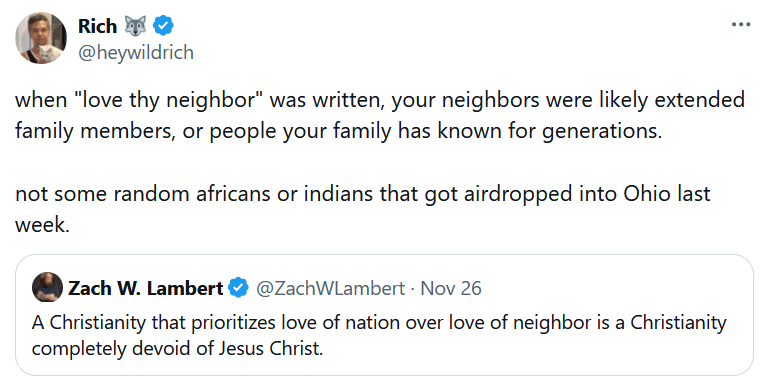
For context, Zach Lambert is a self-proclaimed “Post-Evangelical,” which basically means he’s a liberal Christian with “progressive” theological positions. I don’t recommend Zach as a source for sound Biblical doctrine. But let’s ignore him for a moment and focus on his point. He says true Christians should not love their nation more than they love their neighbor.
This refers to the words of Jesus Christ, who said that the second-greatest commandment is to “love your neighbor as yourself” (Mark 12:31). There is no command in the Bible to love your nation. It’s not wrong to love your nation, but it seems pretty clear that loving your neighbor is more important. On this, at least, I can agree with Zach.
Rich challenges this notion. He asserts that the context of “love your neighbor” in the Bible was back when your “neighbors” were people you knew well or were related to. As many have pointed out, this is nonsense. If he read the passage he’s talking about, he would quickly realize how wrong he is. Let’s take a look.
“He, desiring to justify himself, said to Jesus, ‘And who is my neighbor?’ Jesus replied, ‘A man was going down from Jerusalem to Jericho, and he fell among robbers, who stripped him and beat him and departed, leaving him half dead. …a Samaritan, as he journeyed, came to where he was, and when he saw him, he had compassion. … Which of these…proved to be a neighbor to the man who fell among the robbers?’ He said, ‘The one who showed him mercy.’ And Jesus said to him, ‘You go, and do likewise.'” — Luke 10:29-30, 33, 36-37 (ESV)
A man in the crowd asks Jesus “Who is my neighbor?” This is an important question, but the answer isn’t as simple as “family” or “people who live near you.” No, instead Jesus answers in the form of a parable which demonstrates a fuller meaning.
The principle character in this parable is a Samaritan. This was a people group living near Israel in the time of Christ. Their ancestors were part of the Northern Kingdom of Israel, which fell in 721 B.C. when the Assyrians attacked.1 Some were led off to Assyria, but those who stayed intermarried with foreigners and eventually became known as the Samaritans. The Jews considered them half-breeds. They hated each other.
Jesus specifically picks out a hated enemy of the Jews to be the protagonist of his story, the one who puts aside racial and national divides in order to show kindness to a man in need. This is in stark contrast to the religious leaders in Jesus’ parable who step over the man on the road. They’re shown to care less about following the second-greatest commandment than a lowly Samaritan, a great offense to those listening to Jesus. The Jews saw themselves as superior, as garnering God’s favor purely based on their heritage. How wrong they were.
Rich is essentially the man who questions Jesus. He refuses to accept that certain people groups are worthy of our love as Christians (though he himself doesn’t claim to be a Christian, interestingly). We have to draw the line somewhere, he thinks. I’ll love my family and other Americans, but not the “random africans or indians that got airdropped into Ohio last week” as he so eloquently puts it. No, Rich. God wants you to love them too. He would have you love even your most hated enemy.
“But I say to you who hear, Love your enemies, do good to those who hate you.” — Luke 6:27 (ESV)
Between the Lines & Outside the Context
But here’s where I must take a step back and look at the bigger picture. This isn’t just about who you show love to in your daily life. This isn’t just about moral principles. Rich is getting at something different. Ironically, so is Zach. They’re bringing connotations of foreign policy into this discussion. And that’s certainly NOT something Jesus was talking about in his parable. This is essential to point out.
It’s a common trend nowadays for liberal Christians (like Zach) to take the Bible out of context in an attempt to force the Scriptures to support their positions on all sorts of societal, economic, and political issues. “Jesus was a socialist,” they might say. “The early church is an example of Communism,” they might say. It’s all lies. There’s a world of difference between Jesus’ actual teachings and his theoretical position on which laws should be passed relating to mass immigration or wealth redistribution. We must be careful to rightly divide the words of God.
“Do your best to present yourself to God as one approved, a worker who has no need to be ashamed, rightly handling the word of truth.” — 2 Timothy 2:15 (ESV)
The question is not, “How can I apply Jesus’ words to foreign policy?” This is an improper use of Scripture called “eisegesis,” in which we attempt to inject our own ideas into the Bible. No, instead we ought to ask, “What was Jesus trying to say here?”
The answer seems to relate to the way Jesus’ audience, the Jews, conducted themselves in their daily lives. They might encounter people they despise, but Jesus tells them to show love regardless. They might have enemies, but Jesus tells them to show love regardless. Jesus was NOT trying to advocate for any kind of foreign policy position. He wasn’t aligning himself with any law. He wasn’t rebuking or affirming Rome’s authority in how it managed borders. Those are completely separate issues.
It’s perfectly acceptable to vote for strong borders while obeying Jesus’ command to love your neighbor. There are very good practical reasons for the government to regulate immigration, especially with how many widespread problems have arisen from lax policies as of late. Our “neighbors” are not just foreigners, but also our fellow Americans. Voting for strong borders is a form of loving our neighbors. At the same time, it’s imperative that we imitate Christ in how we treat any and all people we come across in our daily lives as Americans. If we see immigrants, we should love them. They are our “neighbors,” as Jesus makes clear to us.
Is this a contradiction? No, it is not. Whatever situation we find ourselves in, we obey Christ in loving our neighbors, even if the situation is not ideal. But that does not imply that we should actively seek to tear down our borders and invite everyone into America. Those are two completely different things. In the same way, we should trust God to provide for our needs, but this does not mean we should neglect to use the resources God provides. “Jesus take the wheel,” we say as we press on the gas with our eyes closed. “I gave you a steering wheel for a reason!” God replies as he shakes his head in disappointment.
It’s also worth pointing out that the man on the road was genuinely in need. Many immigrants are in need, but many are not. In fact, some are dangerous and should be refused entry regardless.2 Jesus certainly didn’t mean to imply that loving your neighbor means inviting criminals into your home. Locking up criminals, no matter where they come from, is not opposed to Jesus’ command to love your enemy. It’s just another way governments keep the peace and protect their citizens. This is entirely appropriate and consistent with how Paul talks about the purpose of government in Romans 13:1-7.
Another potential connotation in Zach’s post is a disagreement with “Christian Nationalism,” which I go over in detail here. I’m not certain this was his intention, but it seems likely. Suffice to say that Christian Nationalism is not Biblical, but that doesn’t give Zach a pass. Many Christian Nationalists want to bring patriotism (love of country) back. I don’t have a problem with patriotism. I have a problem with uniting the church and the state. Again, see my other post for more details. The only point on which I can confidently agree with Zach is the idea that no Christian should love his nation more than he loves his neighbor. Jesus is clear on this.
Conclusion
I do believe it is my responsibility as a Christian to show love and kindness to all people, whether they are an African immigrant or a close friend. The Christian faith has no racial or national boundaries. We ought to be evangelizing to all people as well. At the same time, I will openly advocate for strong borders in America. Most civilized countries around the world also want strong borders. This is not racist or hateful. It is simply a reality in properly governing a country and keeping citizens safe.
Don’t go looking for foreign policy from Jesus’ parables. Don’t go looking for Christian insights from an unbeliever like Rich. Don’t go looking for sound doctrine from a “Post-Evangelical” like Zach. Read Christ’s words on his own terms. Follow wise counsel from leaders in your local church who imitate Christ in their daily lives. Vote for policies that promote the safety and prosperity of the nation. But do not cling to race or national identity or social justice. Cling to Christ.
Let me know your thoughts in the comments below. Enter your email to be notified for my next post. Thanks for reading. Godspeed.
Processing…
Success! You're on the list.
Whoops! There was an error and we couldn't process your subscription. Please reload the page and try again.
This post is a transcript of the above YouTube video, with minor alterations. Check out my channel for theology, woodworking, and more! Click HERE to subscribe.
In the world of American Christianity, there are two common paths I see kids taking nowadays.
The first is tradition. It’s comforting to stick to what you know and embrace the familiar. Many people copy their parents’ faith and don’t think too much of it. But others have noticed how apathetic so many modern churches are. They don’t want the same faith that their parents had. They want something bigger and grander. They want to return to the old ways, dig up old traditions and hold fast to them in what eventually becomes an aimless pursuit of religious nostalgia. This is where you’ll find a lot of dogmatic young people who are hard to get along with unless you subscribe to their specific ideas of “how things should be.”
The second path so many are taking is the deconstruction of their faith. The phrase has become ubiquitous in today’s culture. We’re seeing not only nominally Christian celebrities “deconstructing their faith,” but also openly Christian authors, speakers, and even pastors—very influential figures for our youth. It’s more popular than ever to question Christianity. American culture is getting more hostile to traditional Christian values as time goes on. It’s much more convenient for public figures to distance themselves from fundamental doctrines and stick to the hazy no-mans-land of progressive Christianity. They might claim they’re just “searching” or “finding what makes sense to them.” They still claim to be Christian, but they live in such a way that any self-respecting Christian of the last 2000 years couldn’t distinguish them from an unbeliever. This new culture of skepticism has grown like a cancer and spread on the back of political dogma to great effect among our youth.
So what’s the right answer? Should you reject modernity and embrace tradition or should you deconstruct your faith? I’m here to tell you there’s a better way. Don’t reject the old just because it’s old. Don’t embrace the new just because it’s new. Instead, pursue truth.
There can actually be great value in deconstructing your faith. It’s healthy to take a critical look at your own worldview. But that’s not where you should stop. Asking questions, challenging norms, and tearing down traditions is easy. The hard part is settling on what you actually do believe and sticking to it. After you’ve deconstructed your faith, what do you have left? Most people don’t have much of anything, and the void is quickly filled by worldliness and hedonism. Instead, reconstruct your faith. After removing the baseless traditions and inconsistencies, replace them with what’s true. That’s the sign of real maturity.
Here are four ways you can do just that.
1. Build up Truth From Valuable, Authoritative Sources
First, the Bible.
“If you abide in my word, you are truly my disciples, and you will know the truth, and the truth will set you free.” — John 8:31b-32 (ESV)
Become a student of the word of God and you will know truth and that truth will set you free. Be willing to hear out your Christian peers as well. Your interpretations of Scripture won’t always be correct. Join a Bible study at your church. Talk to your pastors about hard questions and be willing to listen. Read old books by credible theologians. There’s no shortage of resources available to you.
2. Be Willing to be Wrong
“With humility comes wisdom.” — Proverbs 11:2b (CSB)
If you tossed away a doctrine in the process of deconstructing your faith that turns out to be true, have the humility to add it back. If you picked up something wrong, be willing to let go of it. Remember, you are not pursuing a specific framework. You are pursuing truth. Your goal is not to become a good Baptist, a good Presbyterian, a good pre-millennialist, or a good covenant theologist. Your goal is to become a good Christian who clings to truth above all else.
“He has told you, O man, what is good; and what does the Lord require of you but to do justice, and to love kindness, and to walk humbly with your God?” — Micah 6:8 (ESV)
3. Walk the Walk
“Has the Lord as great delight in burnt offerings and sacrifices, as in obeying the voice of the Lord? Behold, to obey is better than sacrifice, and to listen than the fat of rams.” — 1 Samuel 15:22 (ESV)
Now, we are saved by faith in Christ, and having good theology and sound traditions is important. But the life of a Christian will also produce good fruit at the end of the day, and that’s the hardest part. Be willing to live the “mundane” Christian life. You don’t have to restructure your church denomination, correct everyone’s ideas about the end times, or reclaim the political arena for Christian values in order to make a difference and obey Christ. Big goals are good to have, but steadfast living day by day is immediate, impactful, and essential.
“And by this we know that we have come to know him, if we keep his commandments.” — 1 John 2:3 (ESV)
You can’t change the world if you don’t have your life together. So be the man or woman of God that you’re meant to be in the little things. Work your day job as unto the Lord, even if it’s frustrating. Forgive your parents, even if they don’t accept it. Share Christ with that coworker, even if it’s awkward. Give your resources and time to causes in your church, even if nobody notices. Lay down your pride in your marriage, even if it’s not reciprocated. These “little things” are not little at all. They are the real battleground for not only your heart, but the world. God has already won the battle and he’s the one who will get the credit for it. Walk in his victory and dare to claim it in your daily habits.
“If I have the gift of prophecy and understand all mysteries and all knowledge, and if I have all faith so that I can move mountains but do not have love, I am nothing.” — 1 Corinthians 13:2 (CSB)
4. Embrace Unity With Other Believers in a Local Church
“If anyone says, ‘I love God,’ and hates his brother, he is a liar; for he who does not love his brother whom he has seen cannot love God whom he has not seen.” — 1 John 4:20 (ESV)
Church is not optional for the Christian. Walking through the forest may show you God’s glory, but it’s not enough to save you. Reading the Bible is what allows you to understand that glory and the path to salvation, that you may experience it beyond your short life here on earth. In the same way, following Christ in your own private life will yield good fruit, but it’s not enough for your soul. You need a church.
“And let us consider how to stir up one another to love and good works, not neglecting to meet together, as is the habit of some, but encouraging one another, and all the more as you see the Day drawing near.” — Hebrews 10:24-25 (ESV)
Membership in a church is what allows you to thrive in knowledge, holiness, and proper worship with other Christians. Paul talks at length about the importance and benefit of being united with a church:
Now as we have many parts in one body, and all the parts do not have the same function, in the same way we who are many are one body in Christ and individually members of one another.
According to the grace given to us, we have different gifts: If prophecy, use it according to the proportion of one’s faith; if service, use it in service; if teaching, in teaching; if exhorting, in exhortation; giving, with generosity; leading, with diligence; showing mercy, with cheerfulness.
Let love be without hypocrisy. Detest evil; cling to what is good. Love one another deeply as brothers and sisters. Take the lead in honoring one another. Do not lack diligence in zeal; be fervent in the Spirit; serve the Lord. Rejoice in hope; be patient in affliction; be persistent in prayer. Share with the saints in their needs; pursue hospitality… Rejoice with those who rejoice; weep with those who weep. — Romans 12:4-13, 15
If you’re serious about following Christ, you won’t just feel obligated to attend a worship service once a week; you’ll seek out a church where you can serve and encourage others, eagerly offering your time, money, and talents for the benefit of the congregation. That means getting to know these people, praying for them regularly, meeting their needs, and being present with them to study the word and worship together.
“Now the full number of those who believed were of one heart and soul, and no one said that any of the things that belonged to him was his own, but they had everything in common.” — Acts 4:32 (ESV)
Just as we should not expect to reach perfection in ourselves this side of eternity, we cannot expect to find “the perfect church.” It doesn’t exist. Every church is full of sinners and you are one of them. Don’t keep hopping around between churches. Pick one that preaches the word rightly, join it, and get involved. Don’t leave or become disillusioned if you encounter some drama, secondary theological disagreements, or different aesthetic preferences. Learning to live in unity and love with people who are not exactly like you is not only healthy, but necessary.
“As for a person who stirs up division, after warning him once and then twice, have nothing more to do with him, knowing that such a person is warped and sinful; he is self-condemned.” — Titus 3:10-11 (ESV)
“A new commandment I give to you, that you love one another: just as I have loved you, you also are to love one another. By this all people will know that you are my disciples, if you have love for one another.” — John 13:34-35 (ESV)
Surrounding yourself with other Christians and learning to live life together is the best thing you can do to reconstruct your faith. It will challenge you to be humble, encourage you towards obedience, and secure you in the truth.
“Finally, all of you, have unity of mind, sympathy, brotherly love, a tender heart, and a humble mind.” — 1 Peter 3:8 (ESV)
Let me know your thoughts in the comments below. Enter your email to keep in touch with me. Thanks for reading. Godspeed.
Processing…
Success! You're on the list.
Whoops! There was an error and we couldn't process your subscription. Please reload the page and try again.
This post is a transcript of the above YouTube video, with minor alterations. Check out my channel for theology, woodworking, and more! Click HERE to subscribe.
One of the most popular beliefs of the day is that God loves everybody… God’s Love toward all His creatures is the fundamental and favorite tenet of Universalists, Unitarians, Theosophists, Christian Scientists, Spiritualists, Russellites, etc. … That God loves everybody is quite a modern belief. The writings of the church fathers, the Reformers or the Puritans will (we believe) be searched in vain for any such concept. (Pink 1918/2015, 42) — A. W. Pink
This is not a defense of “Calvinism” as a whole. I am not strictly a Calvinist. I am a Christian. But I hold to some beliefs that fall under the larger umbrella that is “Calvinism.” I recently saw Trent’s video called “One Christian Truth Calvinists CAN’T SAY” (Horn 2024) and I thought it was worth talking about. Given that Trent is a Catholic and I’m a reformed protestant, I’m sure this is not the only thing we disagree on. My goal is not to target Trent specifically. My goal is to defend God’s sovereignty and show you why opposing arguments are flawed. Let’s get started.
God Loves Everyone?
Trent begins by saying that John 3:16 tells us God loves everyone. He believes God’s love for everyone is a core Christian truth that cannot be argued. He says Calvinism contradicts this truth. So it must be Calvinism that is wrong, not John 3:16.
This is a persuasive strategy. By pitting some guy’s theological ideas (Calvinism) against the Bible itself, he can easily convince people to side with the Bible and toss out Calvinism. I’m going to challenge Trent’s framework on two fronts.
First, I am not convinced that the Bible actually claims “God loves everyone” in the way Trent thinks.
Second, there are certain ways in which “God loves everyone” without contradicting Calvinism.
Trent unequivocally states that a Christian should be able to say this to anyone: “God planned for all eternity that you would be alive because he loves you and wants you to have eternal happiness in Him.” Let’s break it down.
“God planned for all eternity that you would be alive.” This I agree with, and it lines up perfectly with God’s sovereignty as described in the Bible. Psalm 139:13-16 and Ephesians 1 show clearly that God plans our days in advance. He creates us with intention.
“Because he loves you.” This is where Trent thinks he has Calvinists pinned. He even says, “It’s very instructive to watch Calvinists try to answer the question ‘Does God love everyone.’ Because you can see them trying to reconcile our common sense intuition—that God loves all people, and if he loves them he’d want them to be saved—with a Calvinist theology.”
Appealing to common sense is not an argument. When discussing theology, we should look to the Bible.
What John 3:16 Means
John 3:16 says “For God so loved the world…” This is the strongest evidence for Trent’s position. It’s the best he’s got, which as you will soon see, is not much. John does not say “God loves everyone.” He says “God loved the world.” If you look at how that original Greek word is used elsewhere in the NT, you quickly see that it can have different meanings depending on the context.
When Jesus’ followers tell him to show himself “to the world” (Jn 7:4, ESV), do they mean “to every human being?” No. Pharisees say of Jesus that “the world has gone after him.” (Jn 12:19, ESV) Do they mean every human being? No. When Paul says that the faith of his audience in Rome is “proclaimed in all the world,”(Rom 1:8, ESV) does he mean proclaimed to every human being? Of course not. Arthur Pink points this out, saying “the term ‘the world’ often has a relative rather than an absolute force.” (Pink 1918/2015, 43)
We also find phrases like “foundations of the world.” “Kingdoms of the world.” “gain the whole world and forfeit his soul.” “He was in the world.” “…before the world existed.” “The world” often refers to the created order in a more general sense.
How exactly does God love the world? Let’s keep reading in John 3. “he gave his only Son, that whoever believes in him should not perish but have eternal life.” (ESV) Already, we have John referring to a specific group—those who believe. “For God did not send his Son into the world to condemn the world, but in order that the world might be saved through him.” (ESV) Interesting. What does “the world” mean in this verse? Does it mean “every human being?” No. It cannot, or else John would be arguing that everyone is saved, which is the heresy of universalism. Instead, a better definition of “world” in verse 17 might be “the created order in general, but specifically those who follow God.” This interpretation renders the verse like so (my interpretation): “For God did not send his Son into the created order to condemn it, but so the created order, specifically those who follow God, might be saved through him.” This interpretation is consistent with the context and much more in line with the rest of Scripture.
Some will argue that “might” removes the need to scrutinize “world.” After all, just because every single person might get saved doesn’t necessarily mean they will get saved, right? The problem here is that “might” is not a word of uncertainty in this context. The meaning in the Greek is clear—this verse is describing something that will certainly happen. Other translations, such as the Christian Standard Bible, New International Version, and New Living Translation avoid confusion by removing the word “might” entirely.
I propose that John 3:16 is referring to how God loved the created order in general (including all people he created), but especially the elect, in his act of sending Christ. This is more accurate than just saying “God loves everyone.” Trent’s interpretation is insufficient. He doesn’t even attempt to read the context, consider the original Greek, or explore the greater implications of his conclusions. In fact, he has to change the wording of the text and cut out the context in order to make his point. That alone should speak volumes.
“God so loved the world.” Many suppose that this means, The entire human race. … Unnumbered millions lived and died before the Saviour came to the earth, lived here “having no hope and without God in the world,” and therefore passed out into an eternity of woe. If God “loved” them, where is the slightest proof thereof? (Pink 1918/2015, 43) — A. W. Pink
The World According to…
If anyone is in Christ, he is a new creation. The old has passed away; behold, the new has come. All this is from God, who through Christ reconciled us to himself and gave us the ministry of reconciliation; that is, in Christ God was reconciling the world to himself, not counting their trespasses against them, and entrusting to us the message of reconciliation. — 2 Corinthians 5:17-19 (ESV)
That’s the same Greek word as before, “world.” Paul says God was reconciling the world, not counting their sins against them. Is Paul talking about every human being here? No. He cannot, for that would imply that God removes sin from everyone, which is again the heresy of universalism. Rather, Paul refers to those who are saved, the Christian church he writes to and the rest of God’s elect in the world at large. The context makes this perfectly clear. “reconciled us” … “gave us the ministry of reconciliation” Who is “us?” It’s the church Paul is writing to, of course. Christians!
Trent later brings up 1 John 2:2, which says: “He [Christ] is the propitiation for our sins, and not for ours only but also for the sins of the whole world.” (ESV) Again, “world” does not refer to “everyone.” John is not saying that all sin is erased, saving all people. That would be heresy. His point is that Christ’s sacrifice is sufficient for any and all peoples in any part of the world. This can only be a measure of God’s potential ability to save, not who he actually saves. This is an important distinction. A Calvinist interpretation of God’s love and salvation for those who actually receive these things avoids the heresy of universalism and adheres to the Bible’s true meaning.
Christ’s sacrifice is sufficient for all, but effective for those who actually believe. Just like a voucher program is sufficient for all who register for it, but only effective for those who take part in it.
God Loves His People
Now that we’ve thoroughly covered what the Bible says about “the world,” let’s take a quick look at what it says about God loving humanity. What we find is that God loves his followers specifically.
“God shows his love for us in that while we were still sinners, Christ died for us.” — Romans 5:8 (ESV)
“In this is love, not that we have loved God but that he loved us and sent his Son to be the propitiation for our sins.” — 1 John 4:10 (ESV)
“We love because he first loved us.” — 1 John 4:19 (ESV)
“By this we know love, that he laid down his life for us” — 1 John 3:16 (ESV)
“Love one another, just as I have loved you” — John 13:34 (ESV)
“God, being rich in mercy, because of the great love with which he loved us” — Ephesians 2:4 (ESV)
“The Lord your God is God, the faithful God who keeps covenant and steadfast love with those who love him and keep his commandments.” — Deuteronomy 7:9 (ESV)
So… does God love everyone? Well, it depends on what you mean by that. Does God give every human being common grace by allowing us the gift of life? Yes, and we’ll talk more about that in a moment. Does God love “the world” in his act of sending his Son to die and be the propitiation for the sins of those who believe? Yes, his love is for all mankind in that broad sense. But God does not “love every human being” in the way Trent means. God specifically and especially loves those who follow him—the Scriptures overwhelmingly support this.
Does God Want All to be Saved?
Going back to Trent’s thesis, he finishes with the idea that God “wants you to have eternal happiness in Him.” He supports this with 1 Tim 2:4, which says that God “desires all people to be saved and to come to the knowledge of the truth.” (ESV) This is a common objection to Calvinism. Let’s hear it in Trent’s own words: “Under Calvinism … God does not want everyone to be saved, because if God did want that, then God would have chosen to save everyone.”
The Calvinist answer to this is twofold.
First, it is helpful to view God’s desires on different levels. God may desire all people to be saved, but his greater desire is to save some rather than all. If we believe in an all-powerful God (which is the only kind of God the Bible supports), we all must believe in different levels of God’s desires. Unless I’m mistaken, Trent believes that God is powerful enough to save everyone, but that he chooses not to. The only difference is that I believe God’s greater desire is election (clearly presented at length in Ephesians 1 and Romans 8-9), whereas Trent believes God’s greater desire is free will (presented at length nowhere in the Bible). And to be clear, there is no room for the interpretation that God desires all to be saved, but is unable to accomplish this. As Arthur Pink puts it, “To argue that God is ‘trying His best’ to save all mankind, but that the majority of men will not let Him save them, is to insist that the will of the Creator is impotent.” (Pink 1918/2015, 5)
Second, as Trent himself admits, 1 Timothy 2:4 might be saying that God wants to save “all kinds” of people rather than “all people.” If we look at the context, Paul is asking for prayer for kings and rulers. Maybe Paul’s saying God desires all kinds of people, even kings, to be saved. But then Trent says this: “Calvinists have to show these passages only mean that.” No, we don’t. That’s asking us to prove a negative, which is a logical fallacy. We don’t have to prove that any verse lacks a specific meaning. We only have to read the verse as it is and interpret it appropriately based on the context. The Bible thoroughly supports a sovereign God who predestines some to salvation and others to damnation for his own perfect purposes.
The Lord has made everything for its purpose, even the wicked for the day of trouble. (ESV) — Proverbs 16:4
This is a good time to address another relevant verse. Near the end of his video, Trent references 2 Peter 3:9, but he leaves out an essential part of the verse. Here’s the whole verse:
The Lord is not slow to fulfill his promise as some count slowness, but is patient toward you, not wishing that any should perish, but that all should reach repentance. — 2 Peter 3:9 (ESV)
The “you” is the Christians Peter is writing to. In the verse before (and all over this letter) he calls his audience “beloved.” That’s why he mentions God’s promise, which he expounds upon in verse 13: “according to his promise we are waiting for new heavens and a new earth in which righteousness dwells.” That promise is only for Christians. God is patient towards his elect, that we all might reach repentance.
Why Does God Send People to Hell?
Trent’s next blunder is his assertion that Calvinists believe people go to hell not because they reject God, but because God rejects them. This isn’t just a gross oversimplification, it’s wrong. Calvinists absolutely believe that people go to hell because they reject God. In fact, Calvinists say this is our default state as human beings. All of us sin (Rom 5:12). We all reject God, despite seeing evidence of his greatness in creation (Rom 1:20) and despite having the law of God written on our hearts (Rom 2:14). It’s only when God calls us to himself that we accept him (John 6:44). So yes, everyone who goes to hell was put there specifically because they rejected God. Paul says “the wages of sin is death” (Rom 6:23).
Calvinists also believe in predestination. Both ideas can be true at once.
He chose us in him before the foundation of the world, that we should be holy and blameless before him. In love he predestined us for adoption to himself as sons through Jesus Christ, according to the purpose of his will. … In him we have obtained an inheritance, having been predestined according to the purpose of him who works all things according to the counsel of his will. — Ephesians 1:4-5, 11 (ESV)
This is one of several passages where we read that God chooses those who follow him before the world was even made. He predestined us, but that’s not all. He also works all things according to his will. God is absolutely sovereign. Oh, and while we’re here, I might as well mention verse 14, which tells us that the Holy Spirit is “the guarantee of our inheritance until we acquire possession of it.” (ESV) This supports the Calvinist idea of Perseverance of the Saints.
No Calvinist believes that God turns away otherwise believing, repentant people because they aren’t on his list. Neither do they believe that God drags otherwise damned souls into heaven kicking and screaming. The reality is that people who are repentant were always on God’s list and those who reject him were never on his list.
John MacArthur
Trent then goes on to criticize John MacArthur, who appears to be inconsistent on the question of whether God loves everyone. John says that the campus crusade slogan “God loves you and has a wonderful plan for your life” is not true. Currently, there’s a terrible plan for your life unless you repent. (MacArthur 2020, 0:15) Trent insists that a Calvinist should know that for the elect, there was never a terrible plan in store.
First, why use a clip from John MacArthur? He may have some Calvinist ideas, but surely a better source would be the Westminster Confession or the Bible. Romans 9 and Ephesians 1 would be much more worthy of Trent’s time. Second, Trent knows what MacArthur really means. MacArthur is simply saying that the phrase “God loves everyone” is incorrect in the traditional sense, as we’ve covered in detail. Of course, he would agree that there was never really a terrible plan for the elect, but his statement was implicitly about those who are not elect. When we are evangelizing, there’s no point in trying to discover who is elect and who is not. Only God knows. It’s our job to spread the gospel to all and let God’s work have its full effect in the hearts of those whom he chooses.
Evil Doctors and the Calvinist God
Trent then uses a clip from R. C. Sproul (Sproul 2017, 1:10) along with an illustration to suggest that Calvinists contradict themselves by claiming God loves everyone enough to give them life (the idea from Jesus’ teachings that “rain falls on the just and the unjust”), but not enough to let them accept him. This is simply the fallacy of false equivalence. The first idea is Common Grace, which is not the same thing as Trent’s idea that “God loves every human being.” It’s completely rational to say that God offers common grace and that he chooses whom he saves. Both can be true. Don’t let Trent pit apples against oranges and force you to choose one. It’s a false dilemma.
Let’s look at Trent’s illustration. He describes a doctor who injects a bunch of children with a slow acting cancer. The doctor treats and saves some of those children, leaving the rest to die. Trent says of the dead children, “the only thing keeping them from being saved was the doctor’s decision to not save them.” This is, again, a gross misrepresentation of the Calvinist viewpoint.
First, it is in no way appropriate to use a human doctor injecting cancer to represent God. There’s simply no comparison to be made between the two. God is perfect by his very nature and does not inject sin into us. In him is no darkness at all (1 Jn 1:5, ESV). Sin originates in our hearts, not God (James 1:13-15, ESV). Again, if Trent referred to an authoritative source such as the Westminster Confession, he would see these points laid out clearly. Reducing God down to a nefarious doctor strips away everything that makes him God, rendering the analogy meaningless. Our judgement of the doctor’s actions is based on his equal standing with us as humans. But God is completely different from us. His ways are higher than our ways (Isaiah 55:8-9, ESV). We can’t judge God for why he saves some, but not others.
What shall we say then? Is there injustice on God’s part? By no means! For he says to Moses, “I will have mercy on whom I have mercy, and I will have compassion on whom I have compassion.” — Romans 9:14-15 (ESV)
Second, the dead children that this doctor injected with cancer are a poor representation of sinful humans. Trent uses children rather than adults to use your emotions against you. Children are innocent and helpless. How dare that evil doctor inject them with cancer! But sinful men are not innocent children. They willfully reject God. That is why they are not saved. God’s greater plan in predestining each soul does not contradict the idea that every soul damned to hell is there because they rejected God.
Prisoners and Pardons
What’s funny is that Trent saw this rebuttal coming. He admits Calvinists would find his analogy to be flawed. So he presents another analogy, this time about a governor granting pardons to some inmates, but not others. The governor cares enough for the prisoners to keep them fed and clothed while they serve their sentence. This is akin to common grace. But the governor only grants pardons to some of the prisoners, not all. This is akin to God choosing whom he saves. But Trent says the analogy falls apart. The human prisoners deserve to be in prison because they chose to break the law. Trent says Calvinism is different because no such choice is offered to man. We’re just screwed if God doesn’t want to save us and there’s nothing we could have done differently.
But Trent mistakenly equates the prisoner’s crime to a lack of acceptance of God. That’s not accurate. I don’t think anyone who heard this illustration would assume that. The prisoner’s crime is the sin they chose to commit—they actively rejected God. The punishment is just. They could have chosen not to violate God’s law, but instead they violated it.
Trent goes on to say that the first analogy is actually more accurate to Calvinism because the cancer was imposed upon the children just like God’s decrees are imposed upon mankind under Calvinism. But Paul has an answer for this in Romans 9.
You will say to me then, “Why does he still find fault? For who can resist his will?” But who are you, O man, to answer back to God? Will what is molded say to its molder, “Why have you made me like this?” Has the potter no right over the clay, to make out of the same lump one vessel for honorable use and another for dishonorable use? What if God, desiring to show his wrath and to make known his power, has endured with much patience vessels of wrath prepared for destruction, in order to make known the riches of his glory for vessels of mercy, which he has prepared beforehand for glory? — Romans 9:19-23 (ESV)
Paul says that blaming God for predestining some but not others is missing the point. God can save whoever he wants. In glorifying himself, he creates some for mercy and others for wrath. That’s how it works. We are still responsible for our sin, as Paul himself affirms.
We must all appear before the judgment seat of Christ, so that each one may receive what is due for what he has done in the body, whether good or evil. — 2 Corinthians 5:10 (ESV)
God is sovereign and man is responsible.
How and If God Loves Everyone
Trent then points out that some Calvinists “bite the bullet” and admit that God does not love everyone, Arthur Pink being one of them. But we’ve already covered this in detail, so we’ll move on. What’s funny is that this quote originally has an asterisk next to it in Pink’s book, pointing to a later section specifically addressing John 3:16, but it appears Trent didn’t think that was worthy of his time.
Trent then says: “Another way Calvinists answer the question, ‘Can you tell anyone you meet God loves them?’ is to claim that we can say God loves anyone, even the damned, because he offers them salvation even though they will never respond to it.”
Yes… That is, in fact, the only appropriate interpretation of John 3:16 if you insist that “the world” means “every human being.” That he finds even this to be unacceptable is sad, to say the least.
Trent then shows a clip of John Piper reiterating this stance. Piper says we are able to say to anyone that God loves them because God sent his son to die, so that if they believe, their sins will be forgiven. (Desiring God 2018, 3:20)
Trent says this is Piper’s version of the gospel: “God loves you, if you believe his son died on the cross for you and spend eternity with him.” Trent says this is a conditional love, but that the real God unconditionally loves every human being.
First, Piper did not say God loves you “if.” Piper said God loves you by sending Christ. The “if” comes later, referring to whether the person believes, not whether God loves them. If a person believes, their sins are forgiven. Notice how Trent always has to tweak the language to make his point. His arguments don’t work if he addresses the opposing view honestly.
Second, Trent calls this a conditional love. Piper did not attach any conditions to his view of God’s love. But Trent appears to be attacking my position instead, that God only loves the elect in the fullest sense. It seems he’s forgotten the “unconditional” part of “Unconditional Election,” another Calvinist doctrine.
[God] saved us and called us to a holy calling, not because of our works but because of his own purpose and grace, which he gave us in Christ Jesus before the ages began. — 2 Timothy 1:9 (ESV)
Third, Trent says that “the real God unconditionally loves every human being.” But Piper also believes God loves “every human being” in the sense that he sent his Son to the whole world. I would reiterate that Christ’s sacrifice is sufficient for every human being and requires nothing of them but acceptance. Christ’s sacrifice is efficient for those who are actually saved. But no, God does not love “everyone” in the same sense that he loves his followers.
We All Reject God
Trent then says that God “offers salvation to all and loves them enough to allow some of them to reject him if they choose.” Trent is presenting this position in contrast to Calvinism, but Calvinists do not object to Trent’s main point here. Every human being does have a choice to reject God. We all take it. That’s the meaning of Total Depravity. We are so corrupted by sin that we all choose evil. Trent is wrong by implying that man’s choice to accept God is what allows him to enter into a right relationship with God. Calvinism holds that God calls us first, and the Bible supports this.
No one can come to me unless the Father who sent me draws him. And I will raise him up on the last day. — John 6:44 (ESV)
Jesus affirms Total Depravity, Irresistible Grace, and the Perseverance of the Saints in just this one verse!
I am sure of this, that he who began a good work in you will bring it to completion at the day of Jesus Christ. — Philippians 1:6 (ESV)
God is the one who begins a work in us and he will see it through.
Trent’s Gospel
Finally, Trent presents his version of the gospel: “God loves you. Believe his son died on the cross for you and spend eternity with him.”
Here’s a question. If I’m an unbeliever, why should I bother? God already loves me, right? So why is belief necessary? Surely God will watch out for me regardless, right? Surely he has my best interests in mind. After all, what good is his love if it doesn’t do anything?
We know that salvation through Christ is the only path to God, our only hope of avoiding his wrath. Trent’s belief that “God loves everyone” based on his feelings and a single Bible verse out of context is not only misinformed, but it discourages sinners away from repentance by making empty promises that amount to nothing when the day of judgement arrives. What exactly will God’s love do for every human being then, Trent?
Let me know your thoughts in the comments. I highly recommend you watch the videos listed in the sources below so you can get the full context. I hold to R. C. Sproul’s position. Enter your email to keep in touch with me. Thanks for reading. Godspeed.
Processing…
Success! You're on the list.
Whoops! There was an error and we couldn't process your subscription. Please reload the page and try again.
MacArthur, John. 2020. “Should we tell unbelievers that God loves them?” Ligonier Ministries. June 8, 2020. Educational video, 1:27. https://www.youtube.com/watch?v=nt6ycJsLhuQ
Sproul, R. C. 2017. “Is It Biblical to Say That God Loves Everyone?” Ligonier Ministries. June 28, 2017. Educational video, 3:23. https://www.youtube.com/watch?v=hTKnHRFZ29M
All Bible quotes are from the English Standard Version unless otherwise stated.









 Veracity Quest