The Turning Point

“The Lord tests the righteous, but his soul hates the wicked and the one who loves violence.”

— Psalm 11:5 (ESV)

On Wednesday, September 10th, 2025, Charlie Kirk was assassinated at the kickoff event of his “American Comeback Tour” at Utah Valley University.

He was a Christian.
He was a husband.
He was a father.
He was a patriot.

And they murdered him.

A single shot was fired from afar, hitting Charlie in the neck as he was in the middle of a peaceful conversation with a student regarding the rising violence of radical leftists.

Charlie has been warning about the growing trend of violent rhetoric on the left for some time now. Today, they proved him right.

Ironically, his legacy now has more power than ever before. They made him a martyr. They ensured that his name and ideas will ring out for generations to come. The young men and women watching this unfold today are becoming more emboldened than ever, more ready to fight if the fight is brought to them—and it most certainly has.

Mark my words. A reckoning is coming upon this nation. If you don’t see it now, you’ll see it in a few years. You’ll see it in the eyes of the young people growing up to be colder than they might have been, more determined than they might have been, less compromising than they might have been. This will be a defining moment for America.

The Best Of Us

Charlie wasn’t like other conservatives. He wasn’t in it for the money or the attention. He wasn’t a career politician. He wasn’t an atheist or an agnostic or even a religious person carrying the label begrudgingly. He was a genuine, outspoken, deeply passionate Christian who regularly advocated for evangelism and spiritual growth in America.

If you’re a conservative Christian reading this, there’s something you have to understand. Charlie wasn’t some kind of crazy radical. His beliefs were representative of the average conservative voter. He wasn’t a racist. He worked with and inspired people from all different backgrounds. He wasn’t hateful. He spoke with love and care, even to those he disagreed with the most. He was the purest among us, a real conservative actually fighting to conserve what’s right and true.

“What is so important to our country is to find our disagreements, respectfully, because when people stop talking, that’s when violence happens. People like me are facing violence, assaults from the left.”

— Charlie Kirk (source)

If they wanted him dead, what makes you think they see you any differently?

The only difference between you and Charlie is visibility. The only difference between you and Charlie is that he decided to get up and speak his mind.

He was making a difference, changing hearts and minds across the nation. He brought his confidence and conservative viewpoints to college campuses, the very places the left planted their flag of victory long ago. He made an impact they couldn’t ignore, and they knew it was impossible to stop his viral grassroots movement without resorting to violence.

We should be so bold as to make the enemies of truth and justice want to murder us. We should stand so tall and speak with such expertise as to be unbeatable without using a bullet. It’s easy to say, but extremely hard to live up to.

The Radical Left Celebrates

Thousands of leftists are celebrating Charlie’s death today. They’re giddy to see his blood spilled onto the ground. You think I’m lying, don’t you? You think it’s just a tiny minority of anonymous online accounts doing this. But you’re wrong. This is happening everywhere.

There’s a lot more where these came from. I’ve seen similar talk even from those I’ve known personally. These are people you might see on the street. Maybe they work in your local grocery store. Maybe you went to school with them. They’re posting from their public social media accounts tied to their jobs and communities. They aren’t afraid to show the world that they want conservative Christians like Charlie Kirk dead.

The only thing I have to say in response is an imprecatory Psalm, for anyone and everyone who dares curse Charlie’s name while his body is still warm and his wife and children in tears.

“He loved cursing—let it fall on him; he took no delight in blessing—let it be far from him. He wore cursing like his coat—let it enter his body like water and go into his bones like oil.”

— Psalm 109:17-18 (CSB)

Stay vigilant, fellow Christians. Be aware, fellow conservatives. Protect your family. Keep a watchful eye. Those who would seek to harm you and yours are acting upon their hatred more and more every day. Understand the times we are living in and act accordingly. Prepare for the worst. Pray for the best.

How to Keep Going

How do you move on from this? How do you go about your day knowing that thousands of people you thought of as fellow Americans would rejoice over your death? How do you keep fighting against such evil without giving in to violence yourself?

We must remind ourselves that the battle is not yet over. We have not lost. Charlie is closer now to his Lord than ever before. God’s judgement will come down upon the wicked; he will have the final say. Not just the murderer, but all those who praise wickedness will be punished according to their deeds. God is the great avenger.

“Vengeance and retribution belong to me. In time their foot will slip, for their day of disaster is near, and their doom is coming quickly.”

— Deuteronomy 32:35 (CSB)

Paul comments on this in Romans, urging his readers to—if possible—live peaceably.

“If possible, as far as it depends on you, live at peace with everyone. Friends, do not avenge yourselves; instead, leave room for God’s wrath, because it is written, ‘Vengeance belongs to me; I will repay,’ says the Lord.”

— Romans 12:17-19 (CSB)

And let us never forget that without God’s grace, each and every one of us would be destined for the lake of fire, and rightly so. Christ’s sacrifice on the cross is all that stands between us and judgement.

“All have sinned and fall short of the glory of God, and are justified by his grace as a gift, through the redemption that is in Christ Jesus”

— Romans 3:23-24 (ESV)

Another Psalm comes to mind. In it, we see David’s righteous anger and grief over the prevalence of the wicked.

“Oh that you would slay the wicked, O God! O men of blood, depart from me! They speak against you with malicious intent; your enemies take your name in vain. Do I not hate those who hate you, O Lord? And do I not loathe those who rise up against you? I hate them with complete hatred; I count them my enemies.”

— Psalm 138:19-22 (ESV)

But what is his conclusion?

“Search me, O God, and know my heart! Try me and know my thoughts! And see if there be any grievous way in me, and lead me in the way everlasting!”

— Psalm 138:23-24 (ESV)

He lays himself before God. He invites God’s pure and utter holiness to purge his heart of any and all sin. He invites God to attend to his every thought, ensuring that it is honoring to his Creator. He asks for God’s guidance along the path towards everlasting life.

We should do the same. Charlie would have wanted nothing less.

“Blessed are those who mourn, for they shall be comforted.”

— Matthew 5:4 (ESV)

Processing…
Success! You're on the list.

The Deadly Practicality of Christian Nationalism

There’s a new ideology lurking in the church. It might not seem like a threat. After all, it isn’t very widespread yet. But that’s part of what makes it dangerous. “Christian nationalism” is growing in large part thanks to vague duplicitous language that masks it as something innocuous. And the draw is strong for disillusioned young men who want to change the world for the better. But when you break it down, the logic falls apart. The morality is hollow. Christ is missing.

Before we get into it, let’s get our definitions straight. When I criticize “Christian nationalism,” I’m referring to the new movement of Christians advocating for the use of authoritarian power to enforce Christianity as the only permitted religion in the nation. The idea is to take back the culture by brute force from the top down and burn any “heretics” who stand in the way. These folks overlap significantly with Kinists, who justify racism by arguing that we’re supposed to “take care of our own” when it comes to tribe and skin color, not just family. If that doesn’t clear things up enough for you, click here to read my introductory post on the topic. Or try Samuel Say’s excellent breakdown.

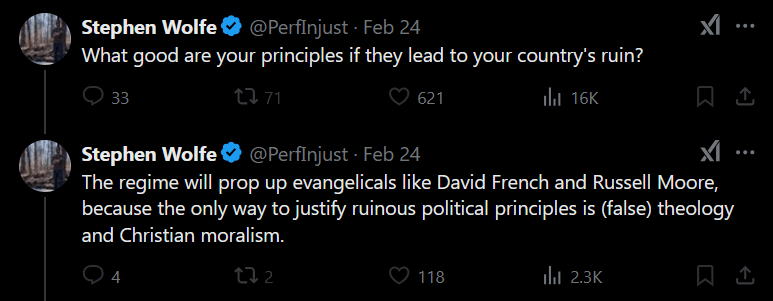
This post from X (Twitter) is what we’ll be discussing today.

Stephen Wolfe is the author of “The Case for Christian Nationalism” and a prominent voice in the movement. It should already be a red flag that he welcomes comparisons to psychopathic serial killers, but we’ll come back to that later. Wolfe advocates for an aggressive Christianity that isn’t afraid to take over the government and enforce God’s laws on all men. Here, he’s criticizing the comparatively passive worldviews proposed by figures such as Russell Moore.

Moore is the author of “Onward: Engaging the Culture without Losing the Gospel.” He stands against the Christian nationalism movement and instead longs for the days of the early church when Christians were on the back foot. He believes Christianity is incompatible with worldly political power and that we should concern ourselves with evangelism instead.

I agree with a lot of Moore’s points in his book, but I do not agree that we should be so passive as to refuse to engage in politics. As Christians, it is our responsibility to use whatever rights or abilities we have to push our culture and government towards what honors God and protects the advancement of the gospel. Moore also has some unsavory (read: left-wing) sources of funding for his work, but that’s another story.

I can agree with some criticism of Moore and French, but I cannot agree with Wolfe’s main point. He’s arguing that principles which lead to the ruin of your country are useless. This is faulty logic.

Post Hoc Ergo Propter Hoc

Let’s assume that our country has fallen into ruin and moral decay. What led us here? Wolfe seems to think it’s the fault of passive Christianity. But is that true?

No. Just because one thing follows another does not prove a causal link. Passive Christians did not advance secularism. They did not fight for abortion or the LGBTQ agenda or humanist reform in schools. They did not vote for the leaders who have done so much damage to our country. Passive Christians were attending church, spreading the gospel, and reading the Bible. None of this is wrong. None of this causes ruin. In fact, it promotes the exact opposite in our culture from the bottom up.

The disagreement is one of strategy—bottom up instead of top down. Moore and others believe in a hands-off approach to politics. We can talk all day about whether this is Biblical. But it is wrong to conclude that this approach is useless just because the secular culture around us has advanced over the years.

The world has always been full of sin. One could easily argue that “the good old days” never existed—that what we imagine as a truly Christian nation in our past was merely a facade of moralistic deism and good manners that we erroneously interpreted as the fruit of genuine faith in Christ.

This is not to say that morals or good manners are bad, only that they do not make a culture “Christian” any more than they make a person “Christian.” In this, I mostly agree with Moore. While America definitely has its roots in Christian values, it was never the bona fide “Christian nation” that Wolfe and others think it was. If anything, you’d have to attribute that label to the Puritan colonies before the USA was formed, and they had their own problems. I talk more about that here.

“Going to church doesn’t make you a Christian any more than going to McDonald’s makes you a hamburger!” — Keith Green

The “use” of passive Christian principles is in the advancement of the true and effectual gospel to hearts and minds, no matter what the culture decides to do. A few more saved souls are better than one “moral” nation without saved souls.

Let’s frame Wolfe’s statement another way.

“What use were the principles of the early church if they led to the fall of Rome?”

I hope you can see just how absurd this statement is. The early church did not contribute to the fall of early Rome. If anything, the early church might have delayed the fall somewhat. It’s hard to know for sure. But early Christians weren’t even trying to save Rome. They were trying to spread the gospel to the world.

This is the fundamental problem with Christian nationalism. It values cultural influence over the gospel. It values worldly power over the power of the Spirit. It values aesthetics over holiness. It values the world more than Christ.

Another Angle

Now, I know what you’re thinking. “That’s not Wolfe’s point! He’s just saying that passive Christian principles didn’t do enough to stop our country from coming to ruin.”

This more charitable interpretation still retains some of the same flaws. The premise of the argument makes no sense. In what universe is any set of principles “enough” to prevent a given culture from falling into moral decay? The cycle of governments, nations, and kings rising and falling has occurred since the dawn of time. Israel fell away from God over and over again. Which nation “did it right” exactly? The USA is very young itself; if even this great experiment has fallen too far, what hope is there?

The fallen, sinful nature of humanity prevents the possibility of a healthy, long-lasting government firmly established on Christian principles that avoids vague moralism and misguided religious violence. You cannot have an ideal society this side of heaven. It’s not going to happen.

But let’s assume for a moment that it is possible, or at least that preserving something better in America was possible. What principles could do that? Wolfe gives us an answer.

Well, it’s sort of an answer. Not really. You’d have to read Wolfe’s book to get a sense for his proposed principles (he basically wants a Christian king). For now, we get a theory.

Wolfe argues that political principles were ordained by God for our political good—therefore, these principles are sufficient and effective towards that end. Wolfe affirms the inverse as well. If your political principles are not sufficient and effective, then God didn’t ordain them, he says.

This is another way of saying, “Whatever works is right.” Wolfe is attempting to sanctify a relativistic practical morality. Why? Because it allows him to do whatever it takes to attain his goals. As long as it leads to a good end, then God must have ordained it! In other words, the end justifies the means. I hope I don’t have to explain the many problems with this.

No Country for Christian Men

Let’s stop for a second and ponder at the choice to reference Anton from “No Country for Old Men.” This character is a violent psychopath. Near the end of the film (spoilers), he has our protagonist at gunpoint. He’s won. He says, “If the rule you followed brought you to this, of what use was the rule?” That’s the line referenced in the image.

The writer of the movie is not proposing that Anton makes a great point here and morality should bend to whatever is most useful. The writer is using Anton as a tool to disillusion the protagonist and offer an observation to the audience. Good guys don’t always win. Sometimes evil prevails. In a world of unfeeling chaos, can justice and order really be preserved? What do we do with that? Do we follow our moral principles even if they lead us to the grave?

For the Christian, the answer is quite simple. Yes, we should do the right thing even if it “doesn’t work.” In the end, God wins. He has saved us and we will get to enjoy him forever in his eternal kingdom. The world isn’t just pure chaos. It’s God’s creation corrupted by sin, but it will be restored someday. The real question for Anton (and those who identify with him) is, “If the practical principles you follow send you to hell, of what use were those principles?”

Back to Wolfe

In addition to supporting moral relativism, Wolfe’s post also makes a sweeping judgement against passive Christianity and any other set of principles that “doesn’t work.” If it fails to preserve the nation (by Wolfe’s standard), then it must not have come from God. This is such an ignorant statement that it’s hard to know where to begin.

The early church did not prevent their countries’ ruin. Were their principles not ordained by God?

Where in the Bible would you even begin to argue that God promises us a Christian nation that won’t fail? Where are we instructed to create such a thing? To be sure, there are plenty of verses that say God blesses nations that obey him. There are plenty that affirm God’s ultimate rule over all nations. There are plenty that say all nations should bow down to God. But nowhere are we promised the possibility of an eternal Christian kingdom. Except…

“Then the seventh angel blew his trumpet, and there were loud voices in heaven, saying, ‘The kingdom of the world has become the kingdom of our Lord and of his Christ, and he shall reign forever and ever.'” — Revelation 11:15 (ESV)

The only government that will last is Christ’s coming kingdom.

“When the Son of Man comes in his glory, and all the angels with him, then he will sit on his glorious throne. Before him will be gathered all the nations, and he will separate people one from another as a shepherd separates the sheep from the goats.” — Matthew 25:31-32 (ESV)

The only “Christian king” who is incorruptible, who will judge the masses rightly, is Christ himself.

“They asked him, ‘Lord, will you at this time restore the kingdom to Israel?’ He said to them, ‘It is not for you to know times or seasons that the Father has fixed by his own authority. But you will receive power when the Holy Spirit has come upon you, and you will be my witnesses in Jerusalem and in all Judea and Samaria, and to the end of the earth.'” — Acts 1:6-8 (ESV)

When the disciples asked Jesus about establishing a kingdom on earth, he made it crystal clear that the time is not yet here. Christ will return. But in the meantime, we are not meant to make a shallow imitation of what we imagine that kingdom will be. We are not given power to physically conquer our enemies. No, we are to love our enemies (Matt 5:44, Rom 12:14, 19-21). That’s the scandal of the gospel. Paul says we are “more than conquerors” because nothing can separate us from God’s love; not death, not ruined nations, not anything (Rom 8:31-39). We are given power to be Christ’s witnesses to the ends of the earth. That is our mission.

Conclusion

In short, I reject the notion that an incorruptible Christian nation is possible in this age. I reject relativistic moral frameworks that propose the end justifies the means. I reject the idea that passive Christianity has contributed to the decline of morality in America. Yet I also condemn passive Christianity’s failure to engage meaningfully with the culture and government. I believe there’s a middle ground where we can fight for what’s right within the peaceful political systems that already exist.

Do not long for the coming kingdom so much that you forget where you are and what your mission is. Do not mistake earthly victory for spiritual victory. Spread the gospel. Pursue holiness. Uphold what is right by the good, righteous means God gives you. Imitate Christ. Be wary of heroes. They come and go. They are sometimes right and sometimes very wrong. But Christ will not fail you, and neither will his Word.

“May the God of peace himself sanctify you completely, and may your whole spirit and soul and body be kept blameless at the coming of our Lord Jesus Christ.” — 1 Thessalonians 5:23 (ESV)

Let me know your thoughts in the comments below. Enter your email to be notified of my next post. Thanks for reading. Godspeed.

Processing…
Success! You're on the list.

What Does it Mean to “Love Your Neighbor?”

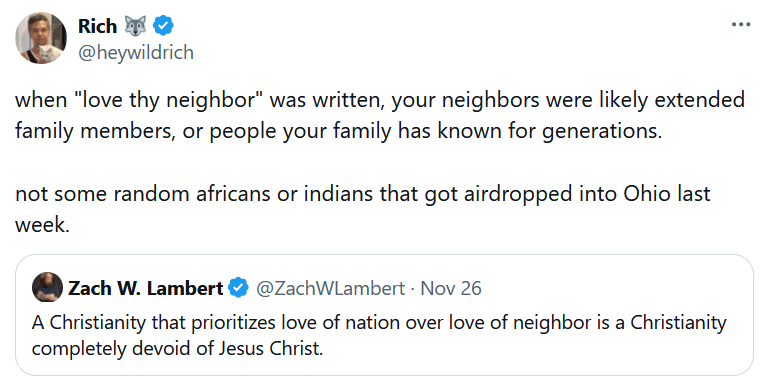
Here’s the post that made me want to write this.

For context, Zach Lambert is a self-proclaimed “Post-Evangelical,” which basically means he’s a liberal Christian with “progressive” theological positions. I don’t recommend Zach as a source for sound Biblical doctrine. But let’s ignore him for a moment and focus on his point. He says true Christians should not love their nation more than they love their neighbor.

This refers to the words of Jesus Christ, who said that the second-greatest commandment is to “love your neighbor as yourself” (Mark 12:31). There is no command in the Bible to love your nation. It’s not wrong to love your nation, but it seems pretty clear that loving your neighbor is more important. On this, at least, I can agree with Zach.

Rich challenges this notion. He asserts that the context of “love your neighbor” in the Bible was back when your “neighbors” were people you knew well or were related to. As many have pointed out, this is nonsense. If he read the passage he’s talking about, he would quickly realize how wrong he is. Let’s take a look.

“He, desiring to justify himself, said to Jesus, ‘And who is my neighbor?’ Jesus replied, ‘A man was going down from Jerusalem to Jericho, and he fell among robbers, who stripped him and beat him and departed, leaving him half dead. …a Samaritan, as he journeyed, came to where he was, and when he saw him, he had compassion. … Which of these…proved to be a neighbor to the man who fell among the robbers?’ He said, ‘The one who showed him mercy.’ And Jesus said to him, ‘You go, and do likewise.'”
— Luke 10:29-30, 33, 36-37 (ESV)

A man in the crowd asks Jesus “Who is my neighbor?” This is an important question, but the answer isn’t as simple as “family” or “people who live near you.” No, instead Jesus answers in the form of a parable which demonstrates a fuller meaning.

The principle character in this parable is a Samaritan. This was a people group living near Israel in the time of Christ. Their ancestors were part of the Northern Kingdom of Israel, which fell in 721 B.C. when the Assyrians attacked.1 Some were led off to Assyria, but those who stayed intermarried with foreigners and eventually became known as the Samaritans. The Jews considered them half-breeds. They hated each other.

Jesus specifically picks out a hated enemy of the Jews to be the protagonist of his story, the one who puts aside racial and national divides in order to show kindness to a man in need. This is in stark contrast to the religious leaders in Jesus’ parable who step over the man on the road. They’re shown to care less about following the second-greatest commandment than a lowly Samaritan, a great offense to those listening to Jesus. The Jews saw themselves as superior, as garnering God’s favor purely based on their heritage. How wrong they were.

Rich is essentially the man who questions Jesus. He refuses to accept that certain people groups are worthy of our love as Christians (though he himself doesn’t claim to be a Christian, interestingly). We have to draw the line somewhere, he thinks. I’ll love my family and other Americans, but not the “random africans or indians that got airdropped into Ohio last week” as he so eloquently puts it. No, Rich. God wants you to love them too. He would have you love even your most hated enemy.

“But I say to you who hear, Love your enemies, do good to those who hate you.”
— Luke 6:27 (ESV)

Between the Lines & Outside the Context

But here’s where I must take a step back and look at the bigger picture. This isn’t just about who you show love to in your daily life. This isn’t just about moral principles. Rich is getting at something different. Ironically, so is Zach. They’re bringing connotations of foreign policy into this discussion. And that’s certainly NOT something Jesus was talking about in his parable. This is essential to point out.

It’s a common trend nowadays for liberal Christians (like Zach) to take the Bible out of context in an attempt to force the Scriptures to support their positions on all sorts of societal, economic, and political issues. “Jesus was a socialist,” they might say. “The early church is an example of Communism,” they might say. It’s all lies. There’s a world of difference between Jesus’ actual teachings and his theoretical position on which laws should be passed relating to mass immigration or wealth redistribution. We must be careful to rightly divide the words of God.

“Do your best to present yourself to God as one approved, a worker who has no need to be ashamed, rightly handling the word of truth.”
— 2 Timothy 2:15 (ESV)

The question is not, “How can I apply Jesus’ words to foreign policy?” This is an improper use of Scripture called “eisegesis,” in which we attempt to inject our own ideas into the Bible. No, instead we ought to ask, “What was Jesus trying to say here?”

The answer seems to relate to the way Jesus’ audience, the Jews, conducted themselves in their daily lives. They might encounter people they despise, but Jesus tells them to show love regardless. They might have enemies, but Jesus tells them to show love regardless. Jesus was NOT trying to advocate for any kind of foreign policy position. He wasn’t aligning himself with any law. He wasn’t rebuking or affirming Rome’s authority in how it managed borders. Those are completely separate issues.

It’s perfectly acceptable to vote for strong borders while obeying Jesus’ command to love your neighbor. There are very good practical reasons for the government to regulate immigration, especially with how many widespread problems have arisen from lax policies as of late. Our “neighbors” are not just foreigners, but also our fellow Americans. Voting for strong borders is a form of loving our neighbors. At the same time, it’s imperative that we imitate Christ in how we treat any and all people we come across in our daily lives as Americans. If we see immigrants, we should love them. They are our “neighbors,” as Jesus makes clear to us.

Is this a contradiction? No, it is not. Whatever situation we find ourselves in, we obey Christ in loving our neighbors, even if the situation is not ideal. But that does not imply that we should actively seek to tear down our borders and invite everyone into America. Those are two completely different things. In the same way, we should trust God to provide for our needs, but this does not mean we should neglect to use the resources God provides. “Jesus take the wheel,” we say as we press on the gas with our eyes closed. “I gave you a steering wheel for a reason!” God replies as he shakes his head in disappointment.

It’s also worth pointing out that the man on the road was genuinely in need. Many immigrants are in need, but many are not. In fact, some are dangerous and should be refused entry regardless.2 Jesus certainly didn’t mean to imply that loving your neighbor means inviting criminals into your home. Locking up criminals, no matter where they come from, is not opposed to Jesus’ command to love your enemy. It’s just another way governments keep the peace and protect their citizens. This is entirely appropriate and consistent with how Paul talks about the purpose of government in Romans 13:1-7.

Another potential connotation in Zach’s post is a disagreement with “Christian Nationalism,” which I go over in detail here. I’m not certain this was his intention, but it seems likely. Suffice to say that Christian Nationalism is not Biblical, but that doesn’t give Zach a pass. Many Christian Nationalists want to bring patriotism (love of country) back. I don’t have a problem with patriotism. I have a problem with uniting the church and the state. Again, see my other post for more details. The only point on which I can confidently agree with Zach is the idea that no Christian should love his nation more than he loves his neighbor. Jesus is clear on this.

Conclusion

I do believe it is my responsibility as a Christian to show love and kindness to all people, whether they are an African immigrant or a close friend. The Christian faith has no racial or national boundaries. We ought to be evangelizing to all people as well. At the same time, I will openly advocate for strong borders in America. Most civilized countries around the world also want strong borders. This is not racist or hateful. It is simply a reality in properly governing a country and keeping citizens safe.

Don’t go looking for foreign policy from Jesus’ parables. Don’t go looking for Christian insights from an unbeliever like Rich. Don’t go looking for sound doctrine from a “Post-Evangelical” like Zach. Read Christ’s words on his own terms. Follow wise counsel from leaders in your local church who imitate Christ in their daily lives. Vote for policies that promote the safety and prosperity of the nation. But do not cling to race or national identity or social justice. Cling to Christ.

Let me know your thoughts in the comments below. Enter your email to be notified for my next post. Thanks for reading. Godspeed.

Processing…
Success! You're on the list.

Sources:

  1. Roat, Alyssa. “Who Were the Samaritans.” Bible Study Tools. May 17, 2024. https://www.biblestudytools.com/bible-study/topical-studies/the-samaritans-hope-from-the-history-of-a-hated-people.html
  2. Conklin, Audrey. “Laken Riley trial highlights Biden-era immigration crisis as mom of slain cheerleader awaits justice.” Fox News. November 21, 2024. https://www.foxnews.com/us/laken-riley-trial-highlights-biden-era-immigration-crisis-mom-slain-cheerleader-awaits-justice

Can God Be Sovereign & Still Give Us Free Will?

Recently, I’ve been thinking about Tenet. It’s a science fiction film where characters travel backwards in time while the world around them is going forwards. Years after it was released, people online are still talking about this movie and how its iconic plot mechanic, called “inversion,” really works.

Tenet is not your typical time travel movie. Instead of branching timelines or parallel universes, it has one single timeline that contains every event without any contradictions. Everything the characters do causes the rest of the movie to happen as shown on screen. The film shows us an intriguing form of determinism, and it’s a perfect way to explain how God’s sovereignty interacts with our freedom of choice.

God’s Absolute Sovereignty

First, let me establish something important. God is sovereign. This doesn’t just mean he can step in and take the reigns every now and then. It doesn’t just mean he’s in control of the good things. It means he is constantly and effortlessly holding the entire universe together and sending it down a single timeline of his intentional design moment by moment (similar to the movie’s single timeline).

“The lot is cast into the lap, but its every decision is from the Lord.”

Proverbs 16:33 (ESV)

The “lot” in that day and age was similar to the dice we use in board games. The New Living Translation says, “We may throw the dice, but the Lord determines how they fall.” What is the author saying? He brings up an object designed to produce a random outcome and says God controls it. Not even the most random aspects of this world are truly random. God is in control of it all. For more on this topic, see my page of Bible passages supporting God’s sovereignty by clicking here.

“Many are the plans in the mind of a man, but it is the purpose of the Lord that will stand.”

Proverbs 19:21 (ESV)

How Tenet Shows Determinism & Free Will

The idea that every event in the universe is fated and fixed is called “determinism.” Tenet displays this quite well, even in the choices the characters make. There’s a car chase where the protagonist is trying to steal an important artifact. We see him acquire it, but he’s forced to give it up after the bad guy threatens to kill a hostage. But… what if the outcome could be changed? The protagonist decides to go back in time to prevent what happened and get the artifact. But in doing so, his actions only ensure that the artifact ends up in the hands of the bad guy.

Why is this important? It shows us that you can’t cheat reality with time travel in Tenet. You can only contribute to a singular timeline of events, whether intentionally or accidentally. The characters make real choices, yet the outcome is fixed—and it works. There are no contradictions or forced decisions. Everything just happens.

Neil, another character in the movie, has a great line explaining how Tenet’s determinism meshes with the choices we make.

“What’s happened’s happened. Which is an expression of faith in the mechanics of the world, not an excuse to do nothing.”

Neil

This is where determinism meets free will and, against all odds, harmonizes with it. It’s the solution to all the countless questions posed by skeptics: “If God is sovereign, why pray?” “If God is sovereign, why evangelize?” “If God is sovereign, aren’t our actions meaningless?”

What’s happened is done. What is to come is determined. But that doesn’t give us an excuse to do nothing. We aren’t outside observers of the universe. We are active participants whether we like it or not. Our actions will be part of the singular timeline of reality. The question is, what will we do now?

“You mean,” said Lucy rather faintly, “that it would have turned out all right—somehow? But how? Please, Aslan! Am I not to know?”
“To know what would have happened, child?” said Aslan. “No. Nobody is ever told that.”
“Oh dear,” said Lucy.
“But anyone can find out what will happen,” said Aslan.

C.S. Lewis, Prince Caspian

Compatibilism

The idea that free will is compatible with determinism is called “compatibilism.” Now, many people reject this position. Some argue that free will amounts to nothing if the universe is determined. Others say determinism means little if we truly have freedom of choice. You can see the dilemma.

I lean more towards determinism, but I still believe our choices are free in the sense that we willingly pick from various options moment to moment, even if our eventual decisions are inevitable. I don’t believe we have the ability to surprise God or to change outcomes by pivoting away from something we were going to do. God is never forced to shuffle around the cards of reality. It all goes exactly as planned and we do exactly what we choose to do. If that’s a form of compatibilism, so be it.

God is sovereign. Man is responsible. Both statements are true. The words we use to describe this phenomenon are less important than our understanding of God’s ultimate supremacy and our ultimate accountability for our sin.

“Fate?” – PROTAGONIST

“Call it what you want.” – NEIL

“What do you call it?” – PROTAGONIST

“Reality.” – NEIL

Let me know your thoughts in the comments below. Enter your email to keep in touch with me. Thanks for reading. Godspeed.

Processing…
Success! You're on the list.

How to Find Lasting Positive Change

Last time, we talked about what it means to acknowledge who you truly are. Far from self-centered affirmation, this entails the voluntary dissection of your very soul, the opening up of yourself to God. He created us. We ought to have the courage to face him and admit our shortcomings. That doesn’t mean it won’t be difficult, of course.

Today, I want to talk about some steps we can take to move towards lasting change in our lives. Acknowledging your sin and your tendencies is one thing, but repenting and moving unto action is another entirely. Let’s begin.

“Those whom I love, I reprove and discipline, so be zealous and repent. Behold, I stand at the door and knock. If anyone hears my voice and opens the door, I will come in to him and eat with him, and he with me.”

Revelation 3:19-20 (ESV)

This verse shows us what it really means to let conviction move us to be more like Christ. Repentance isn’t just saying we’re sorry. Jesus stands at the door. He knocks, asking us to let him into our life. We cannot reap the benefits of a proper relationship with Christ unless we open the door and let him in. But letting him in requires us to surrender ourselves to him—not just the most attractive parts, either. We’re talking about everything. But “everything” is a rather unimpressive word on its own. Let me paint you a picture.

Jesus Pays a Visit

Imagine for a moment that Jesus knocks on the front door. We think of ourselves as a pretty good Christian, so we have no problem letting him in, right? We undo the lock. We turn the handle, slowly swinging the door open. We greet our Lord and Savior. He asks if we would like him to step inside. Oh, of course! How silly of us. So we step aside and allow him access to our living room. It’s organized fairly well. There’s a couch on the far side and a welcome mat laid before the door with a coat rack and a place for shoes. The room is well-lit and inviting.

This is nice, we think to ourselves. Jesus in my house? What a privilege! Pleasantries are exchanged. We shuffle our feet and stare up at the ceiling, wondering what to say next. Then Jesus asks if he might take a look around the house. What? We weren’t expecting this, but that’s okay. We lead him into the office and show him our projects. We lead him upstairs to the guest room. We show him where the bathroom is. We might even comment on the kitchen as we pass through it. But then Jesus speaks up.

“What about your closet?” We stop, stunned for a moment. Why on earth would he want to look in there, we ask ourselves. We weren’t planning on letting him see every part of the house. This is most irregular. Jesus asks where the bedroom is. We stare at our feet for a moment, trying to think of an excuse. “Oh, still tidying up in there. Sorry about that!”

Jesus still wants to see it. He waits, standing patiently. We swallow the lump in our throat and force our legs to move us towards the bedroom. This isn’t fun anymore. We weren’t prepared for this! How rude of Jesus to insist on seeing the parts of our house we obviously don’t want anyone snooping around in. We open the door to the bedroom, revealing a bit of a mess. The bed isn’t made. Clothes hang over the side of the hamper. There’s a stray pair of underwear peeking out from beneath the bed. Jesus looks around the room. Then he asks again to see the closet.

The Inner Conflict

What would you say? Would you let him see what you have hiding in the far reaches of your mind? Would you allow him access to the sins you hold most dear, the grudges you’ve held onto for years, or the bad habits you still try to ignore? Maybe you’d say, “Enough! Get out.” Most people do.

One of the hardest things in the world is to let someone else see the most intimate parts of you. It’s why divorce is so common and friendships can be so fragile. It challenges your ego, forcing you to come to grips with your weakness as others see it openly. We hate dealing with our flaws and sins. We hide them away beneath layers of veneer—the Facebook posts, friendly smiles, and displays of virtue we hope distracts onlookers from the complicated mess underneath.

Yet this internal struggle is one we must face if we hope to pursue a life that honors Christ.

“You shall be holy to me, for I the Lord am holy and have separated you from the peoples, that you should be mine.”

Leviticus 20:26 (ESV)

Lest you think of this as the grumpy, domineering God of the Old Testament, here it is again in the New Testament. God does not change.

“You therefore must be perfect, as your heavenly Father is perfect.”

Matthew 5:48 (ESV)

Christ confirms the Leviticus passage here in the Sermon on the Mount. Peter confirms it in his epistle.

“As obedient children, do not be conformed to the passions of your former ignorance, but as he who called you is holy, you also be holy in all your conduct, since it is written, ‘You shall be holy, for I am holy.'”

1 Peter 1:14-16 (ESV)

There is no such thing as a “drifting” Christian, a man of God who does not seek his face. If you let yourself drift, you will invariably find yourself moving closer to sin. So what are some practical ways to start opening up your life to Christ and letting him sanctify you?

Confess

It starts with confessing. In a therapy session, clients might be asked to verbalize their desires and their realizations about themselves. This might seem unnecessary. After all, we already know how we feel. But there’s something powerful about using audible words to confess inner realities. So confess your sins to God out loud. Admit your faults. Don’t skip this part. Remember, you can’t start with changing yourself. You have to let Christ reign first.

“I have not come to call the righteous but sinners to repentance.”

Luke 5:32 (ESV)

“If we confess our sins, he is faithful and just to forgive us our sins and to cleanse us from all unrighteousness.”

1 John 1:9 (ESV)

“If my people who are called by my name humble themselves, and pray and seek my face and turn from their wicked ways, then I will hear from heaven and will forgive their sin and heal their land.”

2 Chronicles 7:14 (ESV)

Center Yourself in Truth

Next, center yourself in the truth. Don’t just jump into self-help books or temporary, emotional effort. You won’t get far. You have to keep your eye focused on what matters in order to get out of the wilderness. Part of this is reading God’s Word and dwelling on his truth. You have to saturate yourself with it if you expect to see its fruit in your life.

“And you will know the truth, and the truth will set you free.”

John 8:32 (ESV)

The truth is the answer to your problems. But what is truth?

“Jesus said to him, ‘I am the way, and the truth, and the life. No one comes to the Father except through me.'”

John 14:6 (ESV)

“Be still, and know that I am God. I will be exalted among the nations, I will be exalted in the earth!”

Psalm 46:10 (ESV)

Ultimately, God is truth. Only by pursuing Christ will we find that truth. Dwell on God’s nature and become intimately familiar with Jesus and his teachings.

“Do your best to present yourself to God as one approved, a worker who has no need to be ashamed, rightly handling the word of truth.”

2 Timothy 2:15 (ESV)

“Sanctify them in the truth; your word is truth.”

John 17:17 (ESV)

Only when you become a real man of God—a student of theology, someone who’s “bananas for Jesus” as Keith Green said—will you become a man God uses to do great things.

“But the one who looks into the perfect law, the law of liberty, and perseveres, being no hearer who forgets but a doer who acts, he will be blessed in his doing.”

James 1:25 (ESV)

Go Forth Unto Action

This leads us to action that is supported by faith, deeds that are backed by love, and a changed life as the result of a changed heart. Don’t put the cart before the horse. This kind of thing can’t be manufactured. It has to be genuine, overflowing out of the new creation God has made you into.

“The good person out of the good treasure of his heart produces good, and the evil person out of his evil treasure produces evil, for out of the abundance of the heart his mouth speaks.”

Luke 6:45 (ESV)

“Therefore, if anyone is in Christ, he is a new creation. The old has passed away; behold, the new has come. All this is from God, who through Christ reconciled us to himself and gave us the ministry of reconciliation.”

2 Corinthians 5:17-18 (ESV)

“Do not present your members to sin as instruments for unrighteousness, but present yourselves to God as those who have been brought from death to life, and your members to God as instruments for righteousness.”

Romans 6:13 (ESV)

Persevere

But that’s not the end. The true test is consistency and perseverance. This is perhaps the least glamorous part of the process. Everyone loves stories of people who turned their life around, saved relationships, or overcame addictions. But nobody gets excited about the prospect of a long life of honest living in obedience to God, showing his love to strangers, coworkers, and family. We want the adventure and the drama without the commitment.

“Therefore, my beloved brothers, be steadfast, immovable, always abounding in the work of the Lord, knowing that in the Lord your labor is not in vain.”

1 Corinthians 15:58 (ESV)

“Therefore, since we are surrounded by so great a cloud of witnesses, let us also lay aside every weight, and sin which clings so closely, and let us run with endurance the race that is set before us.”

Hebrews 12:1 (ESV)

If you feel like giving up, like putting a stop to this uncomfortable process of exposing your heart for replacement and sacrificing your whole being to God’s purposes, just remember Christ. Center yourself back to the truth. This last passage convicts me regularly that I have it far too comfortable in America to be complaining. I need to persevere, keeping my sights set firmly on Christ.

“Consider him who endured from sinners such hostility against himself, so that you may not grow weary or fainthearted. In your struggle against sin you have not yet resisted to the point of shedding your blood.”

Hebrews 12:3-4 (ESV)

Let me know your thoughts in the comments below. Enter your email if you want to be notified when my next post goes live. Thanks for reading. Godspeed.

Processing…
Success! You're on the list.