What Does it Mean to “Love Your Neighbor?”

Here’s the post that made me want to write this.
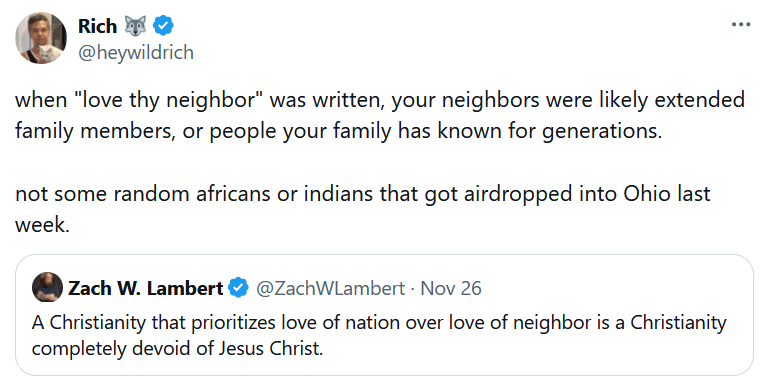
For context, Zach Lambert is a self-proclaimed “Post-Evangelical,” which basically means he’s a liberal Christian with “progressive” theological positions. I don’t recommend Zach as a source for sound Biblical doctrine. But let’s ignore him for a moment and focus on his point. He says true Christians should not love their nation more than they love their neighbor.

This refers to the words of Jesus Christ, who said that the second-greatest commandment is to “love your neighbor as yourself” (Mark 12:31). There is no command in the Bible to love your nation. It’s not wrong to love your nation, but it seems pretty clear that loving your neighbor is more important. On this, at least, I can agree with Zach.

Rich challenges this notion. He asserts that the context of “love your neighbor” in the Bible was back when your “neighbors” were people you knew well or were related to. As many have pointed out, this is nonsense. If he read the passage he’s talking about, he would quickly realize how wrong he is. Let’s take a look.

“He, desiring to justify himself, said to Jesus, ‘And who is my neighbor?’ Jesus replied, ‘A man was going down from Jerusalem to Jericho, and he fell among robbers, who stripped him and beat him and departed, leaving him half dead. …a Samaritan, as he journeyed, came to where he was, and when he saw him, he had compassion. … Which of these…proved to be a neighbor to the man who fell among the robbers?’ He said, ‘The one who showed him mercy.’ And Jesus said to him, ‘You go, and do likewise.'”
— Luke 10:29-30, 33, 36-37 (ESV)

A man in the crowd asks Jesus “Who is my neighbor?” This is an important question, but the answer isn’t as simple as “family” or “people who live near you.” No, instead Jesus answers in the form of a parable which demonstrates a fuller meaning.

The principle character in this parable is a Samaritan. This was a people group living near Israel in the time of Christ. Their ancestors were part of the Northern Kingdom of Israel, which fell in 721 B.C. when the Assyrians attacked.1 Some were led off to Assyria, but those who stayed intermarried with foreigners and eventually became known as the Samaritans. The Jews considered them half-breeds. They hated each other.

Jesus specifically picks out a hated enemy of the Jews to be the protagonist of his story, the one who puts aside racial and national divides in order to show kindness to a man in need. This is in stark contrast to the religious leaders in Jesus’ parable who step over the man on the road. They’re shown to care less about following the second-greatest commandment than a lowly Samaritan, a great offense to those listening to Jesus. The Jews saw themselves as superior, as garnering God’s favor purely based on their heritage. How wrong they were.

Rich is essentially the man who questions Jesus. He refuses to accept that certain people groups are worthy of our love as Christians (though he himself doesn’t claim to be a Christian, interestingly). We have to draw the line somewhere, he thinks. I’ll love my family and other Americans, but not the “random africans or indians that got airdropped into Ohio last week” as he so eloquently puts it. No, Rich. God wants you to love them too. He would have you love even your most hated enemy.

“But I say to you who hear, Love your enemies, do good to those who hate you.”
— Luke 6:27 (ESV)

Between the Lines & Outside the Context

But here’s where I must take a step back and look at the bigger picture. This isn’t just about who you show love to in your daily life. This isn’t just about moral principles. Rich is getting at something different. Ironically, so is Zach. They’re bringing connotations of foreign policy into this discussion. And that’s certainly NOT something Jesus was talking about in his parable. This is essential to point out.

It’s a common trend nowadays for liberal Christians (like Zach) to take the Bible out of context in an attempt to force the Scriptures to support their positions on all sorts of societal, economic, and political issues. “Jesus was a socialist,” they might say. “The early church is an example of Communism,” they might say. It’s all lies. There’s a world of difference between Jesus’ actual teachings and his theoretical position on which laws should be passed relating to mass immigration or wealth redistribution. We must be careful to rightly divide the words of God.

“Do your best to present yourself to God as one approved, a worker who has no need to be ashamed, rightly handling the word of truth.”
— 2 Timothy 2:15 (ESV)

The question is not, “How can I apply Jesus’ words to foreign policy?” This is an improper use of Scripture called “eisegesis,” in which we attempt to inject our own ideas into the Bible. No, instead we ought to ask, “What was Jesus trying to say here?”

The answer seems to relate to the way Jesus’ audience, the Jews, conducted themselves in their daily lives. They might encounter people they despise, but Jesus tells them to show love regardless. They might have enemies, but Jesus tells them to show love regardless. Jesus was NOT trying to advocate for any kind of foreign policy position. He wasn’t aligning himself with any law. He wasn’t rebuking or affirming Rome’s authority in how it managed borders. Those are completely separate issues.

It’s perfectly acceptable to vote for strong borders while obeying Jesus’ command to love your neighbor. There are very good practical reasons for the government to regulate immigration, especially with how many widespread problems have arisen from lax policies as of late. Our “neighbors” are not just foreigners, but also our fellow Americans. Voting for strong borders is a form of loving our neighbors. At the same time, it’s imperative that we imitate Christ in how we treat any and all people we come across in our daily lives as Americans. If we see immigrants, we should love them. They are our “neighbors,” as Jesus makes clear to us.

Is this a contradiction? No, it is not. Whatever situation we find ourselves in, we obey Christ in loving our neighbors, even if the situation is not ideal. But that does not imply that we should actively seek to tear down our borders and invite everyone into America. Those are two completely different things. In the same way, we should trust God to provide for our needs, but this does not mean we should neglect to use the resources God provides. “Jesus take the wheel,” we say as we press on the gas with our eyes closed. “I gave you a steering wheel for a reason!” God replies as he shakes his head in disappointment.

It’s also worth pointing out that the man on the road was genuinely in need. Many immigrants are in need, but many are not. In fact, some are dangerous and should be refused entry regardless.2 Jesus certainly didn’t mean to imply that loving your neighbor means inviting criminals into your home. Locking up criminals, no matter where they come from, is not opposed to Jesus’ command to love your enemy. It’s just another way governments keep the peace and protect their citizens. This is entirely appropriate and consistent with how Paul talks about the purpose of government in Romans 13:1-7.

Another potential connotation in Zach’s post is a disagreement with “Christian Nationalism,” which I go over in detail here. I’m not certain this was his intention, but it seems likely. Suffice to say that Christian Nationalism is not Biblical, but that doesn’t give Zach a pass. Many Christian Nationalists want to bring patriotism (love of country) back. I don’t have a problem with patriotism. I have a problem with uniting the church and the state. Again, see my other post for more details. The only point on which I can confidently agree with Zach is the idea that no Christian should love his nation more than he loves his neighbor. Jesus is clear on this.

Conclusion

I do believe it is my responsibility as a Christian to show love and kindness to all people, whether they are an African immigrant or a close friend. The Christian faith has no racial or national boundaries. We ought to be evangelizing to all people as well. At the same time, I will openly advocate for strong borders in America. Most civilized countries around the world also want strong borders. This is not racist or hateful. It is simply a reality in properly governing a country and keeping citizens safe.

Don’t go looking for foreign policy from Jesus’ parables. Don’t go looking for Christian insights from an unbeliever like Rich. Don’t go looking for sound doctrine from a “Post-Evangelical” like Zach. Read Christ’s words on his own terms. Follow wise counsel from leaders in your local church who imitate Christ in their daily lives. Vote for policies that promote the safety and prosperity of the nation. But do not cling to race or national identity or social justice. Cling to Christ.

Let me know your thoughts in the comments below. Enter your email to be notified for my next post. Thanks for reading. Godspeed.

Processing…
Success! You're on the list.

Sources:

  1. Roat, Alyssa. “Who Were the Samaritans.” Bible Study Tools. May 17, 2024. https://www.biblestudytools.com/bible-study/topical-studies/the-samaritans-hope-from-the-history-of-a-hated-people.html
  2. Conklin, Audrey. “Laken Riley trial highlights Biden-era immigration crisis as mom of slain cheerleader awaits justice.” Fox News. November 21, 2024. https://www.foxnews.com/us/laken-riley-trial-highlights-biden-era-immigration-crisis-mom-slain-cheerleader-awaits-justice


Were Early Americans Christian Nationalists?

In my first post about Christian nationalism, I talked about how everyone’s definition is different. So before we get started, I want to make it clear that today I’ll be discussing Christian nationalism in the sense of a top-down, authoritarian approach to aligning a nation’s laws with the Bible.

The people who want this kind of government today in the United States usually view early America through rose-colored glasses. They love the idea of returning to the 1800s when everyone was Christian and nobody questioned how many genders there were. Don’t get me wrong, I get it. I’m sick and tired of postmodernism too. But it’s naive to think that early America was some kind of ideal Christian nationalist society.

A Christian Culture?

It is true that the vast majority of early Americans identified as Christian. As one might expect, this led to leaders, policies, and ways of living that reflected traditional Christian values to some extent. But make no mistake, this was still a country rife with sin. The true, invisible church has always been a minority.

“Enter by the narrow gate. For the gate is wide and the way is easy that leads to destruction, and those who enter by it are many. For the gate is narrow and the way is hard that leads to life, and those who find it are few.” — Matthew 7:13-14 (ESV)

Most people who call themselves Christians in an accepting society are not bonafide believers. They’re nominal Christians—Christian in name only. They might believe in good moral principles. They might go to church. They might even read their Bible. But none of this makes you a Christian. Only by truly believing in Jesus Christ and his sacrifice for you on the cross can you be saved.

“But,” I hear you say, “even if the true church was the minority, wouldn’t you rather live in a society full of nominal Christians than a society full of degenerates?” Not really. I’d rather evangelize to people who don’t know Christ than people who’ve been deluded into thinking they’re Christians because they attend church. Sure, living in a society accepting of Christians is more comfortable for me, but we are not promised comfort and it’s not our end goal as Christians. Regardless, it’s not our decision how people behave because we cannot control what people believe.

The Founding Fathers Rejected Christian Nationalism

You see, early America had this thing called the First Amendment. In part, it reads: “Congress shall make no law respecting an establishment of religion, or prohibiting the free exercise thereof.”

The founding fathers had various perspectives on religion. Many were deists or Unitarians. Some were devout Christians.1 But in the end, they agreed that freedom of religion was necessary and a state church was a bad idea. This philosophy traces its origins back to the Anabaptist movement.2 It also flies in the face of Christian nationalism, which proposes that we revoke this freedom in favor of an exclusively Christian state. The harsh reality is that the founding fathers rejected this notion, though their writings were still clearly inspired by Christian principles.

Some will argue that because everyone identified as Christian at the time, the founding fathers really only wanted freedom of denomination, not freedom of religion. This might make some degree of sense at first glance. We should interpret the founding documents according to their historical context, right? Well, maybe, but not to the degree that we completely change the meaning of the original text. The First Amendment makes no distinction about denominations. It addresses religion. To those who still disagree, I would ask you this: Do you think the Second Amendment is only supposed to apply to old-fashioned muskets? Of course not. It addresses the right to bear arms. This doesn’t change with the times. Neither does the First Amendment change with the times.

Early Americans Fled Christian Nationalism

Why did the founding fathers value freedom of religion? Well, it goes back to the settlers who came over on the Mayflower. Not to be confused with the British settlers who founded Jamestown to expand the Crown, these Pilgrims were fleeing a form of “Christian nationalism” back home. They were sick of being persecuted for their beliefs by the Church of England. We talked in my last post about the dangers of giving governmental power to any specific branch of Christianity. You end up with one group of Christians condemning another group of Christians as heretics and bringing down the full force of the state upon them. This is not the way of Christ.

“Some indeed preach Christ from envy and rivalry, but others from good will… What then? Only that in every way, whether in pretense or in truth, Christ is proclaimed, and in that I rejoice.” — Philippians 1:15, 18 (ESV)

Paul is not too concerned with those preaching Christ from wrong motives. In Mark 9:38-41, Jesus tells the apostles not to worry about separate groups of people casting out demons in his name. I get the feeling that Jesus does not look down kindly on the horrific violence between “Christian” governments throughout history.

From Christian Colonies to Free States

The Puritans who founded the Massachusetts Bay Colony were much closer to being Christian nationalists. They also fled religious persecution, but they sought to create explicitly Christian commonwealths under England to demonstrate that their beliefs were superior to the state church they escaped. They had laws against committing adultery, committing blasphemy, and ignoring the Sabbath. The punishment in many cases was death, after one or two strikes.3 Remember, this is when Christianity had its strongest influence on the civil order of society.

From the Library of Congress:

“The religious persecution that drove settlers from Europe to the British North American colonies sprang from the conviction, held by Protestants and Catholics alike, that uniformity of religion must exist in any given society. This conviction rested on the belief that there was one true religion and that it was the duty of the civil authorities to impose it, forcibly if necessary, in the interest of saving the souls of all citizens. … The dominance of the concept … meant majority religious groups who controlled political power punished dissenters in their midst.”4

The colonial era saw plenty of Christian-on-Christian persecution. This time, it was between Protestant groups over denominational differences. Whichever group had the most influence in a region bullied minority groups until they submitted or fled. And if you were Catholic, you could expect even worse treatment. We don’t want to go back to these times. It wasn’t the utopia many believe it was. I much prefer the mentality of the founding fathers, who in the course of creating one of the best countries in the world, implemented some of the strongest protections for human rights and freedom for all.

“Be kind to one another, tenderhearted, forgiving one another, as God in Christ forgave you.” — Ephesians 4:32 (ESV)

The Christian influence on America didn’t stop with the founding fathers, however. Laws in various states relating to Christian principles persisted through the 19th century, such as religious requirements to hold public office. But by the 20th century, the Supreme Court was striking down these discriminatory laws, the separation of church and state saw more support, and public opinion shifted towards humanism. Today, some of these laws remain on the books, but they’re never enforced.

Conclusion

As you can see, there’s a lot of nuance in the history of American Christianity. The Pilgrims sought to separate from the Church of England so they could worship in peace. The Puritans fled from persecution under Christian nationalism, only to establish their own version of it. The founding fathers enshrined freedom of religion in our Constitution, but the public continued to uphold Christian values in the fabric of society for many decades. Now, we’re seeing the continual downfall of Christian influence on American life. Many long for the old days, and I can see why. But it’s important that we not forget the lessons our history has taught us.

1. Implicit Christian influence has always led to a healthier society. It’s impossible to deny the positive cultural effect that a majority Christian opinion can have on a nation.

2. Explicit Christian authority has always led to persecution and oppression, whether it’s the Church of England against the Pilgrims, the Protestant settlers against each other, or both Protestants and Catholics against the Anabaptists.

I’m very thankful that the founding fathers established freedom of religion. It’s why I can drive past so many different denominations worshiping peacefully on the way to my own church with its specific beliefs and traditions. It’s why none of us have to fear for our lives when we change our minds about certain doctrines or secondary issues. It’s why we still have the power to openly preach the gospel to our neighbors despite the fact that most of our nation has fallen so far from God. I’m proud to be an American.

Let me know your thoughts in the comments below. Enter your email to be notified for my next post. Thanks for reading. Godspeed.

Processing…
Success! You're on the list.

Sources:

  1. Stratton, Eleanor. “Founders’ Vision of Religious Freedom.” U.S. Constitution.net. May 23, 2024. https://www.usconstitution.net/founders-vision-of-religious-freedom/
  2. Verduin, Leonard. That First Amendment and The Remnant, The Christian Hymnary, 1998.
  3. Smith, Sarah M., Tucker, Ellen D., Tucker, David. State (Colonial) Legislatures>Virginia House of Burgesses & William Penn. “Laws, Rights, and Liberties Related to Religion in Early America: Articles, Laws, and Orders, Divine, Politic, and Martial for the Colony in Virginia.” December 31, 1610. https://teachingamericanhistory.org/document/laws-rights-and-liberties-related-to-religion-in-early-america/
  4. America as a Religious Refuge: The Seventeenth Century, Part 1.” The Library of Congress. https://www.loc.gov/exhibits/religion/rel01.html

The Insanity of the Pro-Choice Agenda

“For you formed my inward parts; you knitted me together in my mother’s womb. I praise you, for I am fearfully and wonderfully made. Wonderful are your works; my soul knows it very well. My frame was not hidden from you, when I was being made in secret, intricately woven in the depths of the earth. Your eyes saw my unformed substance; in your book were written, every one of them, the days that were formed for me, when as yet there was none of them.”

Psalm 139:13-16 (ESV)

In two days, a bill called the “Women’s Health Protection Act” will go to a vote in the US Senate. Sounds pretty great, right? Shockingly enough, this bill has nothing at all to do with protecting health. It’s specifically designed to guarantee immunity for murder. And don’t worry, there’s a nice helping of virtue signaling in there as well.

The pro-abortion act was passed by the House of Representatives last September. It came shortly after Texas implemented new restrictions on abortion. With a pro-life majority on the Supreme Court, which declined to interfere with the Texas law, there’s real hope that Roe v. Wade might be overturned in June of this year. The death cult is scared, but they aren’t going down without a fight. Even though it’s expected not to make it past the Senate, this new bill is a perfect representation of just how insane the “pro-choice” agenda has become in 2022.

Don’t take my word for it. I encourage you to read through the act in its entirety here. I will be referring to specific sections to give you the highlights. Let’s begin.

Abortion services are essential to health care and access to those services is central to people’s ability to participate equally in the economic and social life of the United States.1

In the span of one sentence, murder has been justified not only as “health care,” but as a key component of equality. This is blatant propaganda of Orwellian proportions. It borders on an eliminationist mockery of feminism, declaring that women can only truly be equal with men when they offer up their children to be slaughtered in cold blood. If you believe all people are created equal, as is stated in our Declaration of Independence, it’s impossible to propose that women are lesser without the freedom to murder their offspring; it’s beyond any shred of reason to simultaneously hold that the worth of a child’s life is dependent on whether he or she is wanted.

Reproductive Justice is a human right that can and will be achieved when all people… have the economic, social, and political power and resources to define and make decisions about their bodies, health, sexuality, families, and communities in all areas of their lives, with dignity and self-determination.2

Ah yes, it wouldn’t be a leftist propaganda piece without some good old social justice. Not only do they frame murder as a tenet of feminism and equality, but now they have the audacity to invent a phrase to get the idea across that they’re really, definitely the good guys here. After all, who could disagree with justice?

The funny thing is that in avoiding the question, they beg another more gruesome one. They claim abortion is about granting people the power to make decisions about their bodies. Rather than address whether or not abortion is murder, they insist that this is only about the power of the individual. They miss the point entirely by pretending unborn children are only organs of the mother, but what’s worse are the implications. They specify families and communities here. Are they insinuating that mothers have the right to slice through their relatives and neighbors until the world is to their liking? They would say no, I’m sure. But the language is pretty damning. Perhaps they should hire proofreaders.

Pro-Life is Racist?

Reproductive justice seeks to address restrictions on reproductive health, including abortion, that perpetuate systems of oppression… white supremacy, and anti-Black racism. This violent legacy has manifested in policies including enslavement, rape, and experimentation on Black women; forced sterilizations; medical experimentation on low-income women’s reproductive systems; and the forcible removal of Indigenous children. Access to… abortion services, has always been deficient in the United States for Black, Indigenous, and other People of Color (BIPOC).3

Whew, that’s a lot of desperation in a single paragraph. You can almost see them begging at the feet of minorities to approve of their violent crusade. This paragraph, like many others, was entirely unnecessary for “abortion rights” to be preserved as a result of this bill. They chose to add it for political reasons. They couldn’t just advocate for murder. They had to imply that anyone opposing their bloody tirade is a racist complicit in rape, slavery, and forced sterilization.

Let’s take a look at the logic for a moment. The claim? Restrictions on abortion perpetuate racism. The evidence? “Policies including enslavement, rape, and experimentation on Black women…” The list goes on. None of these “policies” exist today. By their own admission, they’re trying to fix something that isn’t broken. It’s all empty ramblings. The only thing in this list that’s somewhat relevant today in America is the “forcible removal of Indigenous children.” In a stunning turn of events, they’ve suddenly decided to defend the rights of young ones, but only if they’re brown and only to exploit their existence for political clout. If that isn’t the very definition of racism, I don’t know what is. This is not to mention that even with control over the House and the presidency, Democrats still haven’t done anything to reverse the “kids in cages” problem at the border that has existed since the Obama era. The hypocrisy is pungent.

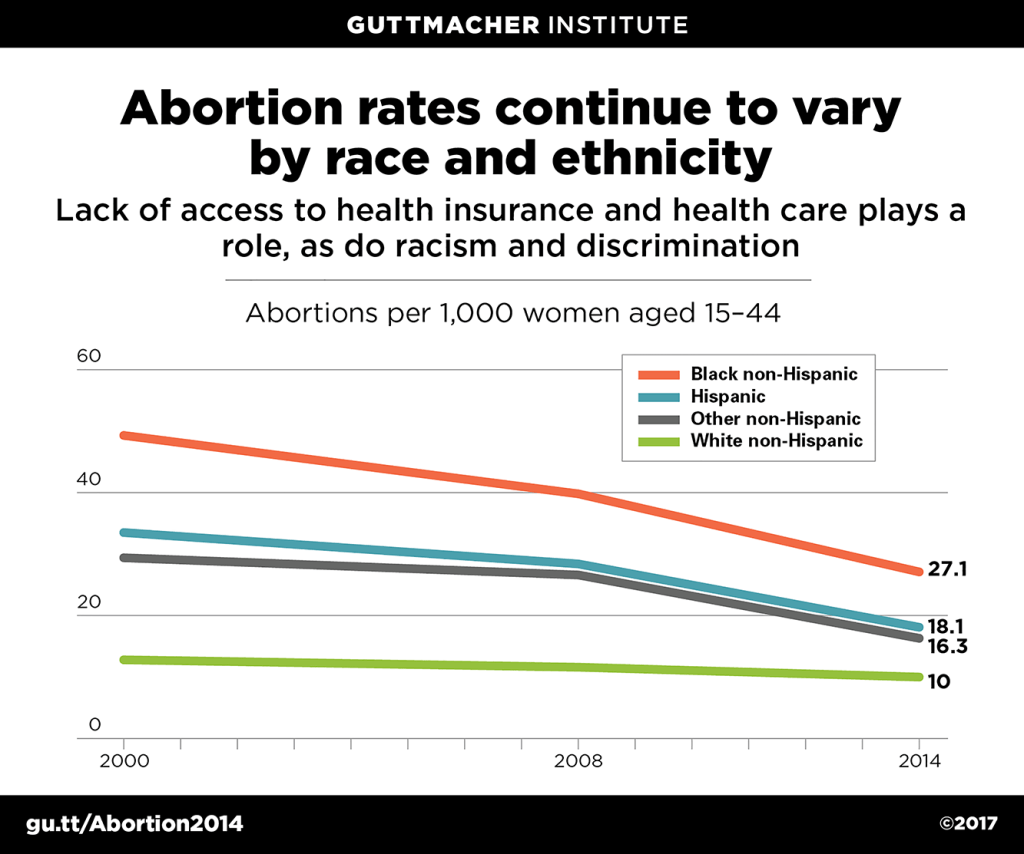
Lastly, they claim that access to abortion has “always been deficient” for minorities in the US. This is simply not true. Let’s take a look at this infographic by the pro-abortion group, Guttmacher Institute.

They claim there’s a horrible problem with income inequality, racism, and discrimination as it relates to abortion. Then they show us the data. As it turns out, white women have the fewest abortions per capita! Minorities have far more abortions. It doesn’t seem like they’re having much trouble finding people to kill their babies for them, even assuming they have less access to necessary funds and available clinics.

Now, I’m not ignorant of their intentions here. They don’t want you to look at the number of abortions per capita. They want you to notice that the rate of decline over time is slowest for white people. Their hypothesis is that the boogeyman of “systematic racism” is somehow cutting off access to abortion (and/or birth control) for minorities. They couldn’t imagine any other alternative, least of all that minorities are just choosing to have fewer abortions for personal reasons. Culture isn’t homogeneous and attributing an effect to a cause without evidence is bad science.

The legacy of restrictions on reproductive health, rights, and justice is not a dated vestige of a dark history. Presently, the harms of abortion-specific restrictions fall especially heavily on people with low incomes, BIPOC, immigrants, young people, people with disabilities, and those living in rural… areas.4

Ah, it seems they anticipated my objection that the evils they wrongfully attribute to pro-lifers are irrelevant to modern times. Unfortunately, they’ve forgotten to list any evidence. What a shame. We only get more empty words.

Don’t Forget Trans People!

The terms “woman” and “women” are used in this bill to reflect the identity of the majority of people targeted and affected by restrictions on abortion services… which are rooted in misogyny. However, access to abortion services is critical to the health of every person capable of becoming pregnant. This Act is intended to protect all people with the capacity for pregnancy—cisgender women, transgender men, non-binary individuals, those who identify with a different gender, and others.5

That’s right. They have to satisfy every possible gender-obsessed group they can think of. That includes trans people. But the funny thing is, in appealing to a tiny minority of their audience, they alienate the vast majority. Women are getting tired of confused men intruding on their spaces and identity, removing femininity from language and culture in favor of politically correct androgyny. What ever happened to feminism?

It reminds me of what happened to J.K. Rowling. She preached feminism for years and was loved by the left. When she saw the insanity of the trans movement, she stood by real women in refusing to change her language or her beliefs. She’s since been canceled by the very people who once championed her cause. These days, it’s not enough to be liberal. It’s not enough to be feminist. It’s not enough to advocate for abortion. You have to say men are women. Men can get pregnant. Men can be oppressed by abortion restrictions. I’m again reminded of Orwell’s 1984. Truth is stranger than fiction.

Here are a couple more quotes that stood out to me. “Abortion is essential health care and one of the safest medical procedures in the United States.”6 Murder is safe and essential? Makes sense to me! “International human rights law recognizes that access to abortion is intrinsically linked to the rights to life, health, equality and non-discrimination, privacy, and freedom from ill-treatment.”7 Abortion is linked to the right to life? That’s the saddest thing I’ve heard all day. Also, pro-lifers are apparently anti-privacy now. I wasn’t aware of that one.

Conclusion

I know I’m not changing anyone’s mind with this post. Those of you who support abortion probably can’t stand me. I’m comfortable with that. Those of you who are against abortion probably agree with me. My goal today was not to provide some amazing new insight on abortion itself. My goal was to highlight just how nuts this “pro-choice” movement has become in recent years, to reveal their true agenda. It’s not just about abortion anymore. It’s about changing language to accommodate insane mental gymnastics. It’s about attaching any and all oppression, past and present, to conservatives. It’s about elevating men who wish they were women above actual women.

Do you still think this is about “women’s health?”

Leave your answer in the comments below. Enter your email if you want to be notified when my next post goes live. Thanks for reading. Godspeed.

Processing…
Success! You're on the list.
  1. Section 2, (a), (1) of the Women’s Health Protection Act of 2021, H. R. 3755, 117th Cong. (2021)
  2. IBID, Section 2, (a), (4)
  3. IBID, Section 2, (a), (5)
  4. IBID, Section 2, (a), (6)
  5. IBID, Section 2, (a), (8)
  6. IBID, Section 2, (a), (11)
  7. IBID, Section 2, (a), (16)