
What Does it Mean to “Love Your Neighbor?”

Here’s the post that made me want to write this.
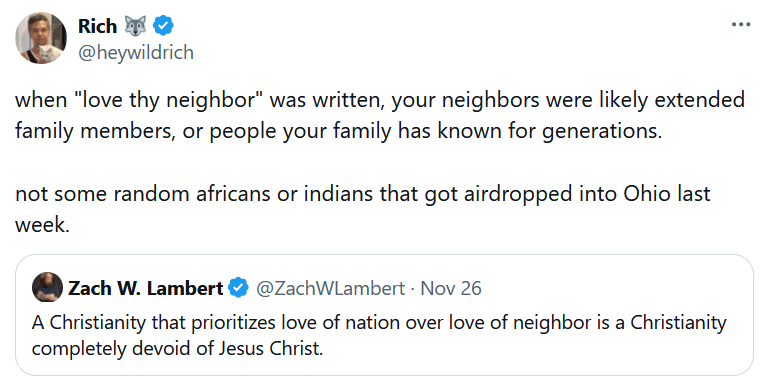
For context, Zach Lambert is a self-proclaimed “Post-Evangelical,” which basically means he’s a liberal Christian with “progressive” theological positions. I don’t recommend Zach as a source for sound Biblical doctrine. But let’s ignore him for a moment and focus on his point. He says true Christians should not love their nation more than they love their neighbor.

This refers to the words of Jesus Christ, who said that the second-greatest commandment is to “love your neighbor as yourself” (Mark 12:31). There is no command in the Bible to love your nation. It’s not wrong to love your nation, but it seems pretty clear that loving your neighbor is more important. On this, at least, I can agree with Zach.

Rich challenges this notion. He asserts that the context of “love your neighbor” in the Bible was back when your “neighbors” were people you knew well or were related to. As many have pointed out, this is nonsense. If he read the passage he’s talking about, he would quickly realize how wrong he is. Let’s take a look.

“He, desiring to justify himself, said to Jesus, ‘And who is my neighbor?’ Jesus replied, ‘A man was going down from Jerusalem to Jericho, and he fell among robbers, who stripped him and beat him and departed, leaving him half dead. …a Samaritan, as he journeyed, came to where he was, and when he saw him, he had compassion. … Which of these…proved to be a neighbor to the man who fell among the robbers?’ He said, ‘The one who showed him mercy.’ And Jesus said to him, ‘You go, and do likewise.'”
— Luke 10:29-30, 33, 36-37 (ESV)

A man in the crowd asks Jesus “Who is my neighbor?” This is an important question, but the answer isn’t as simple as “family” or “people who live near you.” No, instead Jesus answers in the form of a parable which demonstrates a fuller meaning.

The principle character in this parable is a Samaritan. This was a people group living near Israel in the time of Christ. Their ancestors were part of the Northern Kingdom of Israel, which fell in 721 B.C. when the Assyrians attacked.1 Some were led off to Assyria, but those who stayed intermarried with foreigners and eventually became known as the Samaritans. The Jews considered them half-breeds. They hated each other.

Jesus specifically picks out a hated enemy of the Jews to be the protagonist of his story, the one who puts aside racial and national divides in order to show kindness to a man in need. This is in stark contrast to the religious leaders in Jesus’ parable who step over the man on the road. They’re shown to care less about following the second-greatest commandment than a lowly Samaritan, a great offense to those listening to Jesus. The Jews saw themselves as superior, as garnering God’s favor purely based on their heritage. How wrong they were.

Rich is essentially the man who questions Jesus. He refuses to accept that certain people groups are worthy of our love as Christians (though he himself doesn’t claim to be a Christian, interestingly). We have to draw the line somewhere, he thinks. I’ll love my family and other Americans, but not the “random africans or indians that got airdropped into Ohio last week” as he so eloquently puts it. No, Rich. God wants you to love them too. He would have you love even your most hated enemy.

“But I say to you who hear, Love your enemies, do good to those who hate you.”
— Luke 6:27 (ESV)

Between the Lines & Outside the Context

But here’s where I must take a step back and look at the bigger picture. This isn’t just about who you show love to in your daily life. This isn’t just about moral principles. Rich is getting at something different. Ironically, so is Zach. They’re bringing connotations of foreign policy into this discussion. And that’s certainly NOT something Jesus was talking about in his parable. This is essential to point out.

It’s a common trend nowadays for liberal Christians (like Zach) to take the Bible out of context in an attempt to force the Scriptures to support their positions on all sorts of societal, economic, and political issues. “Jesus was a socialist,” they might say. “The early church is an example of Communism,” they might say. It’s all lies. There’s a world of difference between Jesus’ actual teachings and his theoretical position on which laws should be passed relating to mass immigration or wealth redistribution. We must be careful to rightly divide the words of God.

“Do your best to present yourself to God as one approved, a worker who has no need to be ashamed, rightly handling the word of truth.”
— 2 Timothy 2:15 (ESV)

The question is not, “How can I apply Jesus’ words to foreign policy?” This is an improper use of Scripture called “eisegesis,” in which we attempt to inject our own ideas into the Bible. No, instead we ought to ask, “What was Jesus trying to say here?”

The answer seems to relate to the way Jesus’ audience, the Jews, conducted themselves in their daily lives. They might encounter people they despise, but Jesus tells them to show love regardless. They might have enemies, but Jesus tells them to show love regardless. Jesus was NOT trying to advocate for any kind of foreign policy position. He wasn’t aligning himself with any law. He wasn’t rebuking or affirming Rome’s authority in how it managed borders. Those are completely separate issues.

It’s perfectly acceptable to vote for strong borders while obeying Jesus’ command to love your neighbor. There are very good practical reasons for the government to regulate immigration, especially with how many widespread problems have arisen from lax policies as of late. Our “neighbors” are not just foreigners, but also our fellow Americans. Voting for strong borders is a form of loving our neighbors. At the same time, it’s imperative that we imitate Christ in how we treat any and all people we come across in our daily lives as Americans. If we see immigrants, we should love them. They are our “neighbors,” as Jesus makes clear to us.

Is this a contradiction? No, it is not. Whatever situation we find ourselves in, we obey Christ in loving our neighbors, even if the situation is not ideal. But that does not imply that we should actively seek to tear down our borders and invite everyone into America. Those are two completely different things. In the same way, we should trust God to provide for our needs, but this does not mean we should neglect to use the resources God provides. “Jesus take the wheel,” we say as we press on the gas with our eyes closed. “I gave you a steering wheel for a reason!” God replies as he shakes his head in disappointment.

It’s also worth pointing out that the man on the road was genuinely in need. Many immigrants are in need, but many are not. In fact, some are dangerous and should be refused entry regardless.2 Jesus certainly didn’t mean to imply that loving your neighbor means inviting criminals into your home. Locking up criminals, no matter where they come from, is not opposed to Jesus’ command to love your enemy. It’s just another way governments keep the peace and protect their citizens. This is entirely appropriate and consistent with how Paul talks about the purpose of government in Romans 13:1-7.

Another potential connotation in Zach’s post is a disagreement with “Christian Nationalism,” which I go over in detail here. I’m not certain this was his intention, but it seems likely. Suffice to say that Christian Nationalism is not Biblical, but that doesn’t give Zach a pass. Many Christian Nationalists want to bring patriotism (love of country) back. I don’t have a problem with patriotism. I have a problem with uniting the church and the state. Again, see my other post for more details. The only point on which I can confidently agree with Zach is the idea that no Christian should love his nation more than he loves his neighbor. Jesus is clear on this.

Conclusion

I do believe it is my responsibility as a Christian to show love and kindness to all people, whether they are an African immigrant or a close friend. The Christian faith has no racial or national boundaries. We ought to be evangelizing to all people as well. At the same time, I will openly advocate for strong borders in America. Most civilized countries around the world also want strong borders. This is not racist or hateful. It is simply a reality in properly governing a country and keeping citizens safe.

Don’t go looking for foreign policy from Jesus’ parables. Don’t go looking for Christian insights from an unbeliever like Rich. Don’t go looking for sound doctrine from a “Post-Evangelical” like Zach. Read Christ’s words on his own terms. Follow wise counsel from leaders in your local church who imitate Christ in their daily lives. Vote for policies that promote the safety and prosperity of the nation. But do not cling to race or national identity or social justice. Cling to Christ.

Let me know your thoughts in the comments below. Enter your email to be notified for my next post. Thanks for reading. Godspeed.

Processing…
Success! You're on the list.

Sources:

  1. Roat, Alyssa. “Who Were the Samaritans.” Bible Study Tools. May 17, 2024. https://www.biblestudytools.com/bible-study/topical-studies/the-samaritans-hope-from-the-history-of-a-hated-people.html
  2. Conklin, Audrey. “Laken Riley trial highlights Biden-era immigration crisis as mom of slain cheerleader awaits justice.” Fox News. November 21, 2024. https://www.foxnews.com/us/laken-riley-trial-highlights-biden-era-immigration-crisis-mom-slain-cheerleader-awaits-justice
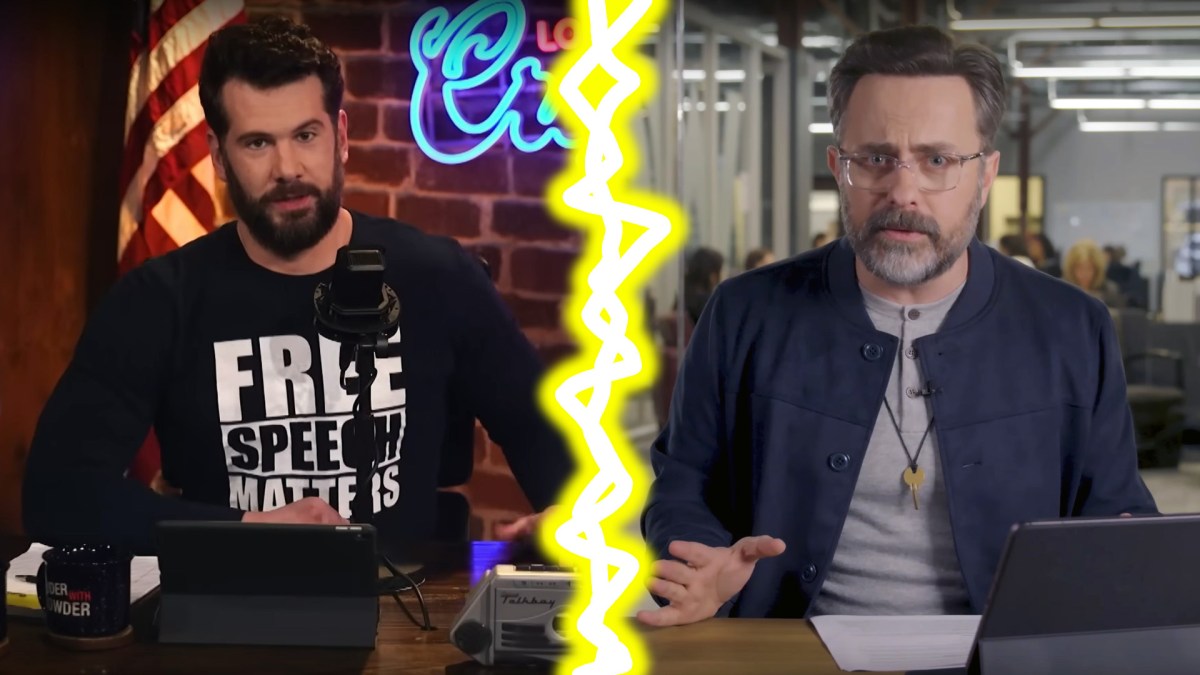
Steven Crowder VS. The Daily Wire — What’s Going On?

On Tuesday, January 17th, conservative talk show host Steven Crowder posted a YouTube video titled, “It’s time to stop…” He says he got an offer from an unnamed conservative media group punishing conservative voices on behalf of “big tech” like YouTube and Facebook. The document spells out the terms of payment, saying that demonetization on YouTube and other platforms would cut pay by 25%. Content strikes for not falling in line with community guidelines is another 20% cut. Being banned off a platform is yet another 10-20% cut. So what’s the problem here?

Crowder says that major players in the conservative movement or “big con,” as he puts it, are in bed with big tech. They’re silencing controversial ideas to make more money on ads. Crowder says he’s been demonetized for years on YouTube and yet he still makes his show, Louder with Crowder, using money from his paid subscribers called the “Mug Club.” He believes in his business model.

Crowder mentioned some other details in the offer that concerned him, including the demanding work schedule, the fact that the company would own the signer’s content and social channels, the high number of ad reads, and more payment cuts for failing to deliver a certain number of episodes per month.

Crowder closed by saying he’s looking to build his own network to support up and coming conservatives. He invited content creators to reach out if they want to partner with him against big tech and “big con.”

The Daily Wire’s Response

One day later, The Daily Wire uploaded a video titled, “Our Offer to Steven Crowder.” Jeremy Boreing, Co-CEO of the company, openly admits the offer came from them. He says he thinks it’s a very good offer, but that Crowder is misunderstanding it. He then goes through the document piece by piece, breaking down the reasoning behind it.

Boreing starts by saying that the offer was a way to open up negotiations, but Crowder was not interested in coming to any agreement. The offer was for $50 million over four years, which he emphasizes several times throughout the video.

Boreing then addresses one of Crowder’s criticisms, saying that the Daily Wire would own the signer’s social channels (aside from Twitter and Instagram) and content while they’re on the team. This is standard procedure for media companies. Part of making their money back is using the signer’s social media for monetization and promotion. He also defends their proposed pay cuts for failing to deliver a specified number of episodes per month. As Boreing puts it, “You can’t pay someone… an unimaginably huge amount of money for their show and then not get the show.”

Boreing then addresses Crowder’s accusation that The Daily Wire is in bed with big tech, saying the assertion is “personally incredibly offensive.” He says The Daily Wire gets demonetized all the time, but their audience and advertisers are on YouTube. It’s the platform that gives them (and Crowder) the best reach. Other platforms like Rumble are nowhere near as big and The Daily Wire hasn’t yet built up their own YouTube alternative. A project like that is a “long term investment,” he says.

Regarding the large pay cuts for demonetization, Boreing says it’s not about punishing content creators, but rather covering the costs of running a business. If a show brings in less money, The Daily Wire pays less money in turn. Boreing says Crowder fails to understand the business model and has “never had to create the company that actually distributes, markets, and monetizes all of that content.”

Boreing asks why it’s so hard for Crowder to “preserve the revenue” on free platforms like YouTube. After all, he could speak his mind freely on paid content such as DailyWire+ without fear of demonetization. Boreing compares this to Crowder’s current model where he will sometimes ask his audience to join him on Mug Club to talk about things that might get him banned from YouTube. But just Mug Club isn’t enough revenue for Boreing. “That’s not a risk that I can take,” he says. He concludes that Crowder’s actions are wrong and that he’s burning a friend in the process.

The Recorded Phone Call

Crowder quickly shot back with another video revealing clips from a phone call he had with Boreing. In it, Boreing can be heard discussing how young talent “can be wage slaves for a little bit” with a company like The Daily Wire before using their newfound fame to go independent.

Crowder accuses Boreing of focusing on the money when “it’s not about the money.” Crowder says it’s about the conservative movement and big tech. He’s concerned about up and coming talent facing these kinds of “slave” contracts. He then plays part of the phone call where he asks Boreing if pay cuts for demonetization would apply to smaller content creators, not just Crowder. Boreing says yes, retorting that everybody loses money when monetization goes away. “You can’t pay the same amount with less revenue.” Crowder can be heard responding, “You need to change your business model or this movement cannot work, Jeremy.”

Crowder says he understands that people like to run businesses differently, but he’s firmly opposed to relying on YouTube revenue as a conservative—so much so that he walked away from $50 million for the sake of those coming after him. He even offers to guide The Daily Wire into a scaled-up version of his own business model. He maintains that taking ownership of a creator’s content is wrong, even with Boreing’s retort that the media company paid to produce this content and should therefore own it. Speaking of plans for a network of his own, Crowder says he will never take ownership of any talent’s work, social channels, or YouTube revenue.

The Bottom Line

So, what’s my take on all of this? I think the disagreement is clear. The Daily Wire has built a successful business model that relies on YouTube revenue. They are not willing to part with it right now. This means they are unable to take on “controversial” talent like Crowder without using heavy pay cuts to make up for lost funds. This leads to softer, more advertiser-friendly content on free platforms like YouTube. The raw, unfiltered content is provided on their paid platform, DailyWire+. This doesn’t mean they’re out to exploit young conservatives and it also doesn’t mean they approve of YouTube’s policies. They just don’t see any other way forward right now.

Then you have Steven. He started out with YouTube revenue as a large part of his income. Over time, he realized he couldn’t rely on it. They demonetized him over and over, but he wasn’t going to censor himself to stay in YouTube’s good graces. Instead, he would fund his show using his own paid platform, Mug Club. His business model today is successful without Google’s money and he’s very proud of that. He believes that big tech’s censorship requires conservatives to cut ties with these platforms. The first step is being financially independent from them.

Both parties agree on a lot, but they draw the (bottom) line in two separate places. The Daily Wire draws the line at demonetization. If any YouTube revenue is lost, it must be met with pay cuts to compensate. Steven Crowder draws the line at getting banned from YouTube (for now). He’s already been demonetized for years and no longer relies on them for revenue. But whether he admits it or not, he still relies on them for exposure. Those viewers contribute significantly to his Mug Club subscriptions. Crowder knows this, but he continues to push hard for a future where sites like Rumble can replace YouTube as a primary platform for conservatives. He believes in cutting all ties with big tech eventually.

And so does Boreing at The Daily Wire, but he doesn’t think it’s realistic to expect that anytime soon. He wants to build alternatives like his own DailyWire+, but in the meantime, he is perfectly happy to play ball with YouTube so he can build his empire of impactful conservative brands and personalities. He wants to compete with big media companies like Disney and Netflix, providing an alternative economy, not just one show. He doesn’t think a subscription-based model like Crowder’s would work for this kind of venture.

Who’s in the Wrong?

Crowder and Boreing disagree on the long-term vision for conservatism. Crowder sees it as a battle for the heart of America where sacrifices must be made to preserve integrity at all costs. Boreing sees it as a strategic path towards true competition and dominance in the market that takes capital to achieve.

I applaud both of their goals, but I’ll be honest, I’m leaning towards Crowder on this one. Hear me out. I don’t think he went about this the right way. I think he’s been unnecessarily confrontational and dramatic about The Daily Wire’s offer. But he’s right about one thing. It’s long past due for conservatives to abandon big tech as much as they reasonably can. I think Crowder’s success with Mug Club and his record-breaking numbers on Rumble speak to the untapped potential of taking risks and exploring other ways to fund conservative voices while still reaching a large audience. I hate self-censorship. I hate that contracts with so many media companies are overreaching and sometimes exploitative (though The Daily Wire isn’t doing anything out of the ordinary in that regard).

At the same time, I appreciate The Daily Wire’s vision of providing more than just a show. We do need an alternative economy for conservatives. We need to fight the culture war, not just the media war. The left brainwashes our kids when they’re at school, when they look at their phone, and when they go to the movies. We need to fight back with alternative social platforms, conservative education, and movies that promote our values. The Daily Wire is doing that, and it takes a lot of money to make it happen. I only worry that they might lose their edge in the meantime.

Crowder has always been at the front lines of conservatism delivering hard hits and taking the brunt of the hate for controversial opinions. I love him for that. His content feels raw and real. The Daily Wire in comparison feels a bit sanitized and their content is less interesting to watch as a result. But that doesn’t mean it’s not important. Their documentary “What is a Woman” changed the conversation on the trans movement. A message of truth with that kind of impact is a huge win for conservatives. Crowder simply isn’t making those kinds of moves yet.

Nobody Wins

It’s sad to see infighting like this. It’s the last thing conservatives need right now. We’re a divided movement after disappointing midterms, looking ahead to a turbulent future of Trumpers versus RINOs. It’s tiring.

I don’t think Crowder will get the kind of reaction he’s going for. He’s stirring the pot and promoting his own brand at the cost of another. It’s going to rub people the wrong way no matter what. His demeanor is needlessly antagonistic. He makes a big deal out of walking away from $50 million when he admits he doesn’t even need it. But The Daily Wire isn’t innocent either. Boreing says $50 million is an “unimaginably huge amount of money.” That might be true for the average American, but in the media space it’s not the killer deal he makes it out to be. The Daily Wire is looking out for their own financial interests at the end of the day. Boreing has also framed this situation as a personal betrayal of friendship on Crowder’s part. Don’t be fooled. This isn’t Crowder attacking Boreing as an individual. It’s a business strategy and a disagreement about the future of the conservative movement as a whole. I hope both parties are able to look past the opportunity for clout and move forward. It’s what’s best for everyone.

Let me know your thoughts in the comments below. Enter your email if you want to be notified when my next post goes live. Thanks for reading. Godspeed.

Processing…
Success! You're on the list.