

Here’s the post that made me want to write this.
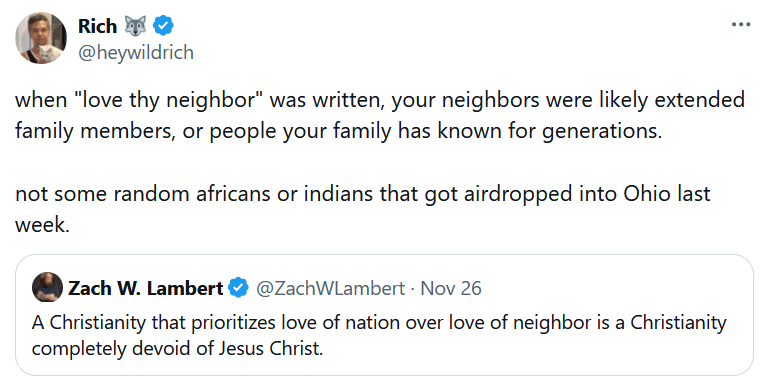
For context, Zach Lambert is a self-proclaimed “Post-Evangelical,” which basically means he’s a liberal Christian with “progressive” theological positions. I don’t recommend Zach as a source for sound Biblical doctrine. But let’s ignore him for a moment and focus on his point. He says true Christians should not love their nation more than they love their neighbor.
This refers to the words of Jesus Christ, who said that the second-greatest commandment is to “love your neighbor as yourself” (Mark 12:31). There is no command in the Bible to love your nation. It’s not wrong to love your nation, but it seems pretty clear that loving your neighbor is more important. On this, at least, I can agree with Zach.
Rich challenges this notion. He asserts that the context of “love your neighbor” in the Bible was back when your “neighbors” were people you knew well or were related to. As many have pointed out, this is nonsense. If he read the passage he’s talking about, he would quickly realize how wrong he is. Let’s take a look.
“He, desiring to justify himself, said to Jesus, ‘And who is my neighbor?’ Jesus replied, ‘A man was going down from Jerusalem to Jericho, and he fell among robbers, who stripped him and beat him and departed, leaving him half dead. …a Samaritan, as he journeyed, came to where he was, and when he saw him, he had compassion. … Which of these…proved to be a neighbor to the man who fell among the robbers?’ He said, ‘The one who showed him mercy.’ And Jesus said to him, ‘You go, and do likewise.'”
— Luke 10:29-30, 33, 36-37 (ESV)
A man in the crowd asks Jesus “Who is my neighbor?” This is an important question, but the answer isn’t as simple as “family” or “people who live near you.” No, instead Jesus answers in the form of a parable which demonstrates a fuller meaning.
The principle character in this parable is a Samaritan. This was a people group living near Israel in the time of Christ. Their ancestors were part of the Northern Kingdom of Israel, which fell in 721 B.C. when the Assyrians attacked.1 Some were led off to Assyria, but those who stayed intermarried with foreigners and eventually became known as the Samaritans. The Jews considered them half-breeds. They hated each other.
Jesus specifically picks out a hated enemy of the Jews to be the protagonist of his story, the one who puts aside racial and national divides in order to show kindness to a man in need. This is in stark contrast to the religious leaders in Jesus’ parable who step over the man on the road. They’re shown to care less about following the second-greatest commandment than a lowly Samaritan, a great offense to those listening to Jesus. The Jews saw themselves as superior, as garnering God’s favor purely based on their heritage. How wrong they were.
Rich is essentially the man who questions Jesus. He refuses to accept that certain people groups are worthy of our love as Christians (though he himself doesn’t claim to be a Christian, interestingly). We have to draw the line somewhere, he thinks. I’ll love my family and other Americans, but not the “random africans or indians that got airdropped into Ohio last week” as he so eloquently puts it. No, Rich. God wants you to love them too. He would have you love even your most hated enemy.
“But I say to you who hear, Love your enemies, do good to those who hate you.”
— Luke 6:27 (ESV)
Between the Lines & Outside the Context
But here’s where I must take a step back and look at the bigger picture. This isn’t just about who you show love to in your daily life. This isn’t just about moral principles. Rich is getting at something different. Ironically, so is Zach. They’re bringing connotations of foreign policy into this discussion. And that’s certainly NOT something Jesus was talking about in his parable. This is essential to point out.
It’s a common trend nowadays for liberal Christians (like Zach) to take the Bible out of context in an attempt to force the Scriptures to support their positions on all sorts of societal, economic, and political issues. “Jesus was a socialist,” they might say. “The early church is an example of Communism,” they might say. It’s all lies. There’s a world of difference between Jesus’ actual teachings and his theoretical position on which laws should be passed relating to mass immigration or wealth redistribution. We must be careful to rightly divide the words of God.
“Do your best to present yourself to God as one approved, a worker who has no need to be ashamed, rightly handling the word of truth.”
— 2 Timothy 2:15 (ESV)
The question is not, “How can I apply Jesus’ words to foreign policy?” This is an improper use of Scripture called “eisegesis,” in which we attempt to inject our own ideas into the Bible. No, instead we ought to ask, “What was Jesus trying to say here?”
The answer seems to relate to the way Jesus’ audience, the Jews, conducted themselves in their daily lives. They might encounter people they despise, but Jesus tells them to show love regardless. They might have enemies, but Jesus tells them to show love regardless. Jesus was NOT trying to advocate for any kind of foreign policy position. He wasn’t aligning himself with any law. He wasn’t rebuking or affirming Rome’s authority in how it managed borders. Those are completely separate issues.
It’s perfectly acceptable to vote for strong borders while obeying Jesus’ command to love your neighbor. There are very good practical reasons for the government to regulate immigration, especially with how many widespread problems have arisen from lax policies as of late. Our “neighbors” are not just foreigners, but also our fellow Americans. Voting for strong borders is a form of loving our neighbors. At the same time, it’s imperative that we imitate Christ in how we treat any and all people we come across in our daily lives as Americans. If we see immigrants, we should love them. They are our “neighbors,” as Jesus makes clear to us.
Is this a contradiction? No, it is not. Whatever situation we find ourselves in, we obey Christ in loving our neighbors, even if the situation is not ideal. But that does not imply that we should actively seek to tear down our borders and invite everyone into America. Those are two completely different things. In the same way, we should trust God to provide for our needs, but this does not mean we should neglect to use the resources God provides. “Jesus take the wheel,” we say as we press on the gas with our eyes closed. “I gave you a steering wheel for a reason!” God replies as he shakes his head in disappointment.
It’s also worth pointing out that the man on the road was genuinely in need. Many immigrants are in need, but many are not. In fact, some are dangerous and should be refused entry regardless.2 Jesus certainly didn’t mean to imply that loving your neighbor means inviting criminals into your home. Locking up criminals, no matter where they come from, is not opposed to Jesus’ command to love your enemy. It’s just another way governments keep the peace and protect their citizens. This is entirely appropriate and consistent with how Paul talks about the purpose of government in Romans 13:1-7.
Another potential connotation in Zach’s post is a disagreement with “Christian Nationalism,” which I go over in detail here. I’m not certain this was his intention, but it seems likely. Suffice to say that Christian Nationalism is not Biblical, but that doesn’t give Zach a pass. Many Christian Nationalists want to bring patriotism (love of country) back. I don’t have a problem with patriotism. I have a problem with uniting the church and the state. Again, see my other post for more details. The only point on which I can confidently agree with Zach is the idea that no Christian should love his nation more than he loves his neighbor. Jesus is clear on this.
Conclusion
I do believe it is my responsibility as a Christian to show love and kindness to all people, whether they are an African immigrant or a close friend. The Christian faith has no racial or national boundaries. We ought to be evangelizing to all people as well. At the same time, I will openly advocate for strong borders in America. Most civilized countries around the world also want strong borders. This is not racist or hateful. It is simply a reality in properly governing a country and keeping citizens safe.
Don’t go looking for foreign policy from Jesus’ parables. Don’t go looking for Christian insights from an unbeliever like Rich. Don’t go looking for sound doctrine from a “Post-Evangelical” like Zach. Read Christ’s words on his own terms. Follow wise counsel from leaders in your local church who imitate Christ in their daily lives. Vote for policies that promote the safety and prosperity of the nation. But do not cling to race or national identity or social justice. Cling to Christ.
Let me know your thoughts in the comments below. Enter your email to be notified for my next post. Thanks for reading. Godspeed.
Sources:
- Roat, Alyssa. “Who Were the Samaritans.” Bible Study Tools. May 17, 2024. https://www.biblestudytools.com/bible-study/topical-studies/the-samaritans-hope-from-the-history-of-a-hated-people.html
- Conklin, Audrey. “Laken Riley trial highlights Biden-era immigration crisis as mom of slain cheerleader awaits justice.” Fox News. November 21, 2024. https://www.foxnews.com/us/laken-riley-trial-highlights-biden-era-immigration-crisis-mom-slain-cheerleader-awaits-justice

 Veracity Quest