

There’s a new ideology lurking in the church. It might not seem like a threat. After all, it isn’t very widespread yet. But that’s part of what makes it dangerous. “Christian nationalism” is growing in large part thanks to vague duplicitous language that masks it as something innocuous. And the draw is strong for disillusioned young men who want to change the world for the better. But when you break it down, the logic falls apart. The morality is hollow. Christ is missing.
Before we get into it, let’s get our definitions straight. When I criticize “Christian nationalism,” I’m referring to the new movement of Christians advocating for the use of authoritarian power to enforce Christianity as the only permitted religion in the nation. The idea is to take back the culture by brute force from the top down and burn any “heretics” who stand in the way. These folks overlap significantly with Kinists, who justify racism by arguing that we’re supposed to “take care of our own” when it comes to tribe and skin color, not just family. If that doesn’t clear things up enough for you, click here to read my introductory post on the topic. Or try Samuel Say’s excellent breakdown.
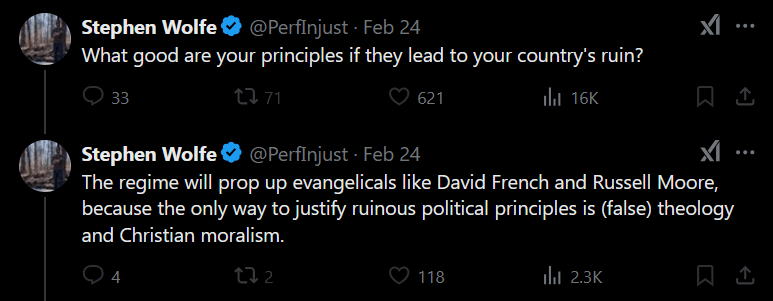
This post from X (Twitter) is what we’ll be discussing today.

Stephen Wolfe is the author of “The Case for Christian Nationalism” and a prominent voice in the movement. It should already be a red flag that he welcomes comparisons to psychopathic serial killers, but we’ll come back to that later. Wolfe advocates for an aggressive Christianity that isn’t afraid to take over the government and enforce God’s laws on all men. Here, he’s criticizing the comparatively passive worldviews proposed by figures such as Russell Moore.
Moore is the author of “Onward: Engaging the Culture without Losing the Gospel.” He stands against the Christian nationalism movement and instead longs for the days of the early church when Christians were on the back foot. He believes Christianity is incompatible with worldly political power and that we should concern ourselves with evangelism instead.
I agree with a lot of Moore’s points in his book, but I do not agree that we should be so passive as to refuse to engage in politics. As Christians, it is our responsibility to use whatever rights or abilities we have to push our culture and government towards what honors God and protects the advancement of the gospel. Moore also has some unsavory (read: left-wing) sources of funding for his work, but that’s another story.
I can agree with some criticism of Moore and French, but I cannot agree with Wolfe’s main point. He’s arguing that principles which lead to the ruin of your country are useless. This is faulty logic.
Post Hoc Ergo Propter Hoc
Let’s assume that our country has fallen into ruin and moral decay. What led us here? Wolfe seems to think it’s the fault of passive Christianity. But is that true?
No. Just because one thing follows another does not prove a causal link. Passive Christians did not advance secularism. They did not fight for abortion or the LGBTQ agenda or humanist reform in schools. They did not vote for the leaders who have done so much damage to our country. Passive Christians were attending church, spreading the gospel, and reading the Bible. None of this is wrong. None of this causes ruin. In fact, it promotes the exact opposite in our culture from the bottom up.
The disagreement is one of strategy—bottom up instead of top down. Moore and others believe in a hands-off approach to politics. We can talk all day about whether this is Biblical. But it is wrong to conclude that this approach is useless just because the secular culture around us has advanced over the years.
The world has always been full of sin. One could easily argue that “the good old days” never existed—that what we imagine as a truly Christian nation in our past was merely a facade of moralistic deism and good manners that we erroneously interpreted as the fruit of genuine faith in Christ.
This is not to say that morals or good manners are bad, only that they do not make a culture “Christian” any more than they make a person “Christian.” In this, I mostly agree with Moore. While America definitely has its roots in Christian values, it was never the bona fide “Christian nation” that Wolfe and others think it was. If anything, you’d have to attribute that label to the Puritan colonies before the USA was formed, and they had their own problems. I talk more about that here.
“Going to church doesn’t make you a Christian any more than going to McDonald’s makes you a hamburger!” — Keith Green
The “use” of passive Christian principles is in the advancement of the true and effectual gospel to hearts and minds, no matter what the culture decides to do. A few more saved souls are better than one “moral” nation without saved souls.
Let’s frame Wolfe’s statement another way.
“What use were the principles of the early church if they led to the fall of Rome?”
I hope you can see just how absurd this statement is. The early church did not contribute to the fall of early Rome. If anything, the early church might have delayed the fall somewhat. It’s hard to know for sure. But early Christians weren’t even trying to save Rome. They were trying to spread the gospel to the world.
This is the fundamental problem with Christian nationalism. It values cultural influence over the gospel. It values worldly power over the power of the Spirit. It values aesthetics over holiness. It values the world more than Christ.
Another Angle
Now, I know what you’re thinking. “That’s not Wolfe’s point! He’s just saying that passive Christian principles didn’t do enough to stop our country from coming to ruin.”
This more charitable interpretation still retains some of the same flaws. The premise of the argument makes no sense. In what universe is any set of principles “enough” to prevent a given culture from falling into moral decay? The cycle of governments, nations, and kings rising and falling has occurred since the dawn of time. Israel fell away from God over and over again. Which nation “did it right” exactly? The USA is very young itself; if even this great experiment has fallen too far, what hope is there?
The fallen, sinful nature of humanity prevents the possibility of a healthy, long-lasting government firmly established on Christian principles that avoids vague moralism and misguided religious violence. You cannot have an ideal society this side of heaven. It’s not going to happen.
But let’s assume for a moment that it is possible, or at least that preserving something better in America was possible. What principles could do that? Wolfe gives us an answer.

Well, it’s sort of an answer. Not really. You’d have to read Wolfe’s book to get a sense for his proposed principles (he basically wants a Christian king). For now, we get a theory.
Wolfe argues that political principles were ordained by God for our political good—therefore, these principles are sufficient and effective towards that end. Wolfe affirms the inverse as well. If your political principles are not sufficient and effective, then God didn’t ordain them, he says.
This is another way of saying, “Whatever works is right.” Wolfe is attempting to sanctify a relativistic practical morality. Why? Because it allows him to do whatever it takes to attain his goals. As long as it leads to a good end, then God must have ordained it! In other words, the end justifies the means. I hope I don’t have to explain the many problems with this.
No Country for Christian Men
Let’s stop for a second and ponder at the choice to reference Anton from “No Country for Old Men.” This character is a violent psychopath. Near the end of the film (spoilers), he has our protagonist at gunpoint. He’s won. He says, “If the rule you followed brought you to this, of what use was the rule?” That’s the line referenced in the image.
The writer of the movie is not proposing that Anton makes a great point here and morality should bend to whatever is most useful. The writer is using Anton as a tool to disillusion the protagonist and offer an observation to the audience. Good guys don’t always win. Sometimes evil prevails. In a world of unfeeling chaos, can justice and order really be preserved? What do we do with that? Do we follow our moral principles even if they lead us to the grave?
For the Christian, the answer is quite simple. Yes, we should do the right thing even if it “doesn’t work.” In the end, God wins. He has saved us and we will get to enjoy him forever in his eternal kingdom. The world isn’t just pure chaos. It’s God’s creation corrupted by sin, but it will be restored someday. The real question for Anton (and those who identify with him) is, “If the practical principles you follow send you to hell, of what use were those principles?”
Back to Wolfe
In addition to supporting moral relativism, Wolfe’s post also makes a sweeping judgement against passive Christianity and any other set of principles that “doesn’t work.” If it fails to preserve the nation (by Wolfe’s standard), then it must not have come from God. This is such an ignorant statement that it’s hard to know where to begin.
The early church did not prevent their countries’ ruin. Were their principles not ordained by God?
Where in the Bible would you even begin to argue that God promises us a Christian nation that won’t fail? Where are we instructed to create such a thing? To be sure, there are plenty of verses that say God blesses nations that obey him. There are plenty that affirm God’s ultimate rule over all nations. There are plenty that say all nations should bow down to God. But nowhere are we promised the possibility of an eternal Christian kingdom. Except…
“Then the seventh angel blew his trumpet, and there were loud voices in heaven, saying, ‘The kingdom of the world has become the kingdom of our Lord and of his Christ, and he shall reign forever and ever.'” — Revelation 11:15 (ESV)
The only government that will last is Christ’s coming kingdom.
“When the Son of Man comes in his glory, and all the angels with him, then he will sit on his glorious throne. Before him will be gathered all the nations, and he will separate people one from another as a shepherd separates the sheep from the goats.” — Matthew 25:31-32 (ESV)
The only “Christian king” who is incorruptible, who will judge the masses rightly, is Christ himself.
“They asked him, ‘Lord, will you at this time restore the kingdom to Israel?’ He said to them, ‘It is not for you to know times or seasons that the Father has fixed by his own authority. But you will receive power when the Holy Spirit has come upon you, and you will be my witnesses in Jerusalem and in all Judea and Samaria, and to the end of the earth.'” — Acts 1:6-8 (ESV)
When the disciples asked Jesus about establishing a kingdom on earth, he made it crystal clear that the time is not yet here. Christ will return. But in the meantime, we are not meant to make a shallow imitation of what we imagine that kingdom will be. We are not given power to physically conquer our enemies. No, we are to love our enemies (Matt 5:44, Rom 12:14, 19-21). That’s the scandal of the gospel. Paul says we are “more than conquerors” because nothing can separate us from God’s love; not death, not ruined nations, not anything (Rom 8:31-39). We are given power to be Christ’s witnesses to the ends of the earth. That is our mission.
Conclusion
In short, I reject the notion that an incorruptible Christian nation is possible in this age. I reject relativistic moral frameworks that propose the end justifies the means. I reject the idea that passive Christianity has contributed to the decline of morality in America. Yet I also condemn passive Christianity’s failure to engage meaningfully with the culture and government. I believe there’s a middle ground where we can fight for what’s right within the peaceful political systems that already exist.
Do not long for the coming kingdom so much that you forget where you are and what your mission is. Do not mistake earthly victory for spiritual victory. Spread the gospel. Pursue holiness. Uphold what is right by the good, righteous means God gives you. Imitate Christ. Be wary of heroes. They come and go. They are sometimes right and sometimes very wrong. But Christ will not fail you, and neither will his Word.
“May the God of peace himself sanctify you completely, and may your whole spirit and soul and body be kept blameless at the coming of our Lord Jesus Christ.” — 1 Thessalonians 5:23 (ESV)
Let me know your thoughts in the comments below. Enter your email to be notified of my next post. Thanks for reading. Godspeed.
 Veracity Quest
When Jesus spoke of peace he was referring to the peace that supersedes human comprehension and is affixed to the heart of the redeemed. Not the fleeting “peace” the world is seeking.
Very true.