The Turning Point

“The Lord tests the righteous, but his soul hates the wicked and the one who loves violence.”

— Psalm 11:5 (ESV)

On Wednesday, September 10th, 2025, Charlie Kirk was assassinated at the kickoff event of his “American Comeback Tour” at Utah Valley University.

He was a Christian.
He was a husband.
He was a father.
He was a patriot.

And they murdered him.

A single shot was fired from afar, hitting Charlie in the neck as he was in the middle of a peaceful conversation with a student regarding the rising violence of radical leftists.

Charlie has been warning about the growing trend of violent rhetoric on the left for some time now. Today, they proved him right.

Ironically, his legacy now has more power than ever before. They made him a martyr. They ensured that his name and ideas will ring out for generations to come. The young men and women watching this unfold today are becoming more emboldened than ever, more ready to fight if the fight is brought to them—and it most certainly has.

Mark my words. A reckoning is coming upon this nation. If you don’t see it now, you’ll see it in a few years. You’ll see it in the eyes of the young people growing up to be colder than they might have been, more determined than they might have been, less compromising than they might have been. This will be a defining moment for America.

The Best Of Us

Charlie wasn’t like other conservatives. He wasn’t in it for the money or the attention. He wasn’t a career politician. He wasn’t an atheist or an agnostic or even a religious person carrying the label begrudgingly. He was a genuine, outspoken, deeply passionate Christian who regularly advocated for evangelism and spiritual growth in America.

If you’re a conservative Christian reading this, there’s something you have to understand. Charlie wasn’t some kind of crazy radical. His beliefs were representative of the average conservative voter. He wasn’t a racist. He worked with and inspired people from all different backgrounds. He wasn’t hateful. He spoke with love and care, even to those he disagreed with the most. He was the purest among us, a real conservative actually fighting to conserve what’s right and true.

“What is so important to our country is to find our disagreements, respectfully, because when people stop talking, that’s when violence happens. People like me are facing violence, assaults from the left.”

— Charlie Kirk (source)

If they wanted him dead, what makes you think they see you any differently?

The only difference between you and Charlie is visibility. The only difference between you and Charlie is that he decided to get up and speak his mind.

He was making a difference, changing hearts and minds across the nation. He brought his confidence and conservative viewpoints to college campuses, the very places the left planted their flag of victory long ago. He made an impact they couldn’t ignore, and they knew it was impossible to stop his viral grassroots movement without resorting to violence.

We should be so bold as to make the enemies of truth and justice want to murder us. We should stand so tall and speak with such expertise as to be unbeatable without using a bullet. It’s easy to say, but extremely hard to live up to.

The Radical Left Celebrates

Thousands of leftists are celebrating Charlie’s death today. They’re giddy to see his blood spilled onto the ground. You think I’m lying, don’t you? You think it’s just a tiny minority of anonymous online accounts doing this. But you’re wrong. This is happening everywhere.

There’s a lot more where these came from. I’ve seen similar talk even from those I’ve known personally. These are people you might see on the street. Maybe they work in your local grocery store. Maybe you went to school with them. They’re posting from their public social media accounts tied to their jobs and communities. They aren’t afraid to show the world that they want conservative Christians like Charlie Kirk dead.

The only thing I have to say in response is an imprecatory Psalm, for anyone and everyone who dares curse Charlie’s name while his body is still warm and his wife and children in tears.

“He loved cursing—let it fall on him; he took no delight in blessing—let it be far from him. He wore cursing like his coat—let it enter his body like water and go into his bones like oil.”

— Psalm 109:17-18 (CSB)

Stay vigilant, fellow Christians. Be aware, fellow conservatives. Protect your family. Keep a watchful eye. Those who would seek to harm you and yours are acting upon their hatred more and more every day. Understand the times we are living in and act accordingly. Prepare for the worst. Pray for the best.

How to Keep Going

How do you move on from this? How do you go about your day knowing that thousands of people you thought of as fellow Americans would rejoice over your death? How do you keep fighting against such evil without giving in to violence yourself?

We must remind ourselves that the battle is not yet over. We have not lost. Charlie is closer now to his Lord than ever before. God’s judgement will come down upon the wicked; he will have the final say. Not just the murderer, but all those who praise wickedness will be punished according to their deeds. God is the great avenger.

“Vengeance and retribution belong to me. In time their foot will slip, for their day of disaster is near, and their doom is coming quickly.”

— Deuteronomy 32:35 (CSB)

Paul comments on this in Romans, urging his readers to—if possible—live peaceably.

“If possible, as far as it depends on you, live at peace with everyone. Friends, do not avenge yourselves; instead, leave room for God’s wrath, because it is written, ‘Vengeance belongs to me; I will repay,’ says the Lord.”

— Romans 12:17-19 (CSB)

And let us never forget that without God’s grace, each and every one of us would be destined for the lake of fire, and rightly so. Christ’s sacrifice on the cross is all that stands between us and judgement.

“All have sinned and fall short of the glory of God, and are justified by his grace as a gift, through the redemption that is in Christ Jesus”

— Romans 3:23-24 (ESV)

Another Psalm comes to mind. In it, we see David’s righteous anger and grief over the prevalence of the wicked.

“Oh that you would slay the wicked, O God! O men of blood, depart from me! They speak against you with malicious intent; your enemies take your name in vain. Do I not hate those who hate you, O Lord? And do I not loathe those who rise up against you? I hate them with complete hatred; I count them my enemies.”

— Psalm 138:19-22 (ESV)

But what is his conclusion?

“Search me, O God, and know my heart! Try me and know my thoughts! And see if there be any grievous way in me, and lead me in the way everlasting!”

— Psalm 138:23-24 (ESV)

He lays himself before God. He invites God’s pure and utter holiness to purge his heart of any and all sin. He invites God to attend to his every thought, ensuring that it is honoring to his Creator. He asks for God’s guidance along the path towards everlasting life.

We should do the same. Charlie would have wanted nothing less.

“Blessed are those who mourn, for they shall be comforted.”

— Matthew 5:4 (ESV)
Processing…
Success! You're on the list.

The Deadly Practicality of Christian Nationalism

There’s a new ideology lurking in the church. It might not seem like a threat. After all, it isn’t very widespread yet. But that’s part of what makes it dangerous. “Christian nationalism” is growing in large part thanks to vague duplicitous language that masks it as something innocuous. And the draw is strong for disillusioned young men who want to change the world for the better. But when you break it down, the logic falls apart. The morality is hollow. Christ is missing.

Before we get into it, let’s get our definitions straight. When I criticize “Christian nationalism,” I’m referring to the new movement of Christians advocating for the use of authoritarian power to enforce Christianity as the only permitted religion in the nation. The idea is to take back the culture by brute force from the top down and burn any “heretics” who stand in the way. These folks overlap significantly with Kinists, who justify racism by arguing that we’re supposed to “take care of our own” when it comes to tribe and skin color, not just family. If that doesn’t clear things up enough for you, click here to read my introductory post on the topic. Or try Samuel Say’s excellent breakdown.

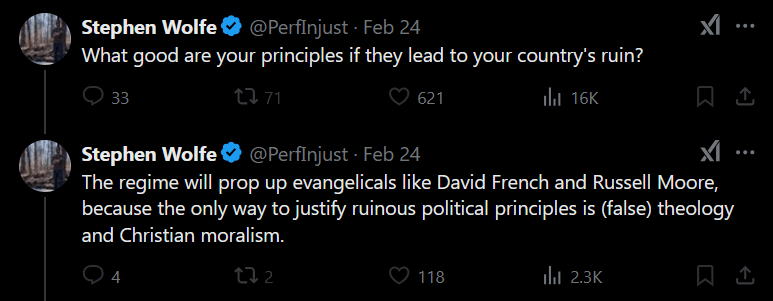
This post from X (Twitter) is what we’ll be discussing today.

Stephen Wolfe is the author of “The Case for Christian Nationalism” and a prominent voice in the movement. It should already be a red flag that he welcomes comparisons to psychopathic serial killers, but we’ll come back to that later. Wolfe advocates for an aggressive Christianity that isn’t afraid to take over the government and enforce God’s laws on all men. Here, he’s criticizing the comparatively passive worldviews proposed by figures such as Russell Moore.

Moore is the author of “Onward: Engaging the Culture without Losing the Gospel.” He stands against the Christian nationalism movement and instead longs for the days of the early church when Christians were on the back foot. He believes Christianity is incompatible with worldly political power and that we should concern ourselves with evangelism instead.

I agree with a lot of Moore’s points in his book, but I do not agree that we should be so passive as to refuse to engage in politics. As Christians, it is our responsibility to use whatever rights or abilities we have to push our culture and government towards what honors God and protects the advancement of the gospel. Moore also has some unsavory (read: left-wing) sources of funding for his work, but that’s another story.

I can agree with some criticism of Moore and French, but I cannot agree with Wolfe’s main point. He’s arguing that principles which lead to the ruin of your country are useless. This is faulty logic.

Post Hoc Ergo Propter Hoc

Let’s assume that our country has fallen into ruin and moral decay. What led us here? Wolfe seems to think it’s the fault of passive Christianity. But is that true?

No. Just because one thing follows another does not prove a causal link. Passive Christians did not advance secularism. They did not fight for abortion or the LGBTQ agenda or humanist reform in schools. They did not vote for the leaders who have done so much damage to our country. Passive Christians were attending church, spreading the gospel, and reading the Bible. None of this is wrong. None of this causes ruin. In fact, it promotes the exact opposite in our culture from the bottom up.

The disagreement is one of strategy—bottom up instead of top down. Moore and others believe in a hands-off approach to politics. We can talk all day about whether this is Biblical. But it is wrong to conclude that this approach is useless just because the secular culture around us has advanced over the years.

The world has always been full of sin. One could easily argue that “the good old days” never existed—that what we imagine as a truly Christian nation in our past was merely a facade of moralistic deism and good manners that we erroneously interpreted as the fruit of genuine faith in Christ.

This is not to say that morals or good manners are bad, only that they do not make a culture “Christian” any more than they make a person “Christian.” In this, I mostly agree with Moore. While America definitely has its roots in Christian values, it was never the bona fide “Christian nation” that Wolfe and others think it was. If anything, you’d have to attribute that label to the Puritan colonies before the USA was formed, and they had their own problems. I talk more about that here.

“Going to church doesn’t make you a Christian any more than going to McDonald’s makes you a hamburger!” — Keith Green

The “use” of passive Christian principles is in the advancement of the true and effectual gospel to hearts and minds, no matter what the culture decides to do. A few more saved souls are better than one “moral” nation without saved souls.

Let’s frame Wolfe’s statement another way.

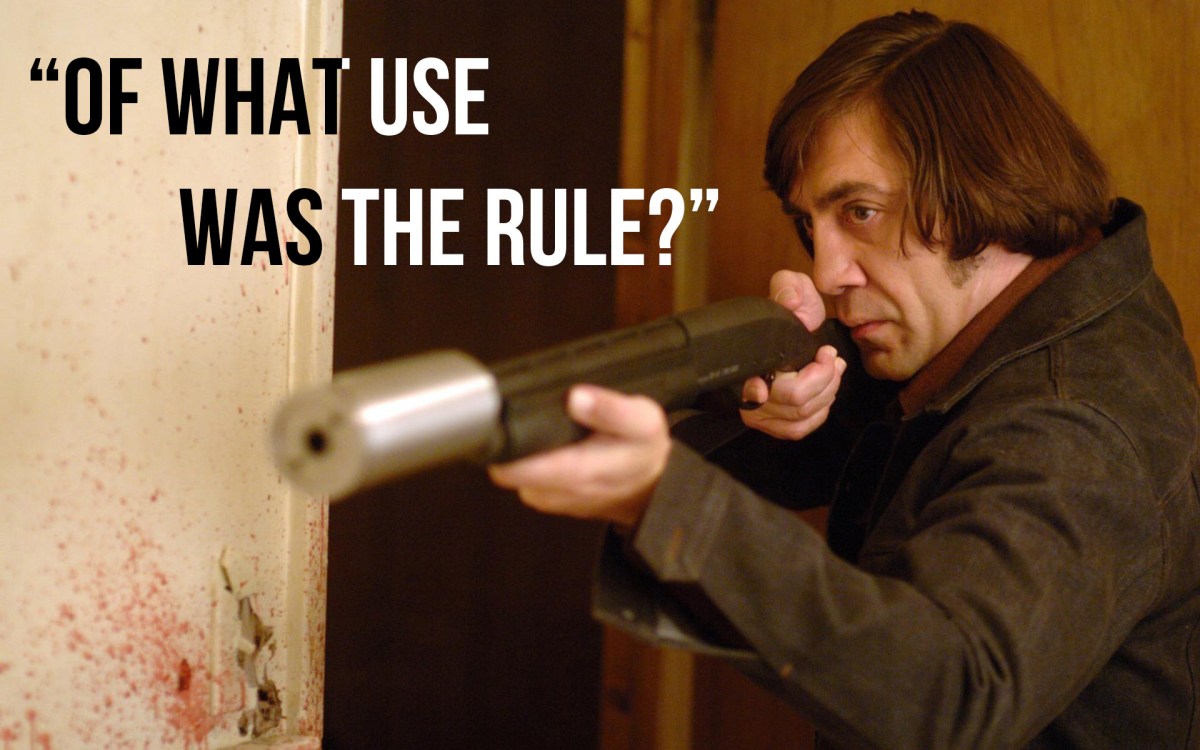
“What use were the principles of the early church if they led to the fall of Rome?”

I hope you can see just how absurd this statement is. The early church did not contribute to the fall of early Rome. If anything, the early church might have delayed the fall somewhat. It’s hard to know for sure. But early Christians weren’t even trying to save Rome. They were trying to spread the gospel to the world.

This is the fundamental problem with Christian nationalism. It values cultural influence over the gospel. It values worldly power over the power of the Spirit. It values aesthetics over holiness. It values the world more than Christ.

Another Angle

Now, I know what you’re thinking. “That’s not Wolfe’s point! He’s just saying that passive Christian principles didn’t do enough to stop our country from coming to ruin.”

This more charitable interpretation still retains some of the same flaws. The premise of the argument makes no sense. In what universe is any set of principles “enough” to prevent a given culture from falling into moral decay? The cycle of governments, nations, and kings rising and falling has occurred since the dawn of time. Israel fell away from God over and over again. Which nation “did it right” exactly? The USA is very young itself; if even this great experiment has fallen too far, what hope is there?

The fallen, sinful nature of humanity prevents the possibility of a healthy, long-lasting government firmly established on Christian principles that avoids vague moralism and misguided religious violence. You cannot have an ideal society this side of heaven. It’s not going to happen.

But let’s assume for a moment that it is possible, or at least that preserving something better in America was possible. What principles could do that? Wolfe gives us an answer.

Well, it’s sort of an answer. Not really. You’d have to read Wolfe’s book to get a sense for his proposed principles (he basically wants a Christian king). For now, we get a theory.

Wolfe argues that political principles were ordained by God for our political good—therefore, these principles are sufficient and effective towards that end. Wolfe affirms the inverse as well. If your political principles are not sufficient and effective, then God didn’t ordain them, he says.

This is another way of saying, “Whatever works is right.” Wolfe is attempting to sanctify a relativistic practical morality. Why? Because it allows him to do whatever it takes to attain his goals. As long as it leads to a good end, then God must have ordained it! In other words, the end justifies the means. I hope I don’t have to explain the many problems with this.

No Country for Christian Men

Let’s stop for a second and ponder at the choice to reference Anton from “No Country for Old Men.” This character is a violent psychopath. Near the end of the film (spoilers), he has our protagonist at gunpoint. He’s won. He says, “If the rule you followed brought you to this, of what use was the rule?” That’s the line referenced in the image.

The writer of the movie is not proposing that Anton makes a great point here and morality should bend to whatever is most useful. The writer is using Anton as a tool to disillusion the protagonist and offer an observation to the audience. Good guys don’t always win. Sometimes evil prevails. In a world of unfeeling chaos, can justice and order really be preserved? What do we do with that? Do we follow our moral principles even if they lead us to the grave?

For the Christian, the answer is quite simple. Yes, we should do the right thing even if it “doesn’t work.” In the end, God wins. He has saved us and we will get to enjoy him forever in his eternal kingdom. The world isn’t just pure chaos. It’s God’s creation corrupted by sin, but it will be restored someday. The real question for Anton (and those who identify with him) is, “If the practical principles you follow send you to hell, of what use were those principles?”

Back to Wolfe

In addition to supporting moral relativism, Wolfe’s post also makes a sweeping judgement against passive Christianity and any other set of principles that “doesn’t work.” If it fails to preserve the nation (by Wolfe’s standard), then it must not have come from God. This is such an ignorant statement that it’s hard to know where to begin.

The early church did not prevent their countries’ ruin. Were their principles not ordained by God?

Where in the Bible would you even begin to argue that God promises us a Christian nation that won’t fail? Where are we instructed to create such a thing? To be sure, there are plenty of verses that say God blesses nations that obey him. There are plenty that affirm God’s ultimate rule over all nations. There are plenty that say all nations should bow down to God. But nowhere are we promised the possibility of an eternal Christian kingdom. Except…

“Then the seventh angel blew his trumpet, and there were loud voices in heaven, saying, ‘The kingdom of the world has become the kingdom of our Lord and of his Christ, and he shall reign forever and ever.'” — Revelation 11:15 (ESV)

The only government that will last is Christ’s coming kingdom.

“When the Son of Man comes in his glory, and all the angels with him, then he will sit on his glorious throne. Before him will be gathered all the nations, and he will separate people one from another as a shepherd separates the sheep from the goats.” — Matthew 25:31-32 (ESV)

The only “Christian king” who is incorruptible, who will judge the masses rightly, is Christ himself.

“They asked him, ‘Lord, will you at this time restore the kingdom to Israel?’ He said to them, ‘It is not for you to know times or seasons that the Father has fixed by his own authority. But you will receive power when the Holy Spirit has come upon you, and you will be my witnesses in Jerusalem and in all Judea and Samaria, and to the end of the earth.'” — Acts 1:6-8 (ESV)

When the disciples asked Jesus about establishing a kingdom on earth, he made it crystal clear that the time is not yet here. Christ will return. But in the meantime, we are not meant to make a shallow imitation of what we imagine that kingdom will be. We are not given power to physically conquer our enemies. No, we are to love our enemies (Matt 5:44, Rom 12:14, 19-21). That’s the scandal of the gospel. Paul says we are “more than conquerors” because nothing can separate us from God’s love; not death, not ruined nations, not anything (Rom 8:31-39). We are given power to be Christ’s witnesses to the ends of the earth. That is our mission.

Conclusion

In short, I reject the notion that an incorruptible Christian nation is possible in this age. I reject relativistic moral frameworks that propose the end justifies the means. I reject the idea that passive Christianity has contributed to the decline of morality in America. Yet I also condemn passive Christianity’s failure to engage meaningfully with the culture and government. I believe there’s a middle ground where we can fight for what’s right within the peaceful political systems that already exist.

Do not long for the coming kingdom so much that you forget where you are and what your mission is. Do not mistake earthly victory for spiritual victory. Spread the gospel. Pursue holiness. Uphold what is right by the good, righteous means God gives you. Imitate Christ. Be wary of heroes. They come and go. They are sometimes right and sometimes very wrong. But Christ will not fail you, and neither will his Word.

“May the God of peace himself sanctify you completely, and may your whole spirit and soul and body be kept blameless at the coming of our Lord Jesus Christ.” — 1 Thessalonians 5:23 (ESV)

Let me know your thoughts in the comments below. Enter your email to be notified of my next post. Thanks for reading. Godspeed.

Processing…
Success! You're on the list.

What Does it Mean to “Love Your Neighbor?”

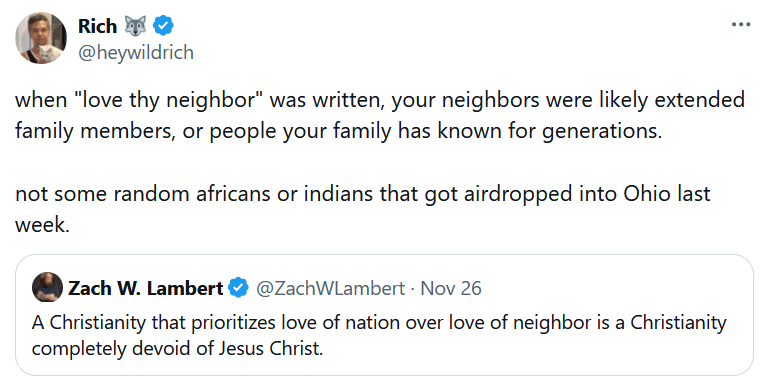
Here’s the post that made me want to write this.

For context, Zach Lambert is a self-proclaimed “Post-Evangelical,” which basically means he’s a liberal Christian with “progressive” theological positions. I don’t recommend Zach as a source for sound Biblical doctrine. But let’s ignore him for a moment and focus on his point. He says true Christians should not love their nation more than they love their neighbor.

This refers to the words of Jesus Christ, who said that the second-greatest commandment is to “love your neighbor as yourself” (Mark 12:31). There is no command in the Bible to love your nation. It’s not wrong to love your nation, but it seems pretty clear that loving your neighbor is more important. On this, at least, I can agree with Zach.

Rich challenges this notion. He asserts that the context of “love your neighbor” in the Bible was back when your “neighbors” were people you knew well or were related to. As many have pointed out, this is nonsense. If he read the passage he’s talking about, he would quickly realize how wrong he is. Let’s take a look.

“He, desiring to justify himself, said to Jesus, ‘And who is my neighbor?’ Jesus replied, ‘A man was going down from Jerusalem to Jericho, and he fell among robbers, who stripped him and beat him and departed, leaving him half dead. …a Samaritan, as he journeyed, came to where he was, and when he saw him, he had compassion. … Which of these…proved to be a neighbor to the man who fell among the robbers?’ He said, ‘The one who showed him mercy.’ And Jesus said to him, ‘You go, and do likewise.'”
— Luke 10:29-30, 33, 36-37 (ESV)

A man in the crowd asks Jesus “Who is my neighbor?” This is an important question, but the answer isn’t as simple as “family” or “people who live near you.” No, instead Jesus answers in the form of a parable which demonstrates a fuller meaning.

The principle character in this parable is a Samaritan. This was a people group living near Israel in the time of Christ. Their ancestors were part of the Northern Kingdom of Israel, which fell in 721 B.C. when the Assyrians attacked.1 Some were led off to Assyria, but those who stayed intermarried with foreigners and eventually became known as the Samaritans. The Jews considered them half-breeds. They hated each other.

Jesus specifically picks out a hated enemy of the Jews to be the protagonist of his story, the one who puts aside racial and national divides in order to show kindness to a man in need. This is in stark contrast to the religious leaders in Jesus’ parable who step over the man on the road. They’re shown to care less about following the second-greatest commandment than a lowly Samaritan, a great offense to those listening to Jesus. The Jews saw themselves as superior, as garnering God’s favor purely based on their heritage. How wrong they were.

Rich is essentially the man who questions Jesus. He refuses to accept that certain people groups are worthy of our love as Christians (though he himself doesn’t claim to be a Christian, interestingly). We have to draw the line somewhere, he thinks. I’ll love my family and other Americans, but not the “random africans or indians that got airdropped into Ohio last week” as he so eloquently puts it. No, Rich. God wants you to love them too. He would have you love even your most hated enemy.

“But I say to you who hear, Love your enemies, do good to those who hate you.”
— Luke 6:27 (ESV)

Between the Lines & Outside the Context

But here’s where I must take a step back and look at the bigger picture. This isn’t just about who you show love to in your daily life. This isn’t just about moral principles. Rich is getting at something different. Ironically, so is Zach. They’re bringing connotations of foreign policy into this discussion. And that’s certainly NOT something Jesus was talking about in his parable. This is essential to point out.

It’s a common trend nowadays for liberal Christians (like Zach) to take the Bible out of context in an attempt to force the Scriptures to support their positions on all sorts of societal, economic, and political issues. “Jesus was a socialist,” they might say. “The early church is an example of Communism,” they might say. It’s all lies. There’s a world of difference between Jesus’ actual teachings and his theoretical position on which laws should be passed relating to mass immigration or wealth redistribution. We must be careful to rightly divide the words of God.

“Do your best to present yourself to God as one approved, a worker who has no need to be ashamed, rightly handling the word of truth.”
— 2 Timothy 2:15 (ESV)

The question is not, “How can I apply Jesus’ words to foreign policy?” This is an improper use of Scripture called “eisegesis,” in which we attempt to inject our own ideas into the Bible. No, instead we ought to ask, “What was Jesus trying to say here?”

The answer seems to relate to the way Jesus’ audience, the Jews, conducted themselves in their daily lives. They might encounter people they despise, but Jesus tells them to show love regardless. They might have enemies, but Jesus tells them to show love regardless. Jesus was NOT trying to advocate for any kind of foreign policy position. He wasn’t aligning himself with any law. He wasn’t rebuking or affirming Rome’s authority in how it managed borders. Those are completely separate issues.

It’s perfectly acceptable to vote for strong borders while obeying Jesus’ command to love your neighbor. There are very good practical reasons for the government to regulate immigration, especially with how many widespread problems have arisen from lax policies as of late. Our “neighbors” are not just foreigners, but also our fellow Americans. Voting for strong borders is a form of loving our neighbors. At the same time, it’s imperative that we imitate Christ in how we treat any and all people we come across in our daily lives as Americans. If we see immigrants, we should love them. They are our “neighbors,” as Jesus makes clear to us.

Is this a contradiction? No, it is not. Whatever situation we find ourselves in, we obey Christ in loving our neighbors, even if the situation is not ideal. But that does not imply that we should actively seek to tear down our borders and invite everyone into America. Those are two completely different things. In the same way, we should trust God to provide for our needs, but this does not mean we should neglect to use the resources God provides. “Jesus take the wheel,” we say as we press on the gas with our eyes closed. “I gave you a steering wheel for a reason!” God replies as he shakes his head in disappointment.

It’s also worth pointing out that the man on the road was genuinely in need. Many immigrants are in need, but many are not. In fact, some are dangerous and should be refused entry regardless.2 Jesus certainly didn’t mean to imply that loving your neighbor means inviting criminals into your home. Locking up criminals, no matter where they come from, is not opposed to Jesus’ command to love your enemy. It’s just another way governments keep the peace and protect their citizens. This is entirely appropriate and consistent with how Paul talks about the purpose of government in Romans 13:1-7.

Another potential connotation in Zach’s post is a disagreement with “Christian Nationalism,” which I go over in detail here. I’m not certain this was his intention, but it seems likely. Suffice to say that Christian Nationalism is not Biblical, but that doesn’t give Zach a pass. Many Christian Nationalists want to bring patriotism (love of country) back. I don’t have a problem with patriotism. I have a problem with uniting the church and the state. Again, see my other post for more details. The only point on which I can confidently agree with Zach is the idea that no Christian should love his nation more than he loves his neighbor. Jesus is clear on this.

Conclusion

I do believe it is my responsibility as a Christian to show love and kindness to all people, whether they are an African immigrant or a close friend. The Christian faith has no racial or national boundaries. We ought to be evangelizing to all people as well. At the same time, I will openly advocate for strong borders in America. Most civilized countries around the world also want strong borders. This is not racist or hateful. It is simply a reality in properly governing a country and keeping citizens safe.

Don’t go looking for foreign policy from Jesus’ parables. Don’t go looking for Christian insights from an unbeliever like Rich. Don’t go looking for sound doctrine from a “Post-Evangelical” like Zach. Read Christ’s words on his own terms. Follow wise counsel from leaders in your local church who imitate Christ in their daily lives. Vote for policies that promote the safety and prosperity of the nation. But do not cling to race or national identity or social justice. Cling to Christ.

Let me know your thoughts in the comments below. Enter your email to be notified for my next post. Thanks for reading. Godspeed.

Processing…
Success! You're on the list.

Sources:

  1. Roat, Alyssa. “Who Were the Samaritans.” Bible Study Tools. May 17, 2024. https://www.biblestudytools.com/bible-study/topical-studies/the-samaritans-hope-from-the-history-of-a-hated-people.html
  2. Conklin, Audrey. “Laken Riley trial highlights Biden-era immigration crisis as mom of slain cheerleader awaits justice.” Fox News. November 21, 2024. https://www.foxnews.com/us/laken-riley-trial-highlights-biden-era-immigration-crisis-mom-slain-cheerleader-awaits-justice

Were Early Americans Christian Nationalists?

In my first post about Christian nationalism, I talked about how everyone’s definition is different. So before we get started, I want to make it clear that today I’ll be discussing Christian nationalism in the sense of a top-down, authoritarian approach to aligning a nation’s laws with the Bible.

The people who want this kind of government today in the United States usually view early America through rose-colored glasses. They love the idea of returning to the 1800s when everyone was Christian and nobody questioned how many genders there were. Don’t get me wrong, I get it. I’m sick and tired of postmodernism too. But it’s naive to think that early America was some kind of ideal Christian nationalist society.

A Christian Culture?

It is true that the vast majority of early Americans identified as Christian. As one might expect, this led to leaders, policies, and ways of living that reflected traditional Christian values to some extent. But make no mistake, this was still a country rife with sin. The true, invisible church has always been a minority.

“Enter by the narrow gate. For the gate is wide and the way is easy that leads to destruction, and those who enter by it are many. For the gate is narrow and the way is hard that leads to life, and those who find it are few.” — Matthew 7:13-14 (ESV)

Most people who call themselves Christians in an accepting society are not bonafide believers. They’re nominal Christians—Christian in name only. They might believe in good moral principles. They might go to church. They might even read their Bible. But none of this makes you a Christian. Only by truly believing in Jesus Christ and his sacrifice for you on the cross can you be saved.

“But,” I hear you say, “even if the true church was the minority, wouldn’t you rather live in a society full of nominal Christians than a society full of degenerates?” Not really. I’d rather evangelize to people who don’t know Christ than people who’ve been deluded into thinking they’re Christians because they attend church. Sure, living in a society accepting of Christians is more comfortable for me, but we are not promised comfort and it’s not our end goal as Christians. Regardless, it’s not our decision how people behave because we cannot control what people believe.

The Founding Fathers Rejected Christian Nationalism

You see, early America had this thing called the First Amendment. In part, it reads: “Congress shall make no law respecting an establishment of religion, or prohibiting the free exercise thereof.”

The founding fathers had various perspectives on religion. Many were deists or Unitarians. Some were devout Christians.1 But in the end, they agreed that freedom of religion was necessary and a state church was a bad idea. This philosophy traces its origins back to the Anabaptist movement.2 It also flies in the face of Christian nationalism, which proposes that we revoke this freedom in favor of an exclusively Christian state. The harsh reality is that the founding fathers rejected this notion, though their writings were still clearly inspired by Christian principles.

Some will argue that because everyone identified as Christian at the time, the founding fathers really only wanted freedom of denomination, not freedom of religion. This might make some degree of sense at first glance. We should interpret the founding documents according to their historical context, right? Well, maybe, but not to the degree that we completely change the meaning of the original text. The First Amendment makes no distinction about denominations. It addresses religion. To those who still disagree, I would ask you this: Do you think the Second Amendment is only supposed to apply to old-fashioned muskets? Of course not. It addresses the right to bear arms. This doesn’t change with the times. Neither does the First Amendment change with the times.

Early Americans Fled Christian Nationalism

Why did the founding fathers value freedom of religion? Well, it goes back to the settlers who came over on the Mayflower. Not to be confused with the British settlers who founded Jamestown to expand the Crown, these Pilgrims were fleeing a form of “Christian nationalism” back home. They were sick of being persecuted for their beliefs by the Church of England. We talked in my last post about the dangers of giving governmental power to any specific branch of Christianity. You end up with one group of Christians condemning another group of Christians as heretics and bringing down the full force of the state upon them. This is not the way of Christ.

“Some indeed preach Christ from envy and rivalry, but others from good will… What then? Only that in every way, whether in pretense or in truth, Christ is proclaimed, and in that I rejoice.” — Philippians 1:15, 18 (ESV)

Paul is not too concerned with those preaching Christ from wrong motives. In Mark 9:38-41, Jesus tells the apostles not to worry about separate groups of people casting out demons in his name. I get the feeling that Jesus does not look down kindly on the horrific violence between “Christian” governments throughout history.

From Christian Colonies to Free States

The Puritans who founded the Massachusetts Bay Colony were much closer to being Christian nationalists. They also fled religious persecution, but they sought to create explicitly Christian commonwealths under England to demonstrate that their beliefs were superior to the state church they escaped. They had laws against committing adultery, committing blasphemy, and ignoring the Sabbath. The punishment in many cases was death, after one or two strikes.3 Remember, this is when Christianity had its strongest influence on the civil order of society.

From the Library of Congress:

“The religious persecution that drove settlers from Europe to the British North American colonies sprang from the conviction, held by Protestants and Catholics alike, that uniformity of religion must exist in any given society. This conviction rested on the belief that there was one true religion and that it was the duty of the civil authorities to impose it, forcibly if necessary, in the interest of saving the souls of all citizens. … The dominance of the concept … meant majority religious groups who controlled political power punished dissenters in their midst.”4

The colonial era saw plenty of Christian-on-Christian persecution. This time, it was between Protestant groups over denominational differences. Whichever group had the most influence in a region bullied minority groups until they submitted or fled. And if you were Catholic, you could expect even worse treatment. We don’t want to go back to these times. It wasn’t the utopia many believe it was. I much prefer the mentality of the founding fathers, who in the course of creating one of the best countries in the world, implemented some of the strongest protections for human rights and freedom for all.

“Be kind to one another, tenderhearted, forgiving one another, as God in Christ forgave you.” — Ephesians 4:32 (ESV)

The Christian influence on America didn’t stop with the founding fathers, however. Laws in various states relating to Christian principles persisted through the 19th century, such as religious requirements to hold public office. But by the 20th century, the Supreme Court was striking down these discriminatory laws, the separation of church and state saw more support, and public opinion shifted towards humanism. Today, some of these laws remain on the books, but they’re never enforced.

Conclusion

As you can see, there’s a lot of nuance in the history of American Christianity. The Pilgrims sought to separate from the Church of England so they could worship in peace. The Puritans fled from persecution under Christian nationalism, only to establish their own version of it. The founding fathers enshrined freedom of religion in our Constitution, but the public continued to uphold Christian values in the fabric of society for many decades. Now, we’re seeing the continual downfall of Christian influence on American life. Many long for the old days, and I can see why. But it’s important that we not forget the lessons our history has taught us.

1. Implicit Christian influence has always led to a healthier society. It’s impossible to deny the positive cultural effect that a majority Christian opinion can have on a nation.

2. Explicit Christian authority has always led to persecution and oppression, whether it’s the Church of England against the Pilgrims, the Protestant settlers against each other, or both Protestants and Catholics against the Anabaptists.

I’m very thankful that the founding fathers established freedom of religion. It’s why I can drive past so many different denominations worshiping peacefully on the way to my own church with its specific beliefs and traditions. It’s why none of us have to fear for our lives when we change our minds about certain doctrines or secondary issues. It’s why we still have the power to openly preach the gospel to our neighbors despite the fact that most of our nation has fallen so far from God. I’m proud to be an American.

Let me know your thoughts in the comments below. Enter your email to be notified for my next post. Thanks for reading. Godspeed.

Processing…
Success! You're on the list.

Sources:

  1. Stratton, Eleanor. “Founders’ Vision of Religious Freedom.” U.S. Constitution.net. May 23, 2024. https://www.usconstitution.net/founders-vision-of-religious-freedom/
  2. Verduin, Leonard. That First Amendment and The Remnant, The Christian Hymnary, 1998.
  3. Smith, Sarah M., Tucker, Ellen D., Tucker, David. State (Colonial) Legislatures>Virginia House of Burgesses & William Penn. “Laws, Rights, and Liberties Related to Religion in Early America: Articles, Laws, and Orders, Divine, Politic, and Martial for the Colony in Virginia.” December 31, 1610. https://teachingamericanhistory.org/document/laws-rights-and-liberties-related-to-religion-in-early-america/
  4. America as a Religious Refuge: The Seventeenth Century, Part 1.” The Library of Congress. https://www.loc.gov/exhibits/religion/rel01.html

What is Christian Nationalism?

Christian nationalism is a popular topic nowadays in the news and on social media. It’s even starting to come up in normal conversation. But… what is Christian nationalism?

Let’s start the conversation with a funny video by Lutheran Satire on YouTube (or you can skip it and scroll down, it’s a free country).

It’s a great video.

This guy does a fantastic job of demonstrating the main problem with the discourse surrounding Christian nationalism. Everyone’s definition is different. Liberals seem to think that Christians taking part in elections or politics in any capacity is Christian nationalism. Edgy political commentators like Nick Fuentes seem to think that Christian nationalism means supporting white supremacy and antisemitism. But they’re at the extremes. What’s a better definition? Here’s one we can start with, taken directly from the video:

Christian nationalism: “A social and governmental system in which Christianity is the driving force that shapes a nation’s laws, people, and culture.”

This seems reasonable, right? At first glance, yes. But the fundamental problem remains. Extremists may be terrible at defining Christian nationalism, but people in the middle are almost as bad. Nobody can agree on this definition, or any definition for that matter.

No Consensus on Christian Nationalism

I’ve heard several people assert that Christian nationalism is inherently Protestant. They argue that the United States was founded by Protestants. But others propose a Catholic influence, given that the Catholic church is by far the largest and most organized church in America. And that’s not even bringing up other major church traditions. Who is correct?

Many assume that Christian nationalism is merely incidental in its influence. They believe the good morals of a nation’s people will naturally lead to laws and practices that reflect a Biblical worldview without the need for top-down mandates. This is roughly what happened in early American history, though it certainly wasn’t perfect. If you ask me, this is the best we can hope for in theory. I’ll talk more about this in the next post.

But times have changed. Public opinion is wildly out of line with the Bible. Christian nationalism is no longer realistic unless the government uses brute force. Many Christian nationalists realize this and don’t mind forcing their religion onto others. In fact, they want to take things further than the founding fathers ever did by eliminating basic freedoms and mandating their form of Christianity for all citizens. This is actually quite similar to the religious persecution that the early American settlers fled from in Europe, ironically enough.

Let’s assume for a moment that a strictly Christian government is possible. What sins should this government regulate? Should theft be illegal? Yes. Should homosexuality be illegal? Maybe, but it depends on who you ask. What about greed or gluttony? Huh… that’s tricky. What about grumbling or complaining? There’s no chance you’re putting anyone in jail for that. But we can go further.

Different denominations disagree on what constitutes a sin. Is drinking a sin, or only heavy drinking? Is divorce always a sin, or is it okay to divorce a cheating partner? Is it a sin for a woman to teach a man anything, or just to preach from the pulpit? It’s impossible to satisfy all Christians, or even all Christians in just one denomination. Let’s not forget how far into progressivism and blatant heresy many modern church denominations are. Do we let them write laws or only traditional churches? How traditional do you have to be? It gets messy very fast. But we can go even further!

What about doctrinal disagreements? If a Baptist gets elected, can he mandate believer’s baptism for all adult Lutherans and Presbyterians? Can a Catholic government punish all churches that fail to affirm the real presence of Christ in the Eucharist? These are secondary issues, but I guarantee you that citizens in a Christian government will fight over them, and it won’t be pretty.

History Repeats Itself

For countless examples of my point, just pick up a history book. The decades following the Reformation were some of the bloodiest in Christian history. Catholics and Protestants killed and ruled over each other in brutal fashion for centuries. Remember Bloody Mary? She burned hundreds of Protestants at the stake for rebelling against her efforts to restore the Catholic church to power in England. Remember the Thirty Years’ War? It was a period of heavy conflict between Catholic and Protestant rulers that devastated Germany, killing one third of its population (a mortality rate twice that of World War I1), and shattered any hope of a unified Europe under one Roman Catholic empire.

I could go on, but I hope the point is clear. Every time a government officially aligns itself with a church, things get ugly. Governments make for terrible church authorities. Do we really expect things to be different this time? Before you know it, you start sounding like a communist. “True Christian nationalism hasn’t been tried! This time it will work. Trust me!”

Where’s the Movement?

Finally, a key problem with Christian nationalism is its complete lack of organization on a national level. There is no central authority leading the charge to make Christian nationalism a reality. There are no clear goals being put forward by any kind of majority as representative of the movement. There is no “Christian Nationalist” party you can vote for in elections. The list goes on…

Conclusion

Christian nationalism falls short right out of the gate because it has no real definition. Nobody can agree on what it should look like. How can you create a unified movement out of so many radically different positions? How can you fight for something if you can’t even articulate what it is that you’re fighting for? And if it’s just a theoretical ideal that will never come to pass, what’s the point?

I don’t have any problem with Christian morals influencing the laws of a country. I think it’s a great thing. But I agree with the founding fathers that religious freedom is paramount. I don’t believe in a top-down approach. I believe in living the Christian life openly and boldly, being a voice of truth and reason for the values you hold dear, and praying for your nation fervently, that God might send more workers for the harvest no matter what the government looks like. Live and let live, but most importantly, evangelize. We are not called to save governments. We are called to save souls.

“First of all, then, I urge that supplications, prayers, intercessions, and thanksgivings be made for all people, for kings and all who are in high positions, that we may lead a peaceful and quiet life, godly and dignified in every way.” – 1 Timothy 2:1-2 (ESV)

Let me know your thoughts in the comments below. Enter your email to be notified for my next post. Thanks for reading. Godspeed.

Processing…
Success! You're on the list.

Sources:

  1. Onnekink, David (2013). War and Religion after Westphalia, 1648–1713. Ashgate Publishing. pp. 1–8. ISBN 9781409480211.

Is Saying “Christ is King” Antisemitic?

This past week, you might have seen a phrase trending online: “Christ is King.”

Well, that’s a nice change of pace. And close to Easter, too! Isn’t this a good thing? Usually it would be. The phrase itself is true. Christ is king. Easter week is a wonderful time to praise our Lord and Savior, and remember when Jesus rode on a donkey’s colt through the streets of Jerusalem as people shouted, “Hosanna! Blessed is he who comes in the name of the Lord! Blessed is the coming kingdom of our father David! Hosanna in the highest! (Mark 11:9-10).” This fulfilled Zechariah 9:9 and Genesis 49:11. Christ is the king of that kingdom so longed for.

But that’s not why “Christ is King” is trending online right now.

Politics & Controversy

Candace Owens, a popular conservative figure, was recently let go from The Daily Wire, a conservative media organization. She has long held the position that America has no business assisting in foreign wars, including the ongoing conflict between Hamas and Israel after the events of October 7th, 2023. Further, she brought up the term “genocide” in relation to the conflict.1

This put her in stark disagreement with Ben Shapiro, the Jewish co-founder of The Daily Wire. Things came to a head in November of 2023 after Ben publicly stated that Candace’s behavior regarding the discourse was “disgraceful.”2

Candace responded, quoting Bible verses that implied she was being persecuted because she’s a Christian.3 She ended by saying “Christ is King.”4

But did Ben attack Candace because of her faith? No, he didn’t. They simply disagreed about Israel. So why would Candace imply she’s being persecuted for her faith? Why say “Christ is King?”

It seems like Candace used this situation to passive-aggressively attack Ben while playing the victim for her audience (plenty of whom are Christians).

She could have defended her position logically. She could have settled things with Ben privately. She could have condemned Ben’s words as disrespectful. But she didn’t. Instead, she quoted Jesus’ words and said “Christ is King” to a known Jew in a conversation that had nothing to do with Christianity. You’d have to be blind to not see why she did this. It’s a tactical move intended to shift the discourse in her favor.

Ben replied to Candace’s post, saying that if she believes her job at The Daily Wire comes between her and God, she can quit.5 She then accused Ben of suggesting that she can’t quote Scripture,6 again adding the phrase “Christ is King.”7

First, Candace used the Bible as a shield against Ben. After all, it’s wrong to attack someone for quoting the Bible, right? Sure, but that’s obviously not what Ben was doing. Samuel Sey, one of my favorite bloggers, criticized Candace for how she framed things.8

Second, Candace doubled down with the phrase “Christ is King.” This was not posted to her general audience. It was directed at Ben specifically. Why? Ben is a Jew and Candace likely used this phrase to get under his skin. She knew most of her Christian followers would miss the subtext and blindly go along with her side of things because she’s “proclaiming Christ.” It’s a win-win for her. And it worked, as we’ll see in a moment.

Since this squabble, Candace has talked about Jewish issues a number of times, attracting controversy after controversy. I don’t know for sure if she’s actually antisemitic, but she’s gotten quite the reputation for her hot takes—so much so that The Daily Wire cut ties with her.9 Several of their members accused her of antisemitism, specifically in her use of the phrase, “Christ is King,”10 which she never said on X before her fight with Ben.

To be clear, nobody at The Daily Wire said the phrase itself was antisemitic. Jeremy Boreing, the CEO, explained in detail that he has a problem with the intentions behind certain people using the phrase, not the phrase itself.

Yet Candace continues to pretend that The Daily Wire has a problem with Jesus (despite the fact that they still employ several Christians). It’s all very silly at this point.

The Internet’s Reaction

That brings us to today’s firestorm on X. There are a couple different groups posting “Christ is King.” Some are normal Christians who just want to celebrate their faith, but far too many are jumping on this trend to direct their anger at Jews (or The Daily Wire).

prawntron15 on X says, "Christ is King you zionist slime."

Even social media personalities claiming to align with Islam are coming out to show their support. Andrew Tate, a womanizer known for exploiting girls in his pornographic business endeavors, added his voice to the fray.11 For context, Candace conducted a controversial interview with him in July of 2023 and has been known to defend him. She “liked” this post:

Tate’s not the only one. Sneako, another Muslim influencer who shares a similar audience, also posted the phrase.12 If either of them properly understood Islam, they would never say Christ is king. Islam teaches that Jesus was merely a prophet. They don’t believe he was the Son of God. They don’t believe he’s a “king” in any sense, much less the way Christians believe it.

Here are some more damning posts from the recent trend:

These examples, and others, prove that this isn’t just genuine Christians getting together to celebrate their Lord. This is a manipulative campaign using gullible Christians to forward the careers of so-called “conservatives” who only care about the name of Christ insofar as it helps them achieve their own selfish goals.

Jesus’ words quoting Isaiah are especially poignant here.

“This people honors me with their lips,
but their heart is far from me”

Matthew 15:8 (ESV)

In context, Jesus is criticizing Jewish leaders for their hypocrisy, but ironically, this verse applies to those attacking Jews today. It’s a terrible thing to claim allegiance to Christ with your mouth when your heart’s true intentions are malicious. Some might even call it Pharisaical.

So is “Christ is King” Actually Antisemitic?

No, the phrase “Christ is King” is not inherently hateful of Jews or antisemitic in any way. The Bible proclaims it to be true. As Samuel Sey stated in his article, “for Christians, ‘Christ is King’ is a theological and political statement about Jesus’ divine identity and supreme authority over all creation.”13

But it’s important to recognize that any phrase can be twisted and used to attack others. Remember “Black lives matter?” The BLM movement was a unique campaign designed to exploit stories in the media and hold rallies to encourage young people to express anger against the “racist” system allegedly oppressing them.

The chosen vehicle for this movement was the phrase, “Black lives matter.” It’s actually pretty brilliant. The phrase itself is true. Black lives do matter. Very few people disagree, and those who do will be seen as racist. This allows you to do whatever you want with the phrase, making you essentially immune to criticism. If anyone questions you, just accuse them of racism!

Ironically, the same conservatives who decried the Black Lives Matter movement for this deception are now using “Christ is King” in a similar manner. It’s disgusting to take a truth about Jesus and club your political adversaries over the head with it. It’s equally disgusting to pretend you don’t understand the subtext at play.

This isn’t the first time people have misused Jesus’ name. The Roman soldiers put a crown of thorns on Jesus’ head specifically to mock his title of “King of the Jews.”

“They stripped him and put a scarlet robe on him, and twisting together a crown of thorns, they put it on his head and put a reed in his right hand. And kneeling before him, they mocked him, saying, ‘Hail, King of the Jews!’ And they spit on him and took the reed and struck him on the head.”

Matthew 27:28-30 (ESV)

It’s true, Jesus is the king of the Jews, in a sense (John 18:33-38). But would you join the Roman soldiers in their antics? Would you blindly repeat after them as they beat Jesus senseless and led him away to die? No, because you understand that, in this context, the title “King of the Jews” is being used in jest—it’s a mockery of Christ, not genuine worship.

What About Israel?

In this case, people are using Christ’s title to attack Jews specifically. This is wrong, but why? Paul talks a lot about Jews in Romans 9-11, answering questions the early church had. Why don’t Jews accept Christ? Did God abandon his people? How do we treat them?

I won’t go into all the answers here, but I encourage you to read those chapters for yourself. They explain God’s relationship to Israel and his plans for their future. I highly recommend this sermon from John Piper as well.

The takeaway is that Christians have no grounds to attack or mock Jews. Paul describes a tree which has some branches broken off (the unbelieving Jews). He says Christian Gentiles are foreign branches grafted onto the tree. But he warns us not to be arrogant toward the broken branches (Rom 11:18). God is able to restore them (the Jews) again.

“Even they, if they do not continue in their unbelief, will be grafted in, for God has the power to graft them in again. For if you were cut from what is by nature a wild olive tree, and grafted, contrary to nature, into a cultivated olive tree, how much more will these, the natural branches, be grafted back into their own olive tree.”

Romans 11:23-24 (ESV)

God is fully capable of saving the Jews. But make no mistake, belief in Jesus is required. Jesus is a Jew—the Jewish Messiah. No Jew can have a right relationship with God while rejecting Christ (John 14:6). That said, Paul is convinced that all Israel will be saved someday (Rom 11:26). Even as he says their rejection of Christ led to the reconciliation of Gentiles, he looks forward to their full inclusion in the body of Christ (Rom 11:11-15). Paul has faith in the Jews—in God’s ability to save them. Do you?

Conclusion

Christianity is offensive to unbelievers of all kinds, including practicing Jews. That’s normal. Jesus warned us about it (John 15:18-25). But our goal in proclaiming Christ should never be to mock people or jump on political bandwagons. Our goal should be to save souls. Our goal should be to pursue holiness in imitating Christ.

“Whoever says ‘I know him’ but does not keep his commandments is a liar, and the truth is not in him, but whoever keeps his word, in him truly the love of God is perfected. By this we may know that we are in him: whoever says he abides in him ought to walk in the same way in which he walked.”

1 John 2:4-6 (ESV)

God forgive us when we worship Christ in word only, when we speak his name in vain in the public square to garner attention (Matt 6:5-7). Let us rather worship him in truth (John 4:21-24), being no hearer who forgets but a doer who acts (James 1:25).

Christ is king. Now act like it.

Let me know your thoughts in the comments below. Enter your email to keep in touch with me. Thanks for reading. Godspeed.

Processing…
Success! You're on the list.

Sources:

  1. https://x.com/RealCandaceO/status/1721533270918062198?s=20
  2. https://x.com/RpsAgainstTrump/status/1724466032071331961?s=20
  3. https://x.com/RealCandaceO/status/1724456541623886079?s=20
  4. https://x.com/RealCandaceO/status/1724457552967004299?s=20
  5. https://x.com/benshapiro/status/1724914588146155542?s=20
  6. https://x.com/RealCandaceO/status/1724916478221173177?s=20
  7. https://x.com/RealCandaceO/status/1724916946301317459?s=20
  8. https://x.com/SlowToWrite/status/1724963520859541897?s=20
  9. https://x.com/JeremyDBoreing/status/1771165501160411423?s=20
  10. https://x.com/JeremyDBoreing/status/1772253907319669011?s=20
  11. https://x.com/Cobratate/status/1772221317019799930?s=20
  12. https://x.com/sneako/status/1772048489372880911?s=20
  13. https://slowtowrite.com/christ-is-king-of-the-jews/

Should Christians Fight the Culture War?

The Michigan House and Senate recently advanced legislation to repeal the 1931 abortion ban (which was nullified last November) and expand the Civil Rights Act to include “sexual orientation” and “gender identity and expression.” Stories come out every day of schools approving pornographic books and LGBT propaganda in their sex ed programs. It’s considered controversial to stand against drag shows for kids. It feels like Christians are losing the culture war. Should we even be fighting it in the first place?

The Good Old Days

In a sense, Christians have been fighting (and losing) the culture war ever since the early days of America. Most of the founding fathers were just deists looking to create a better government in a new land. Some probably had genuine faith, but most didn’t follow Jesus. Don’t get me wrong, Judeo-Christian values were a solid foundation for what is arguably the greatest country in the world. But more cultural support for Christianity doesn’t necessarily translate to “more Christians.”

The most common religion in the western world is moralistic therapeutic deism. That’s a term I stole from one of my favorite Adam4d comics. It’s the belief that a god exists who watches over us and helps us resolve our problems, that we should all be nice to each other, and that life is about being happy. As you can see, the gospel is nowhere to be found. Jesus is nowhere to be found. Neither are repentance, faith, or worship of God. Yet this is the religion most self-proclaimed “Christians” subscribe to in their cushy American lifestyles of traditionally acceptable hedonism.

We Can’t Win

So if most Christians aren’t Christians and Judeo-Christian values can’t save you, what’s the point of fighting the culture war? Is it just for our own comfort? That doesn’t sound like Christianity.

“If you were of the world, the world would love you as its own; but because you are not of the world, but I chose you out of the world, therefore the world hates you.”

John 15:19 (ESV)

“All who desire to live a godly life in Christ Jesus will be persecuted, while evil people and impostors will go on from bad to worse, deceiving and being deceived.”

2 Timothy 3:12-13 (ESV)

True Christianity necessarily involves some kind of persecution simply because true Christianity is never popular. The invisible church will always be a minority. That’s normal. Comfort and acceptance is not our goal. No matter how much the government adheres to Judeo-Christian values, it will never adhere to Christ himself. It’s impossible. The world is, and always has been, at odds with God.

“You adulterous people! Do you not know that friendship with the world is enmity with God? Therefore whoever wishes to be a friend of the world makes himself an enemy of God.”

James 4:4 (ESV)

The idea that we can win the culture war is ultimately a lie. Our battle is not for the presidency, the schools, or the public square. It’s a fight against our own disobedience, disunity, and selfish living. It’s a fight to spread the Word of Christ to all corners of the earth.

“Go therefore and make disciples of all nations, baptizing them in the name of the Father and of the Son and of the Holy Spirit, teaching them to observe all that I have commanded you.”

Matthew 28:19-20a (ESV)

“For our struggle is not against flesh and blood, but against the rulers, against the authorities, against the cosmic powers of this darkness, against evil, spiritual forces in the heavens.”

Ephesians 6:12 (CSB)

But We Should Still Fight

Does this mean we should forget the culture at large? No. I’m sure you’ve heard the popular phrase, “In the world, but not of the world.” David Mathis wrote a fantastic article on this.1 His advice was to change the phrase to: “not of, but sent into.” His reasoning is based on John 17, where we hear Jesus pray to the Father.

“The world hated them because they are not of the world, just as I am not of the world. I am not praying that you take them out of the world but that you protect them from the evil one.”

John 17 14b-15 (CSB)

We are not of the world, similar to how Jesus is not of the world. But instead of praying for our escape from the world, Jesus prays for our protection from temptation. It’s actually a good thing that we’re stuck here on this sinful planet. God put us here for a reason. We shouldn’t seek to be rid of it or ignore it.

“As you sent me into the world, I also have sent them into the world.”

John 17:18 (CSB)

Christ has specifically sent us into the world to carry out his mission of evangelism and to glorify God with our words and deeds. We dare not shy away from our culture to live in isolated bubbles. That would be disobedience.

How We Fight

So what does this mean for the culture war? Our primary influence on the world should be for evangelism and obedience to God in our own communities, but that doesn’t mean we can’t also guide our culture into a morally sound framework with the tools God has given us.

In America, we can vote. That’s a pretty amazing thing. It only takes a little effort to have an impact on our culture for the better. But we can do more. We can run for school board, precinct delegate, and other local positions. We can speak the truth in love to our neighbors. We can testify for or against bills and local policy changes. We can gather signatures for ballot initiatives.

That said, our goal in this should not be to force people into Christianity. We’ve seen how ugly things can get with state religions and forced conversions. If someone wants to live in sin by committing adultery or acting selfishly, we can’t stop them. That’s not our job. Instead, we should aim to create a society that gives us the freedom to do God’s work and live godly lives.

“I urge that supplications, prayers, intercessions, and thanksgivings be made for all people, for kings and all who are in high positions, that we may lead a peaceful and quiet life, godly and dignified in every way.”

1 Timothy 2:1-2 (ESV)

“Let every person be subject to the governing authorities. For there is no authority except from God, and those that exist have been instituted by God . . . if you do wrong, be afraid, because [the government] does not carry the sword for no reason. For it is God’s servant, an avenger that brings wrath on the one who does wrong.”

Romans 13:1, 4b (CSB)

God has told us to obey our governments because they are his servants to keep the peace and punish evildoers. It’s in everyone’s best interest that the government stays true to its purpose. If we fail to pay attention, our leaders are sure to stray from justice and we will see the consequences.

“When the righteous increase, the people rejoice, but when the wicked rule, the people groan.”

Proverbs 29:2 (ESV)

This World Will Not Last

My brother gave a great sermon recently. One of his points stuck out to me as being relevant to this topic. This is the passage he talked about:

“As he was going out of the temple, one of his disciples said to him, ‘Teacher, look! What massive stones! What impressive buildings!’ Jesus said to him, ‘Do you see these great buildings? Not one stone will be left upon another—all will be thrown down.'”

Mark 13:1-2 (CSB)

Jesus quickly shoots down his disciple’s excitement over the temple, foretelling its destruction. We should not put too much faith in earthly institutions. Nothing made by men can stand forever. Nothing made by men is pure. Jesus came to God’s chosen people and found that they had rejected God’s ways. He rebuked them in the presence of the temple.

“Jerusalem, Jerusalem, who kills the prophets and stones those who are sent to her… See, your house is left to you desolate.”

Jesus, Matthew 23:37a, 38

The glorious buildings mean nothing if the hearts of those within are cold. So whatever you do to fight the culture war, remember what you’re fighting for. All political movements will come to an end. All nonprofits will come to an end. All the works of the enemy will come to an end. This world will not last. Praise God.

Let me know your thoughts on the culture war in the comments below. Enter your email to keep in touch with me. Thanks for reading. Godspeed.

Processing…
Success! You're on the list.
  1. David Mathis, “Let’s Revise the Popular Phrase ‘In, But Not Of’,” DesiringGod.org, August 29, 2012, https://www.desiringgod.org/articles/lets-revise-the-popular-phrase-in-but-not-of

Equivocation — Logical Fallacies From a Biblical Perspective

You probably know what a logical fallacy is, don’t you? It’s when someone declares something false to be true. Wait… that’s not it? You say it’s the use of faulty reasoning in an argument? Oh, then we had better clear up our definition of “fallacy.” Can’t have a proper discussion unless we’re all on the same page, after all. And that’s exactly what equivocation is all about.

This is one of my favorite fallacies to talk about. It’s one of the most common, yet least acknowledged. It pops up absolutely everywhere and rarely gets the attention it deserves. It most often leads to quarrels over innocuous things, but can sometimes trick entire generations into believing lies.

Equivocation

This fallacy occurs when a word is used with an ambiguous or double meaning, usually to swap out the definition when the word is used later in the argument. For instance, someone might say that critical thinking is a bad skill to learn because we already have enough critical people in the world. They’ve just used two completely different meanings for the word “critical.” In the first instance, they are referring to the skill of critical thinking in which a person carefully considers something by questioning it with sound reasoning. In the second, they are referring to people who think negatively of those around them and sling insults around. These are entirely different things.

Here’s a less obvious example. I ask my wife for my green jacket. She hands me my jacket with a green hood. But this isn’t the one I wanted. I was thinking of the jacket with a green liner. My wife isn’t ignoring me. She just interpreted “green” to mean the most visible part of the jacket. My definition of “green” was different. I shouldn’t blame my wife for handing me the wrong jacket. I should be more specific and clarify what I meant.

This is how misunderstandings can turn into fights. It’s common for people who are already at odds to use this fallacy against each other, pointing fingers and escalating small disagreements into rifts that tear the entire relationship apart.

“The one who conceals hatred has lying lips, and whoever utters slander is a fool.”

Proverbs 10:18 (ESV)

Remember this fallacy. You need to see it coming so you can stop it in its tracks and disarm bad-faith arguments from friends, news articles, and governments alike. It’s also helpful to be aware of it when you’re the one who’s speaking. You want to be properly understood by those who listen to you.

“Above all, keep loving one another earnestly, since love covers a multitude of sins.”

1 Peter 4:8 (ESV)

Stopping Useless Quarrels

Next time you find yourself on the edge of a conflict, ask yourself how sure you are of the other person’s definitions. If in doubt, ask them. The simple phrase, “What do you mean by that?” can go a long way! Seriously, try it. It can work wonders to deflate tension and bring reason back into the conversation.

It’s no use trying to have a discussion if you can’t agree on what your words mean. You’ll end up talking past each other. I can’t begin to count how many disagreements I’ve experienced or witnessed that could have been resolved right at the beginning if someone had only taken a few moments to clarify the terms.

You may not like the terms someone else uses, but that’s not the point. Your goal is to communicate. Sometimes you have to use their terms and sometimes they have to accept yours. It’s a game of give and take, but the real goal is to understand one another, removing as much ambiguity as possible.

“I urge you to walk worthy of the calling you have received, with all humility and gentleness, with patience, bearing with one another in love, making every effort to keep the unity of the Spirit through the bond of peace.”

Ephesians 4:1-3 (CSB)

Explaining Yourself Effectively

One of the best feelings in the world is being understood. It’s an art form to speak in such a way that the contents of your heart are transported into the mind of another person. It takes practice to learn this skill, but one easy trick you can use is to keep a sharp eye on the definitions of your words.

It’s a common mistake to use equivocation on accident, especially when talking “off the cuff.” When you speak, keep tabs on what significant words you’re using as the cornerstones of your argument. These are the most important words to clarify and stay consistent with.

Let’s say you’re persuading an audience to make a savings account for emergencies only. You might talk about how this money comes in handy for unexpected bills and home repairs. But you also want to emphasize that it can’t save you from emergencies. After all, it’s just money. It won’t prevent bad things from happening to you. We have to trust God at the end of the day.

Your audience is now confused. You said this fund was for “emergencies,” but now you’ve just told them that it’s no use for some “emergencies.” You have to clarify what you mean. The fund is meant for bad situations that can be solved with money, but it won’t save you from a heart attack, it won’t keep you from being arrested if you break the law, and it won’t save your soul from sin. These are different from financial emergencies and it’s important to point that out. Just because you understand your point doesn’t mean others will.

“Let no corrupting talk come out of your mouths, but only such as is good for building up, as fits the occasion, that it may give grace to those who hear.”

Ephesians 4:29 (ESV)

COVID-19 and Lying with Definitions

Misunderstandings and quarrels are one thing, but lies from a business, news organization, or government are another beast entirely. You had better be ready when communication experts purposefully try to brainwash and manipulate you or you won’t stand a chance.

Do you know the definition of “vaccine?” Here it is, according to Merriam-Webster:

Vaccine – noun: a preparation of killed microorganisms, living attenuated organisms, or living fully virulent organisms that is administered to produce or artificially increase immunity to a particular disease.”

At least, that’s what it was until January 2021. Then they changed the definition. Why? Because the new shot developed for COVID-19 didn’t provide immunity. But you see, “protein spike shot” just doesn’t roll off the tongue quite as nicely. The government and big pharma wanted everyone to get this shot. They knew people would trust it more if they called it a vaccine, so they did. They lied. They knowingly advertised the shot as a vaccine even though it wasn’t.

To cover their tracks, dictionaries like Merriam-Webster and other “authoritative” sources changed the definition of a vaccine overnight. Today, it takes up your entire screen and very carefully says that vaccines “stimulate the body’s immune response.” This is different from providing immunity.

This is a clear case of equivocation. The government called the shot a “vaccine” with a new definition knowing the public would accept it based on the previous definition. When they were called out, they claimed this new definition was “more accurate.” Excuse me, but how so? Definitions are based on the use of a word in the culture at large and should never depend solely on the whims of a few ruling elite. This kind of transparent manipulation is becoming more outlandish by the day. They only do it because we fall for it. Stop taking the bait and think for yourself.

“For such persons do not serve our Lord Christ, but their own appetites, and by smooth talk and flattery they deceive the hearts of the naive.”

Romans 16:18 (ESV)

What is Racism?

A similar thing is happening to the definition of “racism.” It was once understood by everyone to be “prejudice or discrimination based on race,” but today you’ll hear a different story from university professors and self-important TV personalities.

Racism is now defined by some as the systematic oppression of people of color by white people. It’s being framed as an amorphous force of evil exclusive to one race (ironically enough). How convenient! This new definition absolves you of the responsibility to provide evidence that a particular person is prejudiced. You can just blame “the system” of racism and claim the same experiences as those who have actually suffered. Isn’t it great to be a victim?

“A fool takes no pleasure in understanding, but only in expressing his opinion.”

Proverbs 18:2 (ESV)

Gender and Sex

When I was growing up, gender and sex were interchangeable. My sex is male. My gender is male. I am a man. They all mean the same things. Today, you’ll be taught that gender is a social construct. Sex is biological and determined by reproductive organs, but gender is your self-expression and can be changed at any time. This new definition allows men to declare themselves to be women and intrude on women’s bathrooms or sports competitions, which were designed with the original (biological) definition of gender in mind.

Modern gender theory is quite recent. It was formed in the 90s by Judith Butler and others, but they refer back to an experiment in the 60s by psychologist John Money. He took twin brothers and raised one of them as a girl, forcing them into sex positions (to reinforce gender roles) and abusing them in other ways. This study was declared to be a success and stands as the foundation for much of modern gender theory.

What they don’t tell you is that the boy was miserable living as a girl and decided as a teenager to go back to living as a boy. He later killed himself with a shotgun and his brother overdosed on antidepressants. The history of modern gender theory is stained with innocent blood.

“Death and life are in the power of the tongue, and those who love it will eat its fruit.”

Proverbs 18:21 (CSB)

Stay Vigilant

Equivocation is dangerous. It can ruin marriages and it can brainwash a country. We must be vigilant in defining what our words mean and speaking the truth in love. We must keep a lookout for anyone trying to manipulate us. Be shrewd as a serpent and innocent as a dove (Matt 10:16).

“Set a guard, O Lord, over my mouth; keep watch over the door of my lips!”

Psalm 141:3 (ESV)

Let me know your thoughts in the comments below. Enter your email to keep in touch with me. Thanks for reading. Godspeed.

Processing…
Success! You're on the list.

Does Proposal 3 Legalize More Than Just Abortion?

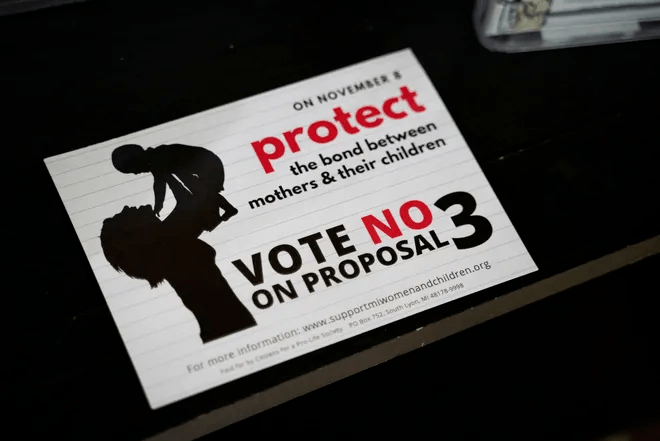
On November 8th, Michigan citizens will vote on whether or not to adopt Proposal 3, a constitutional amendment to legalize abortion. But what about the claims you’ve heard from conservative sources? Does Proposal 3 legalize late-term abortions? Does it allow abortion and sex change therapy on minors without parental consent? Does it allow anyone to perform an abortion?

Today, I give you the answers. No propaganda, no vague nonsense, no misdirection. Just the facts. I highly recommend you also read the proposal yourself by CLICKING HERE. Let’s get to work.

Does Prop 3 Invalidate Existing Laws?

You’ve probably heard liberals claim that Prop 3 won’t change any existing laws. “It just affects abortion!” they say. This is patently false, as you can clearly see in the proposal language. The introductory section reads:

Constitutional Amendment to: …invalidate all state laws that conflict with this amendment.

This is not just an addition to our Constitution for abortion only. Prop 3 is specifically designed to invalidate existing laws that conflict with it. Keep that in mind. We’ll come back to it.

Sterilizing Kids

Now, let’s go over the body of the proposal language. Here’s the first section:

(1) Every individual has a fundamental right to reproductive freedom, which entails the right to make and effectuate decisions about all matters relating to pregnancy, including but not limited to prenatal care, childbirth, postpartum care, contraception, sterilization, abortion care, miscarriage management, and infertility care.

Sounds tame enough, right? It seems like they just want women to be able to make all their own decisions regarding pregnancy. Who could argue with that? The problem is how vague the language is. This ambiguity is present throughout the proposal. Whether you believe it’s intentional or not, it opens the doors to some truly horrible things (besides just abortion).

First, this applies to “every individual.” Not just mothers. Not just women. Not just adults. It applies to a 6 year old boy just as much as a 36 year old woman. That’s important. It shows their fear of affirming the biological fact that only women can have pregnancies to begin with. But that’s not all.

“Every individual” is said to have the right to “reproductive freedom.” What does that mean? They define it as the right to make decisions about “all matters relating to pregnancy.” That’s quite broad. After all, sex is directly related to pregnancy. Can a 6 year old boy consent to sex under this proposal? We don’t know. What is clear is their list of examples, one of which is “sterilization.”

Already, we have a case that this proposal would reasonably allow for a 6 year old boy to choose to sterilize himself for life. That’s not conjecture or me twisting words. That’s explicitly allowed in the actual language. Are you starting to see the problem?

Late-Term Abortion

Conservatives say Prop 3 allows for late-term abortions. Is that true? Let’s review the language:

…the state may regulate the provision of abortion care after fetal viability, provided that in no circumstance shall the state prohibit an abortion that, in the professional judgment of an attending health care professional is medically indicated to protect the life or physical or mental health of the pregnant individual.

At first, this appears to allow for abortion restrictions after “fetal viability” (defined later on). But this is made irrelevant by the exception for “mental health.” Under Prop 3, anyone could get a late-term abortion as long as their “attending health care professional” said it would protect their mental health. The baby can be perfectly healthy and fully developed, yet still killed at the last second because the mother has anxiety.

Not Just Doctors

Notice they don’t say “doctor,” but “health care professional.” This is important. It means anyone working in healthcare could approve of late-term abortions on “mental health” grounds. That applies to dentists, dietitians, and even veterinarians. But it gets worse. Anyone could perform an abortion as well, as we’ll see in a minute.

Enforcing Rights?

(2) The state shall not discriminate in the protection or enforcement of this fundamental right.

I won’t focus on this section too much, but the wording is a bit strange. Since when are rights enforced by the state? Having a right usually means you’re free to do something without the state impeding you. Does this section imply that the state could arrest people who try to discourage abortion or sterilization, such as parents or counselors? We don’t know.

Infanticide

(3) The state shall not penalize, prosecute, or otherwise take adverse action against an individual based on their actual, potential, perceived, or alleged pregnancy outcomes, including but not limited to miscarriage, stillbirth, or abortion.

On the surface, this seems to prevent the state from punishing women for miscarriages. That’s a good thing, right? Yes, but this is a solution for a problem that does not exist. The danger is that this prevents prosecution for any “pregnancy outcome,” real or alleged. This effectively legalizes infanticide. A woman who blatantly murders her baby after it’s born could not be investigated, as this would be an “adverse action” against an “alleged pregnancy outcome.” Nobody should be able to kill a newborn baby, and (almost) no liberal will argue for that. But Prop 3 could make the state enforce it as a right.

Anyone Can Perform Abortions

Nor shall the state penalize, prosecute, or otherwise take adverse action against someone for aiding or assisting a pregnant individual in exercising their right to reproductive freedom with their voluntary consent.

This language says the state can’t do anything to prevent anyone from “assisting” an abortion (or other “reproductive freedom”). This allows anyone to perform an abortion as long as the pregnant woman consents. This is even less strict than “health care professionals.”

Invalidating Existing Laws

Now let’s review the language that raises the most questions about existing laws and regulations (such as parental consent):

An individual’s right to reproductive freedom shall not be denied, burdened, nor infringed upon unless justified by a compelling state interest achieved by the least restrictive means.

At first, this seems to allow for restrictions under certain circumstances. But what does “a compelling state interest” mean? This phrase is part of the strict scrutiny test, which is a judicial standard applied when a law might conflict with the Constitution. For the law to survive, it must be crafted to further a “compelling state interest,” such as protecting public health and safety or regulating violent crime. Not even a constitutional right can prevent the government from carrying out these essential functions. This is why crimes such as defamation are illegal despite the right to freedom of speech, for example.

If the writers of Prop 3 wanted these new “reproductive freedom” rights to be treated like all other constitutional rights, they would have stopped there. But they didn’t. They added the following language, drastically narrowing the definition of a “compelling state interest.”

(4) For the purposes of this section: A state interest is “compelling” only if it is for the limited purpose of protecting the health of an individual seeking care, consistent with accepted clinical standards of practice and evidence-based medicine, and does not infringe on that individual’s autonomous decision-making.

We are given three conditions that must be met. For an existing law to restrict or regulate abortion, sterilization, or any other “reproductive freedom,” it must:

  1. Be for the purpose of protecting the health of the individual
  2. Be consistent with clinical standards of practice
  3. Not infringe on the individual’s decision-making

First, restrictions must be for the purpose of protecting the health of the individual. Does this include mental health? Again, we don’t know. This could invalidate laws preventing tax money from funding abortions, as they protect the conscience of taxpayers and have nothing to do with health. Theoretically, a doctor (or anyone for that matter) could not refuse to perform a late-term abortion on grounds of conscience or religion since this also isn’t concerned with health.

Second, restrictions must be consistent with “accepted clinical standards of practice.” If the “practice” is abortion, who writes these standards? The abortion clinics themselves. This means the abortion industry gets to dictate how abortions are done and remove anything that impedes their business. They make a lot of money from this, meaning they are incentivized to make abortions as expedient as possible. They could ignore health and safety regulations. They could ignore screening requirements designed to ensure that the woman isn’t being coerced into an abortion by an abuser or sex trafficker. They could ignore waiting periods and informed consent laws designed to educate women on the risks of and alternatives to an abortion. It gives abortion providers the power to completely deregulate abortion, making things more dangerous for women.

Third, restrictions must not infringe on the individual’s decision-making. This language is extremely broad, making consent the only real requirement for exercising “reproductive freedom.” Remember, “reproductive freedom” means anything related to pregnancy. A brother and sister could choose to have a baby together. A child could choose to be sterilized for life. A child could consent to sex with an adult, since sex is related to pregnancy. Michigan’s ban on cloning could be nullified, since this is also related to pregnancy. The open-ended language allows for so many horrific possibilities with no room for common-sense regulations applicable to other constitutional rights (via strict scrutiny).

Fetal Viability

One last section to review. Remember the exception for fetal viability I mentioned earlier? Here’s their definition of the term:

“Fetal viability” means: the point in pregnancy when, in the professional judgment of an attending health care professional and based on the particular facts of the case, there is a significant likelihood of the fetus’s sustained survival outside the uterus without the application of extraordinary medical measures.

This seems correct at first glance, but upon further inspection, it actually broadens the definition beyond its original meaning. If you look it up online, you’ll see that fetal viability is defined as “the ability of a human fetus to survive outside the uterus.” That’s it. But Prop 3 adds the condition, “without the application of extraordinary medical measures.” This means babies who could theoretically survive outside the womb with the aid of advanced medical assistance are not protected.

The Rebuttal

The left’s rebuttal to the arguments I’ve made here is that Proposal 3 is only designed to protect a right to abortion. They say the intent isn’t to legalize statutory rape, sterilization of minors, infanticide, or incest. They say they don’t want to erase parental consent or religious freedom. So how do they justify the broad language in the proposal?

They usually bring up other constitutional rights, such as the right to bear arms. The Michigan Constitution says that every person has this right, yet we know kids are excluded and guns are still regulated. Doesn’t the same logic apply to Prop 3?

No, it doesn’t. Regulations on the right to bear arms are tested under their own standard of “historical tradition of firearm regulation.” In addition, this and all other constitutional rights can be limited by regulations that further a “compelling state interest,” such as public health and safety. But Prop 3 goes out of its way to redefine “compelling state interest” such that any law infringing on an individual’s “decision-making” is invalidated.

Parental consent laws might infringe on a child’s decision to have an abortion or sterilize themselves. Statutory rape laws might infringe on a child’s decision to have sex with an adult. Informed consent laws might infringe on a woman’s decision to have a late-term abortion. All of these regulations (and more) have to be thrown out.

This is why Prop 3 is so radical. This is why its defenders rely heavily on “intent” to claim that future case law won’t affect anything but abortion. But how can they be sure? It’s funny. Conservative justices are usually the ones who interpret based on original intent. Liberal justices—the ones Prop 3 advocates will vote for—frequently argue that the Constitution should be interpreted according to the times. What happens when the times change? Why leave the possibility open for Prop 3 to be abused at all? Why not clarify the ambiguous language? Why redefine “compelling state interest?” They don’t have an answer.

The Bottom Line

Even if you believe abortion should be legal in some cases, Prop 3 is extremely problematic. What is meant and what is said are very different things. Aside from the goal of legalizing abortion, the problem with Prop 3 is that its language is far too broad. It fails to clarify questions about the age of those affected, the limits of “reproductive freedoms,” and the state’s ability to interfere. It explicitly removes nearly all restrictions on abortion and anything else related to pregnancy. As written, Prop 3 is a disaster. It’s unprofessional at best and downright villainous at worst.

I will be voting NO on Proposal 3 this coming Tuesday. Enter your email if you want to be notified when my next post goes live. Thanks for reading. Godspeed.

Processing…
Success! You're on the list.

Should Christians Pay Tax?

Yes, we should. But why? And what about when our taxes go towards things that aren’t right?

“Let every person be subject to the governing authorities. For there is no authority except from God, and those that exist have been instituted by God… For because of this you also pay taxes, for the authorities are ministers of God, attending to this very thing. Pay to all what is owed to them: taxes to whom taxes are owed, revenue to whom revenue is owed, respect to whom respect is owed, honor to whom honor is owed.”

Romans 13:1, 6-7 (ESV)

I think most of us would agree that paying taxes is right for a Christian. After all, it’s outlined pretty clearly here. God establishes government to keep law and order. We obey him in paying taxes. We should not do this begrudgingly. We should see it as our due to the institution God has given to serve us and keep us safe.

Paul goes further by saying we should honor and respect our leaders, not merely tolerate them. This can be hard in our current age of partisan hatred and vitriol, but it’s our job as Christians to be different from the world. Resist the temptation to fall in line with how everyone else is acting.

“Do not be conformed to this world, but be transformed by the renewal of your mind, that by testing you may discern what is the will of God, what is good and acceptable and perfect.”

Romans 12:2 (ESV)

Jesus offers us another angle on paying taxes when the Pharisees challenge him.

“‘Tell us, then, what you think. Is it lawful to pay taxes to Caesar, or not?’ But Jesus, aware of their malice, said, ‘Why put me to the test, you hypocrites? Show me the coin for the tax.’ And they brought him a denarius. And Jesus said to them, ‘Whose likeness and inscription is this?’ They said, ‘Caesar’s.’ Then he said to them, ‘Therefore render to Caesar the things that are Caesar’s, and to God the things that are God’s.'”

Matthew 22:17-21 (ESV)

Jesus confirms Paul’s words (perhaps the other way around), but as usual, he goes even further. Have you ever stopped and really thought about that phrase before? “…to God the things that are God’s.” That’s the real kicker. Not only should we offer up our taxes to the government, but we should offer up ourselves to God. He rightfully purchased us on the cross. We owe him our time, our money, and our lives. That’s a tall order.

“Do you not know that your body is a temple of the Holy Spirit within you, whom you have from God? You are not your own, for you were bought with a price. So glorify God in your body.”

1 Corinthians 6:19-20 (ESV)

“I appeal to you therefore, brothers, by the mercies of God, to present your bodies as a living sacrifice, holy and acceptable to God, which is your spiritual worship.”

Romans 12:1-2 (ESV)

It is a far higher and more difficult calling to give God the things that are God’s than to give Caesar the things that are Caesar’s. Yet the Pharisees saw it the other way around. They were shocked Jesus would support this tax. They hated their government, and for good reason. This brings us to another point. Should Christians pay taxes to corrupt governments committing evil acts?

“If Christians can support Rome, what government could they not support? This is the government that killed Christ and almost all the apostles. And here Jesus is telling them, pay for it. Pay that tax that is going to pay the salary of the very men who are about to drive the nails into My hands, not because what they are doing is right, but because government reflects the character of God. God will deal with them.”1

Mark Dever

The key principle here is not about where your money eventually goes, but about respecting the role of government as God has laid it out. Our role is obedience. It’s not ultimately up to the church to keep authorities accountable. It’s up to God.

Does this mean we should never try to improve our government or work to prevent evil from being committed with our tax dollars? No. There’s absolutely a time and a place for making a positive difference, especially in America where we have the privilege to participate in our government. Some of us are called to be godly missionaries, some to be godly office workers, and others to be godly civil servants. My goal is not to dissuade anyone from upholding justice or acting according to their convictions. My goal is to make it undeniably clear that Jesus instructed his followers to pay a tax to their tyrannical ruler and to give themselves up to their glorious Creator.

Let me know your thoughts about taxes in the comments below. Enter your email if you want to be notified when my next post goes live. Thanks for reading. Godspeed.

Processing…
Success! You're on the list.
  1. Mark Dever, God and Politics: Jesus’ Vision for Society, State and Government (Leyland, England: 10Publishing, 2016), 27.