

The Deadly Practicality of Christian Nationalism

There’s a new ideology lurking in the church. It might not seem like a threat. After all, it isn’t very widespread yet. But that’s part of what makes it dangerous. “Christian nationalism” is growing in large part thanks to vague duplicitous language that masks it as something innocuous. And the draw is strong for disillusioned young men who want to change the world for the better. But when you break it down, the logic falls apart. The morality is hollow. Christ is missing.

Before we get into it, let’s get our definitions straight. When I criticize “Christian nationalism,” I’m referring to the new movement of Christians advocating for the use of authoritarian power to enforce Christianity as the only permitted religion in the nation. The idea is to take back the culture by brute force from the top down and burn any “heretics” who stand in the way. These folks overlap significantly with Kinists, who justify racism by arguing that we’re supposed to “take care of our own” when it comes to tribe and skin color, not just family. If that doesn’t clear things up enough for you, click here to read my introductory post on the topic. Or try Samuel Say’s excellent breakdown.

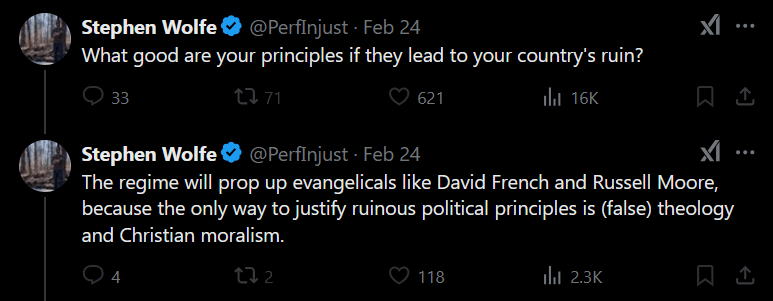
This post from X (Twitter) is what we’ll be discussing today.

Stephen Wolfe is the author of “The Case for Christian Nationalism” and a prominent voice in the movement. It should already be a red flag that he welcomes comparisons to psychopathic serial killers, but we’ll come back to that later. Wolfe advocates for an aggressive Christianity that isn’t afraid to take over the government and enforce God’s laws on all men. Here, he’s criticizing the comparatively passive worldviews proposed by figures such as Russell Moore.
Moore is the author of “Onward: Engaging the Culture without Losing the Gospel.” He stands against the Christian nationalism movement and instead longs for the days of the early church when Christians were on the back foot. He believes Christianity is incompatible with worldly political power and that we should concern ourselves with evangelism instead.

I agree with a lot of Moore’s points in his book, but I do not agree that we should be so passive as to refuse to engage in politics. As Christians, it is our responsibility to use whatever rights or abilities we have to push our culture and government towards what honors God and protects the advancement of the gospel. Moore also has some unsavory (read: left-wing) sources of funding for his work, but that’s another story.

I can agree with some criticism of Moore and French, but I cannot agree with Wolfe’s main point. He’s arguing that principles which lead to the ruin of your country are useless. This is faulty logic.

Post Hoc Ergo Propter Hoc

Let’s assume that our country has fallen into ruin and moral decay. What led us here? Wolfe seems to think it’s the fault of passive Christianity. But is that true?

No. Just because one thing follows another does not prove a causal link. Passive Christians did not advance secularism. They did not fight for abortion or the LGBTQ agenda or humanist reform in schools. They did not vote for the leaders who have done so much damage to our country. Passive Christians were attending church, spreading the gospel, and reading the Bible. None of this is wrong. None of this causes ruin. In fact, it promotes the exact opposite in our culture from the bottom up.

The disagreement is one of strategy—bottom up instead of top down. Moore and others believe in a hands-off approach to politics. We can talk all day about whether this is Biblical. But it is wrong to conclude that this approach is useless just because the secular culture around us has advanced over the years.

The world has always been full of sin. One could easily argue that “the good old days” never existed—that what we imagine as a truly Christian nation in our past was merely a facade of moralistic deism and good manners that we erroneously interpreted as the fruit of genuine faith in Christ.

This is not to say that morals or good manners are bad, only that they do not make a culture “Christian” any more than they make a person “Christian.” In this, I mostly agree with Moore. While America definitely has its roots in Christian values, it was never the bona fide “Christian nation” that Wolfe and others think it was. If anything, you’d have to attribute that label to the Puritan colonies before the USA was formed, and they had their own problems. I talk more about that here.

“Going to church doesn’t make you a Christian any more than going to McDonald’s makes you a hamburger!” — Keith Green

The “use” of passive Christian principles is in the advancement of the true and effectual gospel to hearts and minds, no matter what the culture decides to do. A few more saved souls are better than one “moral” nation without saved souls.

Let’s frame Wolfe’s statement another way.

“What use were the principles of the early church if they led to the fall of Rome?”

I hope you can see just how absurd this statement is. The early church did not contribute to the fall of early Rome. If anything, the early church might have delayed the fall somewhat. It’s hard to know for sure. But early Christians weren’t even trying to save Rome. They were trying to spread the gospel to the world.

This is the fundamental problem with Christian nationalism. It values cultural influence over the gospel. It values worldly power over the power of the Spirit. It values aesthetics over holiness. It values the world more than Christ.

Another Angle

Now, I know what you’re thinking. “That’s not Wolfe’s point! He’s just saying that passive Christian principles didn’t do enough to stop our country from coming to ruin.”

This more charitable interpretation still retains some of the same flaws. The premise of the argument makes no sense. In what universe is any set of principles “enough” to prevent a given culture from falling into moral decay? The cycle of governments, nations, and kings rising and falling has occurred since the dawn of time. Israel fell away from God over and over again. Which nation “did it right” exactly? The USA is very young itself; if even this great experiment has fallen too far, what hope is there?

The fallen, sinful nature of humanity prevents the possibility of a healthy, long-lasting government firmly established on Christian principles that avoids vague moralism and misguided religious violence. You cannot have an ideal society this side of heaven. It’s not going to happen.

But let’s assume for a moment that it is possible, or at least that preserving something better in America was possible. What principles could do that? Wolfe gives us an answer.

Well, it’s sort of an answer. Not really. You’d have to read Wolfe’s book to get a sense for his proposed principles (he basically wants a Christian king). For now, we get a theory.

Wolfe argues that political principles were ordained by God for our political good—therefore, these principles are sufficient and effective towards that end. Wolfe affirms the inverse as well. If your political principles are not sufficient and effective, then God didn’t ordain them, he says.

This is another way of saying, “Whatever works is right.” Wolfe is attempting to sanctify a relativistic practical morality. Why? Because it allows him to do whatever it takes to attain his goals. As long as it leads to a good end, then God must have ordained it! In other words, the end justifies the means. I hope I don’t have to explain the many problems with this.

No Country for Christian Men

Let’s stop for a second and ponder at the choice to reference Anton from “No Country for Old Men.” This character is a violent psychopath. Near the end of the film (spoilers), he has our protagonist at gunpoint. He’s won. He says, “If the rule you followed brought you to this, of what use was the rule?” That’s the line referenced in the image.

The writer of the movie is not proposing that Anton makes a great point here and morality should bend to whatever is most useful. The writer is using Anton as a tool to disillusion the protagonist and offer an observation to the audience. Good guys don’t always win. Sometimes evil prevails. In a world of unfeeling chaos, can justice and order really be preserved? What do we do with that? Do we follow our moral principles even if they lead us to the grave?

For the Christian, the answer is quite simple. Yes, we should do the right thing even if it “doesn’t work.” In the end, God wins. He has saved us and we will get to enjoy him forever in his eternal kingdom. The world isn’t just pure chaos. It’s God’s creation corrupted by sin, but it will be restored someday. The real question for Anton (and those who identify with him) is, “If the practical principles you follow send you to hell, of what use were those principles?”

Back to Wolfe

In addition to supporting moral relativism, Wolfe’s post also makes a sweeping judgement against passive Christianity and any other set of principles that “doesn’t work.” If it fails to preserve the nation (by Wolfe’s standard), then it must not have come from God. This is such an ignorant statement that it’s hard to know where to begin.

The early church did not prevent their countries’ ruin. Were their principles not ordained by God?

Where in the Bible would you even begin to argue that God promises us a Christian nation that won’t fail? Where are we instructed to create such a thing? To be sure, there are plenty of verses that say God blesses nations that obey him. There are plenty that affirm God’s ultimate rule over all nations. There are plenty that say all nations should bow down to God. But nowhere are we promised the possibility of an eternal Christian kingdom. Except…

“Then the seventh angel blew his trumpet, and there were loud voices in heaven, saying, ‘The kingdom of the world has become the kingdom of our Lord and of his Christ, and he shall reign forever and ever.'” — Revelation 11:15 (ESV)

The only government that will last is Christ’s coming kingdom.

“When the Son of Man comes in his glory, and all the angels with him, then he will sit on his glorious throne. Before him will be gathered all the nations, and he will separate people one from another as a shepherd separates the sheep from the goats.” — Matthew 25:31-32 (ESV)

The only “Christian king” who is incorruptible, who will judge the masses rightly, is Christ himself.

“They asked him, ‘Lord, will you at this time restore the kingdom to Israel?’ He said to them, ‘It is not for you to know times or seasons that the Father has fixed by his own authority. But you will receive power when the Holy Spirit has come upon you, and you will be my witnesses in Jerusalem and in all Judea and Samaria, and to the end of the earth.'” — Acts 1:6-8 (ESV)

When the disciples asked Jesus about establishing a kingdom on earth, he made it crystal clear that the time is not yet here. Christ will return. But in the meantime, we are not meant to make a shallow imitation of what we imagine that kingdom will be. We are not given power to physically conquer our enemies. No, we are to love our enemies (Matt 5:44, Rom 12:14, 19-21). That’s the scandal of the gospel. Paul says we are “more than conquerors” because nothing can separate us from God’s love; not death, not ruined nations, not anything (Rom 8:31-39). We are given power to be Christ’s witnesses to the ends of the earth. That is our mission.

Conclusion

In short, I reject the notion that an incorruptible Christian nation is possible in this age. I reject relativistic moral frameworks that propose the end justifies the means. I reject the idea that passive Christianity has contributed to the decline of morality in America. Yet I also condemn passive Christianity’s failure to engage meaningfully with the culture and government. I believe there’s a middle ground where we can fight for what’s right within the peaceful political systems that already exist.

Do not long for the coming kingdom so much that you forget where you are and what your mission is. Do not mistake earthly victory for spiritual victory. Spread the gospel. Pursue holiness. Uphold what is right by the good, righteous means God gives you. Imitate Christ. Be wary of heroes. They come and go. They are sometimes right and sometimes very wrong. But Christ will not fail you, and neither will his Word.

“May the God of peace himself sanctify you completely, and may your whole spirit and soul and body be kept blameless at the coming of our Lord Jesus Christ.” — 1 Thessalonians 5:23 (ESV)

Let me know your thoughts in the comments below. Enter your email to be notified of my next post. Thanks for reading. Godspeed.

Processing…
Success! You're on the list.

What is Christian Nationalism?

Christian nationalism is a popular topic nowadays in the news and on social media. It’s even starting to come up in normal conversation. But… what is Christian nationalism?

Let’s start the conversation with a funny video by Lutheran Satire on YouTube (or you can skip it and scroll down, it’s a free country).

It’s a great video.

This guy does a fantastic job of demonstrating the main problem with the discourse surrounding Christian nationalism. Everyone’s definition is different. Liberals seem to think that Christians taking part in elections or politics in any capacity is Christian nationalism. Edgy political commentators like Nick Fuentes seem to think that Christian nationalism means supporting white supremacy and antisemitism. But they’re at the extremes. What’s a better definition? Here’s one we can start with, taken directly from the video:

Christian nationalism: “A social and governmental system in which Christianity is the driving force that shapes a nation’s laws, people, and culture.”

This seems reasonable, right? At first glance, yes. But the fundamental problem remains. Extremists may be terrible at defining Christian nationalism, but people in the middle are almost as bad. Nobody can agree on this definition, or any definition for that matter.

No Consensus on Christian Nationalism

I’ve heard several people assert that Christian nationalism is inherently Protestant. They argue that the United States was founded by Protestants. But others propose a Catholic influence, given that the Catholic church is by far the largest and most organized church in America. And that’s not even bringing up other major church traditions. Who is correct?

Many assume that Christian nationalism is merely incidental in its influence. They believe the good morals of a nation’s people will naturally lead to laws and practices that reflect a Biblical worldview without the need for top-down mandates. This is roughly what happened in early American history, though it certainly wasn’t perfect. If you ask me, this is the best we can hope for in theory. I’ll talk more about this in the next post.

But times have changed. Public opinion is wildly out of line with the Bible. Christian nationalism is no longer realistic unless the government uses brute force. Many Christian nationalists realize this and don’t mind forcing their religion onto others. In fact, they want to take things further than the founding fathers ever did by eliminating basic freedoms and mandating their form of Christianity for all citizens. This is actually quite similar to the religious persecution that the early American settlers fled from in Europe, ironically enough.

Let’s assume for a moment that a strictly Christian government is possible. What sins should this government regulate? Should theft be illegal? Yes. Should homosexuality be illegal? Maybe, but it depends on who you ask. What about greed or gluttony? Huh… that’s tricky. What about grumbling or complaining? There’s no chance you’re putting anyone in jail for that. But we can go further.

Different denominations disagree on what constitutes a sin. Is drinking a sin, or only heavy drinking? Is divorce always a sin, or is it okay to divorce a cheating partner? Is it a sin for a woman to teach a man anything, or just to preach from the pulpit? It’s impossible to satisfy all Christians, or even all Christians in just one denomination. Let’s not forget how far into progressivism and blatant heresy many modern church denominations are. Do we let them write laws or only traditional churches? How traditional do you have to be? It gets messy very fast. But we can go even further!

What about doctrinal disagreements? If a Baptist gets elected, can he mandate believer’s baptism for all adult Lutherans and Presbyterians? Can a Catholic government punish all churches that fail to affirm the real presence of Christ in the Eucharist? These are secondary issues, but I guarantee you that citizens in a Christian government will fight over them, and it won’t be pretty.

History Repeats Itself

For countless examples of my point, just pick up a history book. The decades following the Reformation were some of the bloodiest in Christian history. Catholics and Protestants killed and ruled over each other in brutal fashion for centuries. Remember Bloody Mary? She burned hundreds of Protestants at the stake for rebelling against her efforts to restore the Catholic church to power in England. Remember the Thirty Years’ War? It was a period of heavy conflict between Catholic and Protestant rulers that devastated Germany, killing one third of its population (a mortality rate twice that of World War I1), and shattered any hope of a unified Europe under one Roman Catholic empire.

I could go on, but I hope the point is clear. Every time a government officially aligns itself with a church, things get ugly. Governments make for terrible church authorities. Do we really expect things to be different this time? Before you know it, you start sounding like a communist. “True Christian nationalism hasn’t been tried! This time it will work. Trust me!”

Where’s the Movement?

Finally, a key problem with Christian nationalism is its complete lack of organization on a national level. There is no central authority leading the charge to make Christian nationalism a reality. There are no clear goals being put forward by any kind of majority as representative of the movement. There is no “Christian Nationalist” party you can vote for in elections. The list goes on…

Conclusion

Christian nationalism falls short right out of the gate because it has no real definition. Nobody can agree on what it should look like. How can you create a unified movement out of so many radically different positions? How can you fight for something if you can’t even articulate what it is that you’re fighting for? And if it’s just a theoretical ideal that will never come to pass, what’s the point?

I don’t have any problem with Christian morals influencing the laws of a country. I think it’s a great thing. But I agree with the founding fathers that religious freedom is paramount. I don’t believe in a top-down approach. I believe in living the Christian life openly and boldly, being a voice of truth and reason for the values you hold dear, and praying for your nation fervently, that God might send more workers for the harvest no matter what the government looks like. Live and let live, but most importantly, evangelize. We are not called to save governments. We are called to save souls.

“First of all, then, I urge that supplications, prayers, intercessions, and thanksgivings be made for all people, for kings and all who are in high positions, that we may lead a peaceful and quiet life, godly and dignified in every way.” – 1 Timothy 2:1-2 (ESV)

Let me know your thoughts in the comments below. Enter your email to be notified for my next post. Thanks for reading. Godspeed.

Processing…
Success! You're on the list.

Sources:

  1. Onnekink, David (2013). War and Religion after Westphalia, 1648–1713. Ashgate Publishing. pp. 1–8. ISBN 9781409480211.

How to Reconstruct Your Faith

This post is a transcript of the above YouTube video, with minor alterations. Check out my channel for theology, woodworking, and more! Click HERE to subscribe.

In the world of American Christianity, there are two common paths I see kids taking nowadays.

The first is tradition. It’s comforting to stick to what you know and embrace the familiar. Many people copy their parents’ faith and don’t think too much of it. But others have noticed how apathetic so many modern churches are. They don’t want the same faith that their parents had. They want something bigger and grander. They want to return to the old ways, dig up old traditions and hold fast to them in what eventually becomes an aimless pursuit of religious nostalgia. This is where you’ll find a lot of dogmatic young people who are hard to get along with unless you subscribe to their specific ideas of “how things should be.”

The second path so many are taking is the deconstruction of their faith. The phrase has become ubiquitous in today’s culture. We’re seeing not only nominally Christian celebrities “deconstructing their faith,” but also openly Christian authors, speakers, and even pastors—very influential figures for our youth. It’s more popular than ever to question Christianity. American culture is getting more hostile to traditional Christian values as time goes on. It’s much more convenient for public figures to distance themselves from fundamental doctrines and stick to the hazy no-mans-land of progressive Christianity. They might claim they’re just “searching” or “finding what makes sense to them.” They still claim to be Christian, but they live in such a way that any self-respecting Christian of the last 2000 years couldn’t distinguish them from an unbeliever. This new culture of skepticism has grown like a cancer and spread on the back of political dogma to great effect among our youth.

So what’s the right answer? Should you reject modernity and embrace tradition or should you deconstruct your faith? I’m here to tell you there’s a better way. Don’t reject the old just because it’s old. Don’t embrace the new just because it’s new. Instead, pursue truth.

There can actually be great value in deconstructing your faith. It’s healthy to take a critical look at your own worldview. But that’s not where you should stop. Asking questions, challenging norms, and tearing down traditions is easy. The hard part is settling on what you actually do believe and sticking to it. After you’ve deconstructed your faith, what do you have left? Most people don’t have much of anything, and the void is quickly filled by worldliness and hedonism. Instead, reconstruct your faith. After removing the baseless traditions and inconsistencies, replace them with what’s true. That’s the sign of real maturity.

Here are four ways you can do just that.

1. Build up Truth From Valuable, Authoritative Sources

      First, the Bible.

      “If you abide in my word, you are truly my disciples, and you will know the truth, and the truth will set you free.”
      — John 8:31b-32 (ESV)

      Become a student of the word of God and you will know truth and that truth will set you free. Be willing to hear out your Christian peers as well. Your interpretations of Scripture won’t always be correct. Join a Bible study at your church. Talk to your pastors about hard questions and be willing to listen. Read old books by credible theologians. There’s no shortage of resources available to you.

      2. Be Willing to be Wrong

        “With humility comes wisdom.”
        — Proverbs 11:2b (CSB)

        If you tossed away a doctrine in the process of deconstructing your faith that turns out to be true, have the humility to add it back. If you picked up something wrong, be willing to let go of it. Remember, you are not pursuing a specific framework. You are pursuing truth. Your goal is not to become a good Baptist, a good Presbyterian, a good pre-millennialist, or a good covenant theologist. Your goal is to become a good Christian who clings to truth above all else.

        “He has told you, O man, what is good; and what does the Lord require of you but to do justice, and to love kindness, and to walk humbly with your God?”
        — Micah 6:8 (ESV)

        3. Walk the Walk

        “Has the Lord as great delight in burnt offerings and sacrifices, as in obeying the voice of the Lord? Behold, to obey is better than sacrifice, and to listen than the fat of rams.”
        — 1 Samuel 15:22 (ESV)

        Now, we are saved by faith in Christ, and having good theology and sound traditions is important. But the life of a Christian will also produce good fruit at the end of the day, and that’s the hardest part. Be willing to live the “mundane” Christian life. You don’t have to restructure your church denomination, correct everyone’s ideas about the end times, or reclaim the political arena for Christian values in order to make a difference and obey Christ. Big goals are good to have, but steadfast living day by day is immediate, impactful, and essential.

        “And by this we know that we have come to know him, if we keep his commandments.”
        — 1 John 2:3 (ESV)

        You can’t change the world if you don’t have your life together. So be the man or woman of God that you’re meant to be in the little things. Work your day job as unto the Lord, even if it’s frustrating. Forgive your parents, even if they don’t accept it. Share Christ with that coworker, even if it’s awkward. Give your resources and time to causes in your church, even if nobody notices. Lay down your pride in your marriage, even if it’s not reciprocated. These “little things” are not little at all. They are the real battleground for not only your heart, but the world. God has already won the battle and he’s the one who will get the credit for it. Walk in his victory and dare to claim it in your daily habits.

        “If I have the gift of prophecy and understand all mysteries and all knowledge, and if I have all faith so that I can move mountains but do not have love, I am nothing.”
        — 1 Corinthians 13:2 (CSB)

        4. Embrace Unity With Other Believers in a Local Church

        “If anyone says, ‘I love God,’ and hates his brother, he is a liar; for he who does not love his brother whom he has seen cannot love God whom he has not seen.”
        — 1 John 4:20 (ESV)

        Church is not optional for the Christian. Walking through the forest may show you God’s glory, but it’s not enough to save you. Reading the Bible is what allows you to understand that glory and the path to salvation, that you may experience it beyond your short life here on earth. In the same way, following Christ in your own private life will yield good fruit, but it’s not enough for your soul. You need a church.

        “And let us consider how to stir up one another to love and good works, not neglecting to meet together, as is the habit of some, but encouraging one another, and all the more as you see the Day drawing near.”
        — Hebrews 10:24-25 (ESV)

        Membership in a church is what allows you to thrive in knowledge, holiness, and proper worship with other Christians. Paul talks at length about the importance and benefit of being united with a church:

        Now as we have many parts in one body, and all the parts do not have the same function, in the same way we who are many are one body in Christ and individually members of one another.

        According to the grace given to us, we have different gifts: If prophecy, use it according to the proportion of one’s faith; if service, use it in service; if teaching, in teaching; if exhorting, in exhortation; giving, with generosity; leading, with diligence; showing mercy, with cheerfulness.

        Let love be without hypocrisy. Detest evil; cling to what is good. Love one another deeply as brothers and sisters. Take the lead in honoring one another. Do not lack diligence in zeal; be fervent in the Spirit; serve the Lord. Rejoice in hope; be patient in affliction; be persistent in prayer. Share with the saints in their needs; pursue hospitality… Rejoice with those who rejoice; weep with those who weep.
        — Romans 12:4-13, 15

        If you’re serious about following Christ, you won’t just feel obligated to attend a worship service once a week; you’ll seek out a church where you can serve and encourage others, eagerly offering your time, money, and talents for the benefit of the congregation. That means getting to know these people, praying for them regularly, meeting their needs, and being present with them to study the word and worship together.

        “Now the full number of those who believed were of one heart and soul, and no one said that any of the things that belonged to him was his own, but they had everything in common.”
        — Acts 4:32 (ESV)

        Just as we should not expect to reach perfection in ourselves this side of eternity, we cannot expect to find “the perfect church.” It doesn’t exist. Every church is full of sinners and you are one of them. Don’t keep hopping around between churches. Pick one that preaches the word rightly, join it, and get involved. Don’t leave or become disillusioned if you encounter some drama, secondary theological disagreements, or different aesthetic preferences. Learning to live in unity and love with people who are not exactly like you is not only healthy, but necessary.

        “As for a person who stirs up division, after warning him once and then twice, have nothing more to do with him, knowing that such a person is warped and sinful; he is self-condemned.”
        — Titus 3:10-11 (ESV)

        “A new commandment I give to you, that you love one another: just as I have loved you, you also are to love one another. By this all people will know that you are my disciples, if you have love for one another.”
        — John 13:34-35 (ESV)

        Surrounding yourself with other Christians and learning to live life together is the best thing you can do to reconstruct your faith. It will challenge you to be humble, encourage you towards obedience, and secure you in the truth.

        “Finally, all of you, have unity of mind, sympathy, brotherly love, a tender heart, and a humble mind.”
        — 1 Peter 3:8 (ESV)

        Let me know your thoughts in the comments below. Enter your email to keep in touch with me. Thanks for reading. Godspeed.

        Processing…
        Success! You're on the list.

        Should Christians Fight the Culture War?

        The Michigan House and Senate recently advanced legislation to repeal the 1931 abortion ban (which was nullified last November) and expand the Civil Rights Act to include “sexual orientation” and “gender identity and expression.” Stories come out every day of schools approving pornographic books and LGBT propaganda in their sex ed programs. It’s considered controversial to stand against drag shows for kids. It feels like Christians are losing the culture war. Should we even be fighting it in the first place?

        The Good Old Days

        In a sense, Christians have been fighting (and losing) the culture war ever since the early days of America. Most of the founding fathers were just deists looking to create a better government in a new land. Some probably had genuine faith, but most didn’t follow Jesus. Don’t get me wrong, Judeo-Christian values were a solid foundation for what is arguably the greatest country in the world. But more cultural support for Christianity doesn’t necessarily translate to “more Christians.”

        The most common religion in the western world is moralistic therapeutic deism. That’s a term I stole from one of my favorite Adam4d comics. It’s the belief that a god exists who watches over us and helps us resolve our problems, that we should all be nice to each other, and that life is about being happy. As you can see, the gospel is nowhere to be found. Jesus is nowhere to be found. Neither are repentance, faith, or worship of God. Yet this is the religion most self-proclaimed “Christians” subscribe to in their cushy American lifestyles of traditionally acceptable hedonism.

        We Can’t Win

        So if most Christians aren’t Christians and Judeo-Christian values can’t save you, what’s the point of fighting the culture war? Is it just for our own comfort? That doesn’t sound like Christianity.

        “If you were of the world, the world would love you as its own; but because you are not of the world, but I chose you out of the world, therefore the world hates you.”

        John 15:19 (ESV)

        “All who desire to live a godly life in Christ Jesus will be persecuted, while evil people and impostors will go on from bad to worse, deceiving and being deceived.”

        2 Timothy 3:12-13 (ESV)

        True Christianity necessarily involves some kind of persecution simply because true Christianity is never popular. The invisible church will always be a minority. That’s normal. Comfort and acceptance is not our goal. No matter how much the government adheres to Judeo-Christian values, it will never adhere to Christ himself. It’s impossible. The world is, and always has been, at odds with God.

        “You adulterous people! Do you not know that friendship with the world is enmity with God? Therefore whoever wishes to be a friend of the world makes himself an enemy of God.”

        James 4:4 (ESV)

        The idea that we can win the culture war is ultimately a lie. Our battle is not for the presidency, the schools, or the public square. It’s a fight against our own disobedience, disunity, and selfish living. It’s a fight to spread the Word of Christ to all corners of the earth.

        “Go therefore and make disciples of all nations, baptizing them in the name of the Father and of the Son and of the Holy Spirit, teaching them to observe all that I have commanded you.”

        Matthew 28:19-20a (ESV)

        “For our struggle is not against flesh and blood, but against the rulers, against the authorities, against the cosmic powers of this darkness, against evil, spiritual forces in the heavens.”

        Ephesians 6:12 (CSB)

        But We Should Still Fight

        Does this mean we should forget the culture at large? No. I’m sure you’ve heard the popular phrase, “In the world, but not of the world.” David Mathis wrote a fantastic article on this.1 His advice was to change the phrase to: “not of, but sent into.” His reasoning is based on John 17, where we hear Jesus pray to the Father.

        “The world hated them because they are not of the world, just as I am not of the world. I am not praying that you take them out of the world but that you protect them from the evil one.”

        John 17 14b-15 (CSB)

        We are not of the world, similar to how Jesus is not of the world. But instead of praying for our escape from the world, Jesus prays for our protection from temptation. It’s actually a good thing that we’re stuck here on this sinful planet. God put us here for a reason. We shouldn’t seek to be rid of it or ignore it.

        “As you sent me into the world, I also have sent them into the world.”

        John 17:18 (CSB)

        Christ has specifically sent us into the world to carry out his mission of evangelism and to glorify God with our words and deeds. We dare not shy away from our culture to live in isolated bubbles. That would be disobedience.

        How We Fight

        So what does this mean for the culture war? Our primary influence on the world should be for evangelism and obedience to God in our own communities, but that doesn’t mean we can’t also guide our culture into a morally sound framework with the tools God has given us.

        In America, we can vote. That’s a pretty amazing thing. It only takes a little effort to have an impact on our culture for the better. But we can do more. We can run for school board, precinct delegate, and other local positions. We can speak the truth in love to our neighbors. We can testify for or against bills and local policy changes. We can gather signatures for ballot initiatives.

        That said, our goal in this should not be to force people into Christianity. We’ve seen how ugly things can get with state religions and forced conversions. If someone wants to live in sin by committing adultery or acting selfishly, we can’t stop them. That’s not our job. Instead, we should aim to create a society that gives us the freedom to do God’s work and live godly lives.

        “I urge that supplications, prayers, intercessions, and thanksgivings be made for all people, for kings and all who are in high positions, that we may lead a peaceful and quiet life, godly and dignified in every way.”

        1 Timothy 2:1-2 (ESV)

        “Let every person be subject to the governing authorities. For there is no authority except from God, and those that exist have been instituted by God . . . if you do wrong, be afraid, because [the government] does not carry the sword for no reason. For it is God’s servant, an avenger that brings wrath on the one who does wrong.”

        Romans 13:1, 4b (CSB)

        God has told us to obey our governments because they are his servants to keep the peace and punish evildoers. It’s in everyone’s best interest that the government stays true to its purpose. If we fail to pay attention, our leaders are sure to stray from justice and we will see the consequences.

        “When the righteous increase, the people rejoice, but when the wicked rule, the people groan.”

        Proverbs 29:2 (ESV)

        This World Will Not Last

        My brother gave a great sermon recently. One of his points stuck out to me as being relevant to this topic. This is the passage he talked about:

        “As he was going out of the temple, one of his disciples said to him, ‘Teacher, look! What massive stones! What impressive buildings!’ Jesus said to him, ‘Do you see these great buildings? Not one stone will be left upon another—all will be thrown down.'”

        Mark 13:1-2 (CSB)

        Jesus quickly shoots down his disciple’s excitement over the temple, foretelling its destruction. We should not put too much faith in earthly institutions. Nothing made by men can stand forever. Nothing made by men is pure. Jesus came to God’s chosen people and found that they had rejected God’s ways. He rebuked them in the presence of the temple.

        “Jerusalem, Jerusalem, who kills the prophets and stones those who are sent to her… See, your house is left to you desolate.”

        Jesus, Matthew 23:37a, 38

        The glorious buildings mean nothing if the hearts of those within are cold. So whatever you do to fight the culture war, remember what you’re fighting for. All political movements will come to an end. All nonprofits will come to an end. All the works of the enemy will come to an end. This world will not last. Praise God.

        Let me know your thoughts on the culture war in the comments below. Enter your email to keep in touch with me. Thanks for reading. Godspeed.

        Processing…
        Success! You're on the list.
        1. David Mathis, “Let’s Revise the Popular Phrase ‘In, But Not Of’,” DesiringGod.org, August 29, 2012, https://www.desiringgod.org/articles/lets-revise-the-popular-phrase-in-but-not-of

        A Critique of the Asbury Revival

        I’m sure you’ve seen the headlines about a revival at Asbury University in Kentucky. A routine worship service was extended as the musicians said they felt led by the Holy Spirit to continue singing. It’s been going on for two weeks now. Yesterday, the administration decided to restrict some services to students only, while leaving other services public and relocating them to larger spaces to accommodate the thousands of outsiders driving in to join.1

        I’m deeply concerned that this is devolving into a spectator sport, an unhealthy glut of emotional affirmation in lieu of genuine repentance, sanctification, and holy living. Did it start out that way? Probably not. Is it entirely fake and vain? No. I’m sure there are hundreds of people worshiping God truthfully at Asbury. But it’s worth talking about whether this event matches up to a real movement by the Holy Spirit and the motivations of spectators and copycat revivals popping up around the country.

        What is a Revival?

        Based on what we’re seeing at Asbury, a revival is when Christians meet together to sing praises to God for a long time with some public confessions now and then. That doesn’t sound quite right to me. Let’s look at the definition according to Webster as a starting point.

        Revival, noun: Renewed and more active attention to religion; an awakening of men to their spiritual concerns.2

        Revival isn’t just about Christians singing together. It’s about all spiritual concerns of men. This means unbelievers coming to salvation in Christ for the first time, believers renewing their faith and obedience to God, and the Bible being rightly preached to the people at large. And yes, worship through song or other means is part of it too.

        This makes sense when you look at the revivals of history. The Great Awakening was a blend of preaching, evangelism, calls to holy living, and worship. There was a core focus on conversion and repentance.3 It wasn’t perfect by any means, but it convicted hearts and drew both the world and the church towards following Jesus. Is that what the Asbury revival is doing?

        Is Asbury’s Revival Real?

        I haven’t witnessed the event myself, but from livestreams and the accounts others have given online, I’ve see both sides of the issue. Proponents who have attended say the Holy Spirit is moving there. How do they know this? They felt comforted, invigorated, and empowered. They focus on their feelings and the atmosphere of the room. Here’s an example:

        I joked that I wanted to lay down and take a nap, run a lap, weep, and laugh, all at the same time. We (my wife and I) worshipped for 6 hours straight and it felt like only 15 minutes had gone by, like time slowing down or standing still in this move of God. No hype here

        Jordan Evans (@thejordy_evans) February 12, 2023 (account now deleted)

        I want to be careful not to paint this event with too broad a brush. I don’t doubt that many attending are having genuine encounters with God. I’m sure there’s been real conversions and worship. What concerns me is the leadership’s narrow focus on emotions and the reports of teaching that’s lukewarm at best and heretical at worst. We have to be discerning and test that which claims to be the work of God. Do not abandon reason in your search for hope.

        “Beloved, do not believe every spirit, but test the spirits to see whether they are from God, for many false prophets have gone out into the world.”

        1 John 4:1 (ESV)

        Scott Brown says the testimonies are “extremely emotional” without much doctrinal truth or repentance. It’s more about feeling close to God than obeying Him. He also notes that there’s a distinct lack of mature pastors present.4 It’s student-led, as proponents have verified.5

        Samuel Sey wrote a fantastic piece about his concerns with the event. Out of the attendees he spoke with, only one said the gospel was being preached. Everyone else contradicted that claim. One said the following:

        “Attending the few chapels I have at seminary, apart from one [or] two chapels that preach a biblical message of repentance, it’s always been about ‘being who you are’ and God loving you ‘as you are.’ There are a lot of messages that are about being ‘true to yourself.'”6

        Sey goes on to note the affirmation of the event by LGBT students and progressive “Christians,” the prominence of female pastors, and the presence of “charismatic chaos.”6 He’s not convinced the event is a true revival. It’s worth noting that Sey grew up and was saved in a culture where emotionally driven “revivals” were the norm. He believes God can save anyone in any context (as do I), but many of his peers returned to lives of sin after professing faith at events like Asbury. The seeds fell on rocky ground and that which sprang up quickly withered away. It’s easy to see why he’s concerned.

        “Not everyone who says to me, ‘Lord, Lord,’ will enter the kingdom of heaven, but the one who does the will of my Father who is in heaven.”

        Matthew 7:21 (ESV)

        Since when are revivals for Christians to have a nice-feeling experience? True revival is when all kinds of people are called through the faithful preaching of the Word to repent, return to God, and reject sin. I like how John Piper puts it.

        “The term revival in its most biblical sense has meant a sovereign work of God in which the whole region of many churches, many Christians has been lifted out of spiritual indifference and worldliness into conviction of sin, earnest desires for more of Christ and his word, boldness in witness, purity of life, lots of conversions, joyful worship, renewed commitment to missions.”7

        John Piper

        There’s nothing about revival that leaves discernment behind in favor of emotions. Revival is not the goal itself—obedience is. Revival is just a tool God can use to draw us back into obedience on a larger scale, convicting individual hearts to follow Him rightly.

        “If my people who are called by my name humble themselves, and pray and seek my face and turn from their wicked ways, then I will hear from heaven and will forgive their sin and heal their land.”

        2 Chronicles 7:14 (ESV)

        Why are so many Christians driving across the country to join Asbury? What are they hoping to find? Jesus doesn’t live in Kentucky. The Holy Spirit isn’t contained on a campus.

        “An hour is coming when you will worship the Father neither on this mountain nor in Jerusalem. But an hour is coming, and is now here, when the true worshipers will worship the Father in Spirit and in truth.”

        Jesus, John 4:21, 23 (CSB)

        We can worship with our own church body in Spirit and in truth no matter where we are. Jesus makes clear that, in the New Covenant, we don’t need to go to a special location. Most people are going to Asbury for the emotional high or to spectate out of curiosity. Neither are spiritually sound intentions.

        Joel Abbott wrote a great article with his own thoughts on the event. He writes:

        “I heard this trend put best by a woman who once tweeted about how she lost her faith. She grew up feeling like she was deeply in love with Jesus, but then she attended a Taylor Swift concert with the same emotional vibe and she realized she just liked the high she got from attending concerts.

        People like this were once sold out for Jesus, but they had never been prepared to apply their faith in real life—the realities of working for food and housing, of love, commitment, and parenthood, or the slow, sometimes seemingly boring task of following Christ.”8

        I wholeheartedly agree. It’s far too easy to mistake emotional highs for spiritual realities. Crowds of people can do strange things to your psyche whether you’re at a concert or a chapel service. Is emotion bad? No. But it needs solid Biblical truth behind it and it needs holy living to follow it. There’s no good reason for substantive preaching to be absent from an event that’s supposed to be the work of the Holy Spirit.

        “This type of emotional fluff won’t lead to ‘revival’: It’s a mix of genuine worship and emotional existentialism that has no ability to call our culture to repentance outside the groupies that want in on the experience.”

        Joel Abbott

        Was This Planned?

        I’m skeptical about the origin of this event. I don’t think it’s as spontaneous as it seems. As Scott Brown points out, Asbury has a history of planning revivals in February. Don’t believe me? Check out this page on their website. It covers eight previous Asbury revivals. Six occurred in February and two in March. Is that a coincidence? Note this section: “In February 1921 the last service of a planned revival lasted until 6 a.m., and services were extended for three days.”9 So they admit they do plan revivals.

        According to Sey’s sources on the event at hand, the president of the seminary emailed the students asking them to visit the chapel to join in “an outpouring of the Holy Spirit.”6

        “The student maintains the ‘revival’ wasn’t planned. But it’s worth noting that Asbury University is part of what is known as the revivalist movement—a group of Charismatic Christians who consistently attempt to produce revivals.”

        Samuel Sey

        After looking at the history of Asbury’s previous revivals, it’s easy to spot a trend. These events usually start with singing or confession in chapel, which is then extended. They always occur in February or March. They frequently draw in significant media coverage. One section reads: “In February 1950 a student testimony led to confessions, victories, and more testimonies. This… became the second leading news story nationwide.”9

        There’s a huge incentive to manufacture events like this. This much media attention leads to thousands of dollars in donations and tuition from new students hungry for an emotionally rich college experience. This wouldn’t be a problem if the event was organic, but the evidence seems to indicate that it’s probably not. We’re seeing history repeat itself.

        Copycat “Revivals”

        The news coverage of Asbury has sparked a nationwide interest in mislabeling extended worship services as “revivals.” Universities supposedly experiencing spontaneous outpourings of the Holy Spirit include Campbellsville University, Northern Kentucky University, and the University of the Cumberlands in KY, along with Lee University in TN, Cedarville University in OH, and Samford University in AL.

        Online, groups of students can be seen singing praise songs and praying together. I have connections at Cedarville specifically, where I’m told students are also going to nearby campuses and malls to evangelize. That’s great to hear! But is it revival?

        It might be the Holy Spirit working powerfully throughout our nation. I hope it is. The evangelism in particular is encouraging. But it might also be an attempt to copy Asbury by extending worship services and calling it “revival” to get a taste of the media spotlight. That’s definitely not the work of the Holy Spirit. That sounds man-centered and manufactured.

        You don’t need to be in the midst of a revival to worship Jesus; you can just have a nice worship service. You don’t need an emotional experience to obey God; you can just follow Him in your day to day life. You certainly don’t need to be plastered all over the news for your Christianity to be valid.

        “We encourage you, brothers and sisters… to seek to lead a quiet life, to mind your own business, and to work with your own hands, as we commanded you, so that you may behave properly in the presence of outsiders and not be dependent on anyone.”

        1 Thessalonians 4:10b-12 (CSB)

        The Fruit of the Spirit

        Time will tell whether the events at Asbury and other colleges turn out to be anything more than emotional worship services with spectators. The proof is in the fruit. When the media stops caring, when the tourists go away, when you have to get up in the morning and go to class or work, will you still have that fire for Jesus? Will new converts remain steadfast in their faith? Will Christians abandon their allegiance with the world and turn back to obedience? Will we see newfound passion for evangelism and Biblical truth in our doctrine? I hope so. Only God knows.

        “In desperation for any semblance of hope for our culture—some Christians have abandoned all discernment and they’re eager to idolize anything or any ‘revival’ that profess Christ.

        But our hope isn’t in a change in our culture. Our hope isn’t in a revival. Our hope isn’t in a Christian culture. All of these are good. We should earnestly pray that God would change our culture.

        But our hope isn’t in the return of a Christian culture. Our hope is in the return of Christ.”6

        Samuel Sey

        Let me know your thoughts on all this in the comments below. Enter your email to keep in touch with me. Thanks for reading. Godspeed.

        Processing…
        Success! You're on the list.
        1. Asbury Revival: Professor calls for end to ‘public phase’ as school scrambles to address overcrowding, Jon Brown, Fox News, https://www.foxnews.com/us/asbury-revival-professor-calls-end-public-phase-school-scrambles-address-overcrowding
        2. Webster’s Dictionary of the English Language, 1828, https://webstersdictionary1828.com/Dictionary/revival
        3. Great Awakening, Britannica, https://www.britannica.com/event/Great-Awakening
        4. Asbury Revival – My Observations, Scott Brown, https://scottbrownonline.com/blogs/63f15155e1ef28e573d78c4e
        5. Jordan Evans, https://twitter.com/thejordy_evans/status/1624622257501773826?s=20
        6. Is the Asbury “Revival” A Real Revival?, Samuel Sey, https://slowtowrite.com/is-the-asbury-revival-a-real-revival/
        7. What Is Revival and Where Do We Find It?, John Piper, Desiring God, https://www.desiringgod.org/interviews/what-is-revival-and-where-do-we-find-it
        8. Let’s have some real talk about this whole Asbury revival thing. We’ll start with a lesson from the Western Front., Joel Abbott, Not the Bee, https://notthebee.com/article/lets-have-some-real-talk-about-this-whole-asbury-revival-thing-cuz-a-lot-of-people-are-getting-hyped-up-about-it
        9. Revivals, Asbury University, https://www.asbury.edu/academics/resources/library/archives/history/revivals/

        Do All Christians Have to go to Church?

        I’ve seen some rather frustrating takes on the internet recently about church. It seems the obligation to go to church has all but died out with the general population, and many people who call themselves Christians have given up on church as well. But why is this?

        I think, in part, it’s a natural progression of our increasingly secular society. Over time, America has turned from a very traditionalist, “Christian” country into a progressive melting pot of all kinds of ideas, religions, lifestyles, and peoples. That’s not necessarily a bad thing, per se. It’s definitely made it harder to be openly Christian, but we still have it great compared to most of the world. We can still worship, study the Word, and meet together without fear in the vast majority of situations. And one thing we consider all too infrequently is that genuine faith shines brightest in the darkness (check out this comic from Adam4d).

        But this isn’t meant to be a post about the evolution of religion and Christianity in America, as fun as that would be to talk about. So let’s get back on track. Church. It’s a word that inspires indifference, disgust, or guilt for many. If you feel this way, you’re not alone. Let me tell you about my time wrestling with this issue; then we’ll look at what the Bible says about it.

        My Experience Growing Up in the Church

        As a kid, my parents always made us attend church on Sundays, and sometimes Sunday nights too. I knew it was something I was supposed to do. I knew it was a place with people I knew, and occasionally things to do or food to eat. But that was about it. Church wasn’t something I desired or enjoyed, in most cases. I always grumbled when dad got us out of bed early every week.

        Then I got saved. At about age 14, I came to the realization that following in my parents’ footsteps was dumb. Either Christianity was right or it wasn’t. If it was, I needed to actually read the Bible and obey the God who was willing to die for me. If it wasn’t, the only logical thing to do would be to abandon the faith and not look back. After all, what’s the use of a religion if it isn’t true?

        After reading through the entire Bible for the first time, praying more than I ever had in my life, studying practical and scientific objections to the Bible, and reading book after book, I came to the conclusion that the Bible is true. All the evidence pointed to Jesus. At this point, I felt I had no choice. To pursue truth was to pursue God’s words. The Bible clearly established church as something important (we’ll get to that). I now had a concrete reason to go to church. But as I grew up, I moved away to college. The drive to church was longer and my sleep schedule became downright irresponsible at times. I didn’t go every week, and many times I’d leave immediately after the service was over. I felt disillusioned at this time with more than just church, for more than a few reasons.

        After a while, a lot of things improved for me, but I still wasn’t satisfied with church. Was it just me? Was I a bad Christian? After talking with my brothers, I realized they felt similarly. The church I was going to at the time felt a bit disconnected and aimless, especially for young people. This isn’t meant to discount the church as a whole. There were, and still are, some incredible Christians there. But I realized it wasn’t working for me, so I looked for a new group of Christians to meet with.

        Today, I’m very thankful to God for the church I’ve found. I’ve had more opportunities to serve, hear truth, and meet fellow young Christians than ever. Part of this is because I matured over time. I realized I had to be more involved than I was. But part of this was the church itself. Why do I tell you this? Because I want you to know that even a “church kid” like me has had ups and downs. I’ve felt obligated, annoyed, and discouraged. I’ve skipped church to sleep in. I’ve avoided people and struggled finding my place. Despite the face a lot of Christians put on, church isn’t just a wonderful festival of joy every week for everyone.

        What Does the Bible Say About Church?

        Now that you know where I’m coming from on this issue, let’s take a look at what the Bible says regarding church. It’s important to note that the New Testament was written at a time when the early church was still developing. Today, we talk about buildings, potlucks, music teams, schedules, and special services. But to early Christians, church was a lot more simple than all of that. It was about meeting together to worship God and encourage one another. And remember, none of these letters were addressing individuals, but rather a whole group of Christians.

        “So then you are no longer strangers and aliens, but you are fellow citizens with the saints and members of the household of God, built on the foundation of the apostles and prophets, Christ Jesus himself being the cornerstone, in whom the whole structure, being joined together, grows into a holy temple in the Lord. In him you also are being built together into a dwelling place for God by the Spirit.”

        Ephesians 2:19-22 (ESV)

        Here, Paul gives us a beautiful picture of the church as a temple. Christians are the building blocks and Christ is the cornerstone. We are all joined together as one. We cannot fulfill this alone. To be a lone brick is to be useless. A brick is designed to come together with hundreds of other bricks to build a home. The same is true for how God designed us. This theme is throughout the New Testament.

        “For just as the body is one and has many members, and all the members of the body, though many, are one body, so it is with Christ. For in one Spirit we were all baptized into one body—Jews or Greeks, slaves or free—and all were made to drink of one Spirit. For the body does not consist of one member but of many.”

        1 Corinthians 12:12-14 (ESV)

        More common than the brick analogy is Paul’s idea of a body with many limbs or “members.” Though many, we are one body of believers. This is the definition of the church. It’s the gathering of believers in the name of Christ. Now notice the last line: “The body does not consist of one member but of many.” This is undeniably proof that you cannot be a church-less Christian. It’s impossible. To be a Christian is to be a member of a body. If you aren’t a member of a group of believers, you simply aren’t living the life God has called you to.

        “And he is the head of the body, the church. He is the beginning, the firstborn from the dead, that in everything he might be preeminent.”

        Colossians 1:18 (ESV)

        Christ is the head of the body, just as he is the cornerstone of the temple. His place as God’s Son, having all things created through him (John 1), and having risen from the dead, is what makes him worthy of our worship. He is why we gather together.

        “And let the peace of Christ rule in your hearts, to which indeed you were called in one body. And be thankful. Let the word of Christ dwell in you richly, teaching and admonishing one another in all wisdom, singing psalms and hymns and spiritual songs, with thankfulness in your hearts to God.”

        Colossians 3:15-16 (ESV)

        Here, we get a better idea of what church ought to look like. We are called to peace and thankfulness to God. We should know his words. We should be teaching and keeping each other accountable. We should be singing together. You can see this pattern of the early church reflected in many churches of today. This is why we meet the way we do. This is why we have liturgies and music and sermons. This is why church cannot be appropriated to just you, a Bible, and nature. No matter how spiritual or helpful your solitary experiences are, they are not and can never be “church.” Don’t fool yourself.

        “And let us consider how to stir up one another to love and good works, not neglecting to meet together, as is the habit of some, but encouraging one another, and all the more as you see the Day drawing near.”

        Hebrews 10:24-25 (ESV)

        It’s not just Paul commanding us to meet for church. This passage from Hebrews is one of the clearest commands in the Bible to meet together regularly. The reason I saved it for last is because, on its own, it doesn’t fully define why we meet or what that looks like. But with the context of the other passages, it’s easy to see that this is a command not just to have more baby showers or game nights, but to have more church. A key part of that is encouraging one another towards love and good works. In today’s world, I think we could stand for a lot more of that kind of encouragement.

        There are so many more passages we could talk about. We could look at church discipline, sacraments, baptism, persecution, unity, and much more. I encourage you to read the letters of the New Testament (as well as Acts) for more clarity on these issues. In all honesty, I’m convinced that those who choose not to belong to a church have little to no experience reading the Bible. It’s such a pervasive and dominant topic that it’s extremely hard to miss and impossible to deny its importance.

        What Should Church Really Look Like?

        Now, we might ask ourselves: What should church look like for us today? What are we actually called to do? Do we really need all these traditions and rituals? It’s clear that many aspects of modern church are rooted in Scripture. Some examples might be church leaders (Titus 1:5-9), music (Eph 5:19), baptism (1 Cor 12:13), prayer (Matt 18:20, James 5:16), public readings of the Bible (1 Tim 4:13), encouragement (1 Thess 5:11), and the sharing of food, resources, and money for the betterment of the church (Acts 2:44-45; 4:32-37).

        But there are, of course, some things that go unmentioned in Scripture. There is no command to meet in a fancy building, to market your church to the world to boost attendance, to give exactly ten percent of your income, to meet on Sunday mornings, or to host social events. All these things, and more, are ancillary at best and heretical at worst. Dietrich Bonhoeffer, the pastor who was killed for his involvement in the plot to assassinate Hitler, had some harsh words for the churches he saw when he visited America.

        “So what stands in place of the Christian message? An ethical and social idealism borne by a faith in progress that—who knows how—claims the right to call itself ‘Christian.’ And in the place of the church as the congregation of believers in Christ there stands the church as a social corporation.

        “Anyone who has seen the weekly program of one of the large New York churches, with their daily, indeed almost hourly events, teas, lectures, concerts, charity events, opportunities for sports, games, bowling, dancing for every age group, anyone who has heard how they try to persuade a new resident to join the church, insisting that you’ll get into society quite differently by doing so, anyone who has become acquainted with the embarrassing nervousness with which the pastor lobbies for membership—that person can well assess the character of such a church.

        “All these things, of course, take place with varying degrees of tactfulness, taste, and seriousness; some churches are basically ‘charitable’ churches; others have primarily a social identity. One cannot avoid the impression, however, that in both cases they have forgotten what the real point is.”

        Dietrich Bonhoeffer

        Christians today have a responsibility to meet together in a way that honors our Lord rather than grieving him. In a time when church has become a dirty word and religion a bad taste in the mouth of the populace, it’s all too tempting to transform our churches into something more appealing and modern. But Jesus didn’t declare Peter to be a business tycoon. Paul never rebuked anyone for having small attendance numbers. Church was never supposed to be a social club.

        “Now these Jews were more noble than those in Thessalonica; they received the word with all eagerness, examining the Scriptures daily to see if these things were so.”

        Acts 17:11 (ESV)

        It all comes back to the Bible. Hold it higher than any word spoken by men. Hold the Bible’s standard for church higher than your desire to make church into something more fun, attractive, or convenient. It’s not about you. It’s about Christ. It’s about meeting regularly to honor, worship, and serve our God together. “Let us go to the house of the Lord! (Psalm 122:1)”

        Let me know your thoughts about church in the comments below. Enter your email if you want to be notified when my next post goes live. Thanks for reading. Godspeed.

        Processing…
        Success! You're on the list.

        Heavenly Minded, Earthly Commissioned

        As I’ve been teaching a Sunday School class on Dietrich Bonhoeffer, I’ve noticed that he and I have a lot in common. He pursued a greater understanding of theology, yet continually felt that head-knowledge wasn’t enough. He was disgusted at American churches with their love for liberal Christianity, social relevance, and conformity to the world. He wasn’t scared to criticize his contemporaries or entertain radical new ideas. He believed love was well worth the risks it brought and the fear of loss. He had bouts of depression. He could be rather intense at times and felt that some people were put off by him.

        But what we’re going to address today is his view that the Christian life is so much more than going to church, reading motivational books, and putting on a good face. He believed the Christian is called to take their faith out of church and into the world.

        “In Jesus Christ the reality of God has entered into the reality of this world. The place where the questions about the reality of God and about the reality of the world are answered at the same time is characterized solely by the name: Jesus Christ. God and the world are enclosed in this name. . . . we cannot speak rightly of either God or the world without speaking of Jesus Christ. All concepts of reality that ignore Jesus Christ are abstractions.”

        Dietrich Bonhoeffer

        We start with the fabric of reality itself. Bonhoeffer believed the incarnation of Christ supports the framework of one reality. To speak of “the world” as if it’s some foreign realm isolated from Christianity is not accurate. Christ came to the world. We are in the world. We’re not called to Paradise just yet. We ought to live to fulfill our earthly commission rather than wait around for the second coming.

        “As long as Christ and the world are conceived as two realms bumping against and repelling each other, we are left with only the following options. Giving up on reality as a whole, either we place ourselves in one of the two realms, wanting Christ without the world or the world without Christ—and in both cases we deceive ourselves”

        Dietrich Bonhoeffer

        So many people gravitate to the extremes. For some, this means love of the world at the expense of their walk with Christ. They can’t get over their habits. They can’t reject addiction. They can’t break off their relationship with materialism, pride, and selfishness. They might be heard saying things like “Don’t judge,” “Nobody is perfect,” or “I’m not into legalism.”

        For others, they love their “Christian” life more than their “real” life. They just want emotional spirituality without having to worry about getting their hands dirty. They ignore the fate of their unbelieving friends in the name of keeping themselves “pure.” They scoff at certain activities, labeling them “worldly” so they can rally behind others in ostracizing those who practice them. They might be heard saying things like, “Don’t be conformed to the world,” “I can’t stand people like that,” or “I’m trying to be more heavenly minded.”

        “There are not two realities, but only one reality, and that is God’s reality revealed in Christ in the reality of the world. Partaking in Christ, we stand at the same time in the reality of God and in the reality of the world. The reality of Christ embraces the reality of the world in itself. The world has no reality of its own independent of God’s revelation in Christ. . . . [T]he theme of two realms, which has dominated the history of the church again and again, is foreign to the New Testament.”

        Dietrich Bonhoeffer

        As the YouTube channel Blimey Cow once said, “Your real life is your spiritual life, and both are going to be awful until you realize that they’re not separate things.” Obsessing over Christian culture and religion to the exclusion of obedient action for Christ is sin. Obsessing over the world and amusement to the exclusion of obedient action for Christ is sin. It boils down to the object of your worship. God doesn’t care what it is; if it’s lower than him, it has to go.

        “I do not ask that you take them out of the world, but that you keep them from the evil one. They are not of the world, just as I am not of the world. Sanctify them in the truth; your word is truth. As you sent me into the world, so I have sent them into the world. And for their sake I consecrate myself, that they also may be sanctified in truth.”

        John 17:15-19 (ESV)

        Here, we witness our Lord and Savior speaking to the Father. He prays that we are kept from sin, sanctified in God’s truth. Yet he also says we are sent into the world. Here, the two realities meet in perfect harmony. We are in the world, yet not of the world. Perhaps even this phrase requires some deconstruction, as David Mathis proposes. Ultimately, we ought to imitate Christ in our actions, pursuing truth and holiness. This should lead us towards the world, not away from it. We should see the broken chaos around us and feel a deep desire to be the hands and feet of Christ to those among it. We should step out in faith, without fear.

        “But the one who looks into the perfect law, the law of liberty, and perseveres, being no hearer who forgets but a doer who acts, he will be blessed in his doing.”

        James 1:25 (ESV)

        Let me know your thoughts in the comments below. Enter your email if you want to be notified when my next post goes live. Thanks for reading. Godspeed.

        Processing…
        Success! You're on the list.

        The American Christian’s Idol of Freedom

        This week’s post will be shorter, as I’m busy with a few things at the moment, one of which is teaching a Sunday School class at my church about Dietrich Bonhoeffer, the German pastor who was killed for his involvement in the plot to assassinate Hitler. As I’ve read about this fascinating figure, I’ve grown to fall in love with his approach to theology, his unwavering commitment to Christ, and his demand for action on behalf of faith.

        Before Hitler rose to power, Bonhoeffer visited America. The land of the free impressed upon him a number of contemplations. Here is one.

        “Freedom as a possession is a doubtful thing for a church; freedom must be won under the compulsion of a necessity. Freedom for the church comes from the necessity of the Word of God. Otherwise it becomes arbitrariness and ends in a great many new ties. Whether the church in America is really ‘free,’ I doubt. They are lonely Sundays over here. Only the Word makes a true community.”

        Dietrich Bonhoeffer

        What I take from this is that Bonhoeffer was annoyed at how highly American churches valued the ethereal concept of “freedom.” The term carries with it the weight and potential of nationalism, for one. Such ties are not of Christ and can only lead away from the truth. As Americans, it’s all too easy to feel a holy sense of entitlement to freedom. But as Christians, the only freedom we are promised is freedom in Christ from the bondage of sin.

        “So Jesus said to the Jews who had believed him, ‘If you abide in my word, you are truly my disciples, and you will know the truth, and the truth will set you free… So if the Son sets you free, you will be free indeed.'”

        John 8:31-32, 36 (ESV)

        We can see that we’re offered spiritual freedom in Christ, but what does the Bible say about physical freedom? It’s important to remember our identity. To think of ourselves as “Americans” is earthly and temporary. We are truly citizens of the kingdom of heaven (Phil 3:20), and Christ tells us what to expect.

        “If the world hates you, know that it has hated me before it hated you. If you were of the world, the world would love you as its own; but because you are not of the world, but I chose you out of the world, therefore the world hates you. Remember the word that I said to you: ‘A servant is not greater than his master.’ If they persecuted me, they will also persecute you. If they kept my word, they will also keep yours.”

        John 15:18-20 (ESV)

        The idea that American Christians deserve physical freedom is undoubtedly extra-biblical. We are promised opposition, not freedom. We are promised God’s loving discipline and the shaping of character through hardships of all kinds, not comfort or safety.

        “In the world you will have tribulation. But take heart; I have overcome the world.”

        John 16:33b (ESV)

        “For the sake of Christ, then, I am content with weaknesses, insults, hardships, persecutions, and calamities. For when I am weak, then I am strong.”

        2 Corinthians 12:10 (ESV)

        It is a trap to pursue earthly freedom above the Word of God. Our chains are not physical. Many a red-blooded American lies upon their bed this night as free as any man has been in a thousand years on this earth, yet bound ever tighter to their pride, their lust, their gluttony, their greed, their adultery.

        Bonhoeffer was imprisoned and hanged for his part in the conspiracy against Hitler. This is what was said of him at his end.

        “I was most deeply moved by the way this lovable man prayed, so devout and so certain that God heard his prayer. At the place of execution, he again said a short prayer and then climbed the steps to the gallows, brave and composed. His death ensued after a few seconds. In the almost fifty years that I worked as a doctor, I have hardly ever seen a man die so entirely submissive to the will of God.”

        H. Fischer-Hüllstrung

        When he saw the path God set before him, Bonhoeffer gave up his high status in Germany, his reputation in the church, and his personal safety to do what had to be done. He valued his usefulness to God far above his earthly freedom. Yet he was free.

        Choose this day to look down at your wrists and see the cuffs keeping you captive. Back away from the bars and see just how small your cell is. Our only hope is to open our eyes to our sin and repent, lest we be lulled into a slumber where our flesh keeps us tied to the depths of hell.

        “We know that our old self was crucified with him in order that the body of sin might be brought to nothing, so that we would no longer be enslaved to sin. For one who has died has been set free from sin.”

        Romans 6:6-7 (ESV)

        Let me know your thoughts on Bonhoeffer in the comments below. Enter your email if you want to be notified when my next post goes live. Thanks for reading. Godspeed.

        Processing…
        Success! You're on the list.